Estimated reading time: 7-8 minutes – Long before passports, airport lounges and delayed flights, Zhu Ying and Kang Tai crossed the seas to encounter one of early Southeast Asia’s most important kingdoms.
Two envoys from the Chinese kingdom of Wu, Zhu Ying and Kang Tai, travelled to Funan in the mid-third century CE. Although their original writings have not survived, passages preserved in later Chinese histories are among the most valuable textual sources for understanding the early political, commercial and cultural world of the lower Mekong.
An Embassy to Funan
Zhu Ying (朱應/朱应) and Kang Tai (康泰) were dispatched by the kingdom of Wu, one of the Three Kingdoms that competed for power in China after the fall of the Han dynasty. Their mission is commonly dated to around 244-247 CE, although historians continue to debate the precise year and itinerary.
The envoys were sent during the reign of Sun Quan, the ruler of Wu, at a time when Chinese courts were increasingly interested in southern sea routes, overseas diplomacy and access to valuable goods. Their visit places Funan within a wider network linking southern China, the Mekong Delta, the Malay Peninsula, India and the maritime routes of the Indian Ocean.
Zhu Ying and Kang Tai apparently wrote separate accounts after their journey. Later traditions attribute works on Funan, foreign countries and southern lands to Kang Tai, while Zhu Ying is associated with a record of foreign things in Funan; however, none of these texts survives in its original form.
Lost Books, Surviving Fragments
What historians now know of their accounts comes mainly through quotations and paraphrases embedded in later Chinese dynastic histories. The most important compilation is the Book of Liang (Liang shu), completed in the seventh century, which includes a section on Funan among its descriptions of southern foreign lands.
This transmission history matters. The Liang shu was compiled centuries after the Wu embassy, so it does not give untouched eyewitness testimony. Instead, it preserves material that was selected, condensed and interpreted by later writers, meaning that each statement must be read with caution.
Yet the importance of the reports remains clear. They form the basis of many later Chinese descriptions of Funan’s geography, customs, rulers, trade goods and relations with neighboring regions.
Funan, written 扶南 in Chinese, was the name Chinese writers used for a major early polity or network of polities in mainland Southeast Asia. The word Funan is probably a phonetic transcription of the Khmer word វ្នំ [vnum], ancient variant of ភ្នំ [phnum], which means “mountain.” Funan flourished approximately from the first century CE until the sixth or seventh century, with its core generally associated with the lower Mekong region of present-day Cambodia and southern Vietnam.
The name should not be understood too simply as the name of a modern, territorially fixed state. Archaeological and historical research suggests a complex landscape of riverine settlements, inland centers, ports, canals and local authorities, whose political relationships could change over time.
The Chinese accounts describe Funan as lying south of the commandery of Ji’nan or Rinan, near a broad sea area. One passage in the Book of Liang describes a large river flowing from the northwest toward the east and into the sea, a geographic image that strongly recalls the lower Mekong environment.
Kang Tai and Zhu Ying’s material portrays Funan as a society deeply shaped by water. Rivers, canals, tides and the sea were not simply geographical features: they supported agriculture, transport, political communication and long-distance commerce.
The texts describe boats, cultivated land and products exchanged through regional trade. Goods associated with Funan in Chinese accounts include precious metals, tin, ivory, aromatic materials, bird feathers and exotic animals, all items that fit a trading system linking inland resources to maritime exchange.
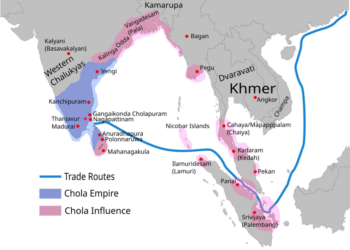
Funan’s significance rested partly on its location between China and India. Rather than functioning only as a passive stop on international routes, lower-Mekong communities participated in the movement, redistribution and transformation of goods, beliefs and political ideas across Asia.
Archaeology reinforces this broad picture. The Óc Eo complex in the Mekong Delta has long been regarded as a key site for studying the economic and urban dimensions of the Funan period, including its commercial connections and canal networks.
Óc Eo is located in present-day An Giang Province in southern Vietnam, within the historical environment of the Mekong Delta. Excavations there have uncovered evidence of dense settlement, craft production, exchange and waterways, making it central to debates about Funan’s geography and economy.
The site is often described as a port or commercial center, but this should not mean that Óc Eo alone explains Funan. It formed part of a larger regional system that also included inland centers, religious sites and connected settlements across what are now Cambodia and Vietnam.
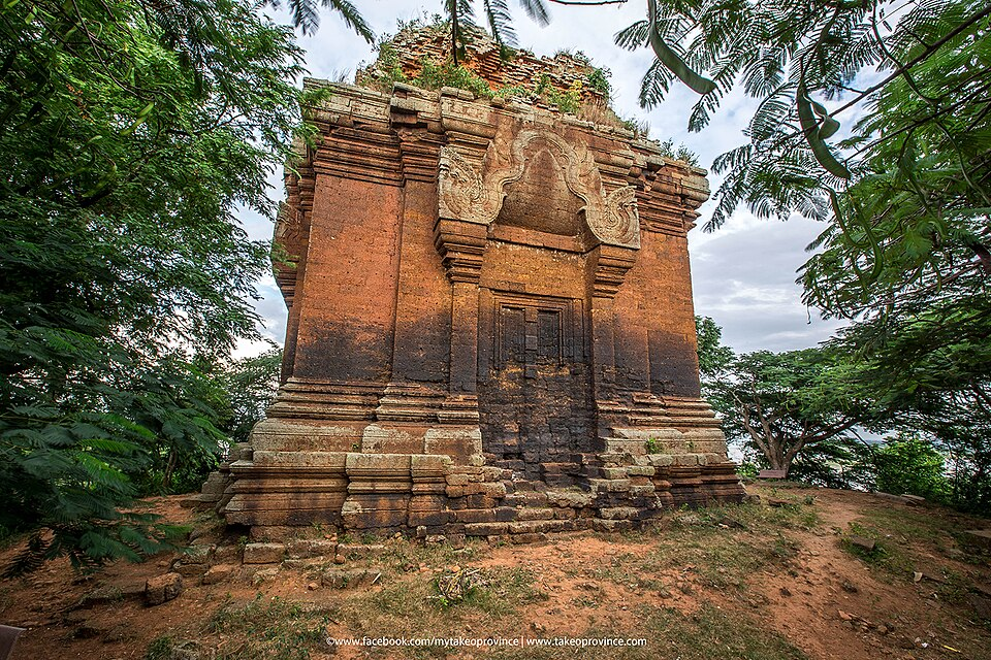
Angkor Borei, in present-day Takeo Province, Cambodia, is one of the important sites frequently discussed alongside Óc Eo. It illustrates why Funan should be approached as a lower-Mekong historical landscape rather than reduced to a single capital or one archaeological location.
The Chinese histories preserve a celebrated foundation story for Funan. In this narrative, a foreign man called Hùntián (混塡), often rendered as Hun-t’ien in older scholarship, arrives from across the sea with a powerful bow and encounters a woman ruler named Liǔyè (柳葉/柳叶).
Liǔyè is said to have ruled the local people before being defeated or persuaded by Hùntián, after which she married him and he became ruler. The story was later connected by many scholars with the South Asian Brahmin Kaundinya and the Cambodian tradition of a nāga princess or Queen Soma.
The connection is important but cannot be treated as fully certain. Chinese transcriptions, later Khmer narratives and Sanskrit inscriptions emerged in different contexts and at different dates, so historians must distinguish between direct evidence and later identifications.
Older histories often presented the Funan origin legend as evidence that an Indian outsider brought civilization to a local population. This approach is now widely questioned because it underestimates the agency, institutions and maritime experience of lower-Mekong communities before and during their contact with South Asia.
Indian religious, artistic and political influences were certainly important in the Funan period. Sanskrit inscriptions, Hindu and Buddhist imagery, and regional connections demonstrate sustained engagement with South Asian cultures and networks.
However, engagement did not mean simple imitation. Local communities adapted external ideas to their own riverine environment, political relationships and religious practices, producing forms of culture that were distinctively Southeast Asian.
The reports attributed to Zhu Ying and Kang Tai are essential, but they are not neutral descriptions. Chinese writers interpreted unfamiliar societies through their own political categories, moral assumptions and ethnographic conventions.
Descriptions of dress, bodies, marriage, law, rulership and customs may therefore reveal as much about Chinese expectations of foreign peoples as about Funanese society itself. A reported custom should not automatically be treated as a universal practice across all communities associated with Funan.
There is also a chronological problem. The surviving accounts combine material from different periods, and later compilers may have added, reorganized or confused information. Funan was not static across the centuries in which Chinese sources discussed it.
For these reasons, the Chinese texts must be compared with archaeology, local inscriptions and environmental evidence. No single source can provide a complete account of early Cambodia or the lower Mekong.
Why Zhu Ying and Kang Tai Matter
Zhu Ying and Kang Tai offer one of the earliest surviving written windows onto the world that later Cambodian history emerged from. Their reports help document the importance of the Mekong Delta as a zone of trade, mobility, diplomacy and cultural interaction long before Angkor.
They also show that Funan was already visible to foreign observers as a significant southern power in the third century CE. Chinese diplomacy toward Funan was part of a larger recognition that the seas south of China were connected to wealthy and politically organized societies.
Their testimony should therefore be used neither uncritically nor dismissed. Read alongside Óc Eo, Angkor Borei and the epigraphic record, the fragments attributed to the two Wu envoys remain a foundation for understanding the early history of the Mekong world.
Pascal Medeville is a writer, editor and translator based in Phnom Penh, Cambodia. His work focuses on Cambodian history, culture, heritage and language, with particular interest in early Southeast Asian civilizations, Khmer traditions and the connections between Cambodia and the wider Asian world.
He develops multilingual digital content and publishing projects that combine historical research with accessible storytelling for contemporary readers.