Hidden amid the quiet rice fields of Takeo Province, the Angkor Borei Museum offers a rare glimpse into Cambodia’s earliest kingdoms – a time when jade, bronze, and Sanskrit scripts flowed down the Mekong Delta like the lifeblood of civilization.

If Angkor Wat is Cambodia’s grand epic in stone, then Angkor Borei is its prologue – quieter, older, and arguably more mysterious. Located in the rural southwest, about 80 kilometers from Phnom Penh, Angkor Borei isn’t on the classic tourist trail, and that’s precisely what makes it fascinating. Here, history whispers rather than shouts.
This museum, modest in size but monumental in significance, sits in the heart of what was once the cradle of Khmer civilization – the ancient kingdom of Funan, later succeeded by Chenla, long before the Angkorian empire rose to power. The Angkor Borei Museum is dedicated to that early chapter of Cambodian history, housing priceless relics that tell the story of how local chiefdoms became kingdoms, and how Indian cultural influences merged with indigenous genius to form Khmer identity.
Whether you’re a history buff, an archaeology enthusiast, or simply someone who enjoys deciphering ancient mysteries between sips of coconut water, the Angkor Borei Museum deserves your attention.
The Setting: An Archaeological Heartland
A landscape shaped by water and myth
Angkor Borei lies near the ancient canal that once connected it to Oc Eo in present-day Vietnam — two vital nodes of the Funan civilization, which thrived from the 1st to the 6th century CE. This landscape wasn’t a dense jungle but a watery world of rivers, rice paddies, and trade routes, where merchants from India and China came to exchange goods and ideas.
Even today, during the rainy season, visitors often have to reach the museum by boat — a suitably romantic way to approach what some call “Cambodia’s oldest city.”
Imagine gliding through the flooded plains while fishermen cast their nets and water buffalo pull plows in the distance. You can almost feel the echoes of ships laden with gold ornaments and exotic ceramics that once sailed the same routes nearly two thousand years ago.
Inside the Museum: Treasures of Pre-Angkorian Cambodia
Modest building, monumental stories
The Angkor Borei Museum was inaugurated in 1999 as a joint effort between the Cambodian Ministry of Culture and APSARA, with support from international archaeologists. It stands as part of a larger archaeological conservation zone that includes nearby Phnom Da – the rocky hill topped by a 6th-century temple, one of Cambodia’s oldest.
From the outside, the museum resembles a traditional Khmer building with a tiled roof and ochre façade. Inside, it’s cool, serene, and surprisingly well curated.
Each gallery focuses on a distinct historical phase, tracing the region’s evolution from Neolithic settlements through Funan and Chenla to the early Angkor period. Display labels are in Khmer and English – refreshingly clear, if not poetic – and the lighting is forgiving enough to photograph your favorite relics without too much glare (a small victory for bloggers everywhere).
- Stone Sculptures of Vishnu and Shiva
The sandstone deities here reflect the earliest examples of Khmer art, influenced by Indian Gupta-style iconography yet unmistakably local in proportion and expression. The famous eight-armed Vishnu from Phnom Da remains one of the most majestic pieces of early Southeast Asian art.

- Inscriptions in Sanskrit and Old Khmer
These fragile slabs provide a linguistic timeline of Cambodia’s cultural fusion. The earliest inscriptions reveal rulers adopting Indian titles while preserving local religious customs – a graceful cultural negotiation centuries before globalization became a buzzword.

- Ceramics, Beads, and Gold Ornaments
Everyday items and trade goods give texture to the abstract glory of kingdoms. The items come from excavations around Angkor Borei and neighboring villages. Some bear resemblance to artifacts found in Oc Eo, proving that Funan was no myth but a maritime network stretching across the lower Mekong. - Architectural Fragments and Reliefs
You’ll also find lintels, miniature stupas, and sculpted bricks – vestiges of temples that have dissolved into the tropical soil. Each stone feels like a paragraph from a lost chronicle.
Phnom Da: The Temple Hill of Early Cambodia
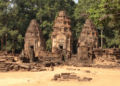
No visit to Angkor Borei is complete without making the short journey (by boat or tuk-tuk, depending on the season) to Phnom Da, a small hill rising above the floodplain. On top stands a sandstone temple built in the 6th century under King Rutravarman, showcasing early Khmer architecture long before the grandeur of Angkor Thom.
Inside the sanctuary once stood a massive statue of Vishnu (now safely preserved at the National Museum in Phnom Penh). The site’s atmosphere is both serene and haunting. From the summit, you can gaze across green fields that once formed the delta heartland of ancient Funan – a kingdom that connected India, China, and Southeast Asia when most of Europe was still in the Dark Ages.

How to Visit Angkor Borei Museum
From Phnom Penh, Takeo Province is about a two- to three-hour drive via National Road 2. The town of Angkor Borei lies east of Takeo City. Depending on the season, you might reach it by road (dry season) or boat (wet season, usually June to October), departing from Takeo’s canal port.
If you want the full historical experience – or simply a reason to post something envy-inducing on Instagram – take the boat. The slow journey through open water and lotus ponds is part of the charm.
- Opening hours: 8:00 AM to 5:00 PM daily; closed on major public holidays.
- Entrance fee: Small and symbolic (around 2 USD).
- Best time to visit: December to March, when Takeo’s countryside glows golden and the museum air-conditioning isn’t overloaded.
- Nearby sights: Phnom Da Temple, the Takeo Lake area.
Bring water, wear light clothes, and if you’re feeling scholarly, take a notebook. Inspiration tends to strike in places where entire civilizations once began.
The story of Angkor Borei is not merely an archaeological curiosity. It’s the foundation of Khmer civilization – the point where art, religion, and governance first forged a distinctly Cambodian identity.
If you strip away the grandeur of later Angkor, you find here the DNA of everything that followed: the worldview, the artistry, even the genius for hydraulic engineering that transformed the Mekong into an empire’s heartbeat.
Visiting the Angkor Borei Museum, therefore, is like meeting the ancestors of Angkor Wat’s architects. You see the first sketches before the masterwork – the impulse to transform stone into story, water into kingdom, and trade into legacy.
The Angkor Borei Museum may not have the fame of Angkor Wat or the crowds of Siem Reap, but it offers something rarer: intimacy with Cambodia’s origins. In its quiet galleries and windswept ruins, visitors can still sense the beginnings of a vast cultural saga.
If Angkor Wat is the symphony, Angkor Borei is the prelude – profoundly human and quietly magnificent.
- National Museum of Cambodia: Overview of prehistoric and early Khmer collections, including artifacts from Angkor Borei.
- APSARA Authority Reports: Archaeological findings and conservation efforts in Takeo’s heritage sites.
- EFEO (École française d’Extrême-Orient): Research on early Southeast Asian civilizations and Funan excavations.
- UNESCO Cultural Heritage Database: Summaries of Cambodia’s registered heritage zones and proposed sites.
- “The Origins of Funan” by Miriam Stark: Scholarly study of Angkor Borei’s role in early state formation.
- Lonely Planet Cambodia (latest edition): Updated travel guidance on routes and amenities in Takeo Province.
Pascal Médeville is a writer and digital publisher based in Cambodia. He explores Southeast Asian history, languages, and gastronomy, with a fondness for dusty museums and riverside noodle stalls. His works on Wonders of Cambodia, Khmerologie, and Sinoiseries bring cultural stories to life with an eye for detail and a dash of humor.