Wonders of Cambodia
  • Home
  • Culture
  • Cuisine
  • Tourism
  • Business
  • Life in Cambodia
  • 中文
  • ខ្មែរ
  • Français
  • Tiếng Việt
  • e-Books
No Result
View All Result
  • Home
  • Culture
  • Cuisine
  • Tourism
  • Business
  • Life in Cambodia
  • 中文
  • ខ្មែរ
  • Français
  • Tiếng Việt
  • e-Books
No Result
View All Result
Wonders of Cambodia
No Result
View All Result
Home Culture

Cambodian-Vietnamese War (1978-1989)

Pascal Medeville by Pascal Medeville
July 13, 2025
in Culture, History
Reading Time: 3 mins read
0
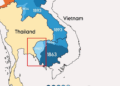
Vietnamese invasion of Cambodia, December 1978 – January 1979 (BorysMapping, CC BY-SA 4.0)

The Cambodian-Vietnamese War was a significant armed conflict between Democratic Kampuchea, ruled by Pol Pot’s Khmer Rouge, and the Socialist Republic of Vietnam, lasting from late 1978 until 1989. This war not only reshaped Cambodia’s political landscape but also ended one of the most brutal genocides of the 20th century.

Background and Causes
The roots of the Cambodian-Vietnamese War lie in the complex and often hostile relationship between the Khmer Rouge regime and Vietnam throughout the 1970s. Initially, the Khmer Rouge had received training and support from Vietnam, but tensions grew due to ideological differences, territorial disputes, and ethnic animosities. By the mid-1970s, after the Khmer Rouge seized power in Cambodia in 1975, relations deteriorated sharply. The Khmer Rouge leadership, under Pol Pot, was suspicious of Vietnamese intentions and increasingly hostile towards Vietnam.
Throughout 1977 and 1978, border skirmishes escalated into open conflict. The Khmer Rouge launched several incursions into Vietnamese territory, including the notorious Ba Chúc massacre in April 1978, where over 3,000 Vietnamese civilians were killed. These attacks provoked a strong response from Vietnam, which began preparing for a large-scale military intervention.

The Vietnamese Invasion of Cambodia
On 21 December 1978, Vietnam launched a limited offensive towards the Cambodian town of Kratie. This was followed by a full-scale invasion on 25 December 1978. Vietnamese forces, numbering in the tens of thousands and supported by air power, quickly overwhelmed the Khmer Rouge defenses. Within two weeks, the Vietnamese army captured Phnom Penh, the Cambodian capital, and deposed the Khmer Rouge government.
The Vietnamese invasion was motivated by multiple factors: to stop the Khmer Rouge’s cross-border attacks, to end the Cambodian genocide perpetrated by Pol Pot’s regime — which had killed between 1.2 and 2.8 million people, or roughly 13 to 30 percent of Cambodia’s population since 1975 — and to install a friendly government in Cambodia.

Aftermath and Occupation
Following the overthrow of the Khmer Rouge, Vietnam installed the People’s Republic of Kampuchea (PRK), a government largely composed of Cambodian communists who had defected from Pol Pot’s regime. Under Vietnamese supervision, Cambodia began a slow process of recovery. Schools reopened, private property was restored, and some Buddhist practices resumed. However, the Vietnamese military presence was seen by many Cambodians as an occupation, leading to ongoing resistance and insurgency.
The Khmer Rouge retreated to the jungles near the Thai border, where they continued to fight alongside other anti-Vietnamese factions, including the Khmer People’s National Liberation Front and FUNCINPEC, led by Norodom Sihanouk. These groups formed the Coalition Government of Democratic Kampuchea in 1982, sustaining a prolonged insurgency against the Vietnamese-backed government.

International Context and Cold War Dynamics
The Cambodian-Vietnamese War was deeply entangled with Cold War geopolitics. China, the United States, and several Western countries supported the Khmer Rouge and other anti-Vietnamese groups as a counterbalance to Vietnam’s Soviet-backed regime. This international support prolonged the conflict and complicated efforts toward peace.
Vietnam’s intervention also triggered the brief Sino-Vietnamese War in 1979, when China launched a punitive invasion of northern Vietnam in response to Vietnam’s actions in Cambodia. This conflict, although short-lived, underscored the regional tensions and the broader Sino-Soviet split influencing Southeast Asia.

Withdrawal and Peace Process
Vietnamese forces remained in Cambodia for over a decade, facing persistent guerrilla warfare and international isolation. The prolonged occupation strained Vietnam’s resources and international standing. Under pressure from the international community and internal challenges, Vietnam began withdrawing its troops in 1989.
The conflict formally ended with the 1991 Paris Peace Agreements, which paved the way for the United Nations Transitional Authority in Cambodia (UNTAC) and the restoration of a constitutional monarchy in 1993. These agreements marked the beginning of Cambodia’s recovery from decades of war and genocide.

Legacy
The Cambodian-Vietnamese War had profound consequences for both countries and the region. It ended the Khmer Rouge’s genocidal regime, saving countless lives, but also led to a decade-long Vietnamese occupation that was deeply unpopular among many Cambodians. The war highlighted the complexities of post-colonial Southeast Asian politics, where ethnic tensions, ideological conflicts, and Cold War rivalries intersected.
Vietnam emerged from the conflict with a more assertive regional role but at significant economic and political cost. Cambodia faced the enormous task of rebuilding a shattered society, economy, and governance structure.

In sum, the Cambodian-Vietnamese War was a pivotal episode in Southeast Asian history, reflecting the tragic human cost of ideological extremism and the geopolitical struggles of the Cold War era.

Don’t miss our upcoming articles!

We don’t spam!

Check your INBOX or SPAM folder to confirm your subscription.

Tags: Cambodian-Vietnamese Warhistory of CambodiaKhmer RougePeople's Republic of KampucheaPRKSoutheast Asian historyVietnamese Invasion of CambodiaVietnamese occupation of Cambodia
ShareTweet
Previous Post

The Spirit of Kampong Cham: History, Culture, and Life Along the Mekong River

Next Post

A few words about the dhole, or Asian wild dog

Pascal Medeville

Pascal Medeville

Author of the blog Wonders of Cambodia, I share my passion for Cambodia through stories, cultural insights, and personal reflections on the country. I'm also the founder of Simili Consulting, where we provide high-quality, professional translation services to international clients.

Related Posts

Two halves of a ripe red-fleshed dragon fruit on a white plate, showing vibrant magenta flesh dotted with tiny black seeds, with whole dragon fruits in the background.
Cuisine

Dragon Fruit in Cambodia: A Complete Guide to the Kingdom’s Vibrant Superfruit

July 19, 2026
Rows of mature rubber trees in a plantation in Tbong Khmum Province, Cambodia, with a dirt road in the foreground and green vegetation surrounding the estate
History

French Introduction of Rubber Plantations to Cambodia: How Colonial Ambition Changed the Kingdom’s Landscape

July 19, 2026
Stone pyramid temple of Prasat Thom at Koh Ker, Cambodia, seen from the front with steep central stairway and green vegetation covering its tiers.
History

Who’s Who: Jayavarman IV, The King Who Moved Angkor

July 18, 2026
Kai Yuan Tong Bao (開元通寶) Tang dynasty copper‑alloy cash coins, heavily corroded, shown at high magnification in two paired front‑and‑back views with square central holes and partially legible Chinese characters, to document examples found at Angkor
History

History: Chinese Coins Reveal Hidden Stories of Angkor

July 18, 2026
AI‑generated scene of a person forcefully mixing fermented fish paste in a huge clay jar, splashes flying, in front of an ornate, weathered Cambodian village structure
Proverbs

Proverb: When you reach into prahok, reach to the armpit

July 15, 2026
Sandstone lintel at Prasat Neang Khmao in Takeo, Cambodia, showing a central mythic face flanked by naga bodies, floral scrolls, and tiny seated figures above, carved in 10th century Khmer Koh Ker style on a brick temple façade.
Architecture

Picture of the day: Radiant Lintel of Prasat Neang Khmao

July 19, 2026
Next Post
A few words about the dhole, or Asian wild dog

A few words about the dhole, or Asian wild dog

  • Trending
  • Comments
  • Latest
The French Protectorate of Cambodia (1863–1953): An Overview

The French Protectorate of Cambodia (1863–1953): An Overview

July 13, 2025
The Franco-Siamese Treaty of 23 March 1907: Borders, Politics, and the Return of Angkor

The Franco-Siamese Treaty of 23 March 1907: Borders, Politics, and the Return of Angkor

February 11, 2026
Cambodian-Vietnamese War (1978-1989)

Cambodian-Vietnamese War (1978-1989)

July 13, 2025
The Legend of Preah Ko Preah Keo: Guardians of Cambodia’s Lost Treasures

The Legend of Preah Ko Preah Keo: Guardians of Cambodia’s Lost Treasures

February 23, 2026
Kampot Province

Takeo Province: A Cradle of Cambodian History and Culture

3
Kratié Town on the Mekong: Colonial Echoes, River Life, and Irrawaddy Dolphins

Kratié Town on the Mekong: Colonial Echoes, River Life, and Irrawaddy Dolphins

3
Banteay Meanchey Province: A Gateway to Cambodia’s Rich Heritage

Banteay Meanchey Province: A Gateway to Cambodia’s Rich Heritage

2
Stung Treng Province: The Gateway to Cambodia’s Northern Wilderness

Stung Treng Province: The Gateway to Cambodia’s Northern Wilderness

2
Two halves of a ripe red-fleshed dragon fruit on a white plate, showing vibrant magenta flesh dotted with tiny black seeds, with whole dragon fruits in the background.

Dragon Fruit in Cambodia: A Complete Guide to the Kingdom’s Vibrant Superfruit

July 19, 2026
Rows of mature rubber trees in a plantation in Tbong Khmum Province, Cambodia, with a dirt road in the foreground and green vegetation surrounding the estate

French Introduction of Rubber Plantations to Cambodia: How Colonial Ambition Changed the Kingdom’s Landscape

July 19, 2026
Decorative lintel of a modern pagoda near Phnom Chisor temple showing a seated Buddha framed by elaborate turquoise naga carvings and floral Khmer motifs above a doorway.

Picture of the day: Naga Guardian Lintel at Phnom Chisor Pagoda

July 19, 2026
Stone pyramid temple of Prasat Thom at Koh Ker, Cambodia, seen from the front with steep central stairway and green vegetation covering its tiers.

Who’s Who: Jayavarman IV, The King Who Moved Angkor

July 18, 2026

Recent News

Two halves of a ripe red-fleshed dragon fruit on a white plate, showing vibrant magenta flesh dotted with tiny black seeds, with whole dragon fruits in the background.

Dragon Fruit in Cambodia: A Complete Guide to the Kingdom’s Vibrant Superfruit

July 19, 2026
Rows of mature rubber trees in a plantation in Tbong Khmum Province, Cambodia, with a dirt road in the foreground and green vegetation surrounding the estate

French Introduction of Rubber Plantations to Cambodia: How Colonial Ambition Changed the Kingdom’s Landscape

July 19, 2026
Decorative lintel of a modern pagoda near Phnom Chisor temple showing a seated Buddha framed by elaborate turquoise naga carvings and floral Khmer motifs above a doorway.

Picture of the day: Naga Guardian Lintel at Phnom Chisor Pagoda

July 19, 2026
Stone pyramid temple of Prasat Thom at Koh Ker, Cambodia, seen from the front with steep central stairway and green vegetation covering its tiers.

Who’s Who: Jayavarman IV, The King Who Moved Angkor

July 18, 2026
Wonders of Cambodia

Exploring Culture, Nature, and Spirit in the Land of Wonder.

Follow Us

Browse by Category

  • Architecture
  • Architecture
  • Art
  • Books
  • Business
  • Business
  • Cinema
  • Costume
  • Costume
  • Cuisine
  • Culture
  • Defense
  • Du lịch
  • e-Books
  • Education
  • Expat life
  • Fauna
  • Festival
  • Flora
  • Food providers
  • Français
  • Geography
  • Handicraft
  • Health
  • Histoire
  • History
  • Hotels
  • Khmer Stories
  • Khmer stories
  • Knowledge
  • Language
  • Last posts
  • Lịch sử
  • Life in Cambodia
  • Literature
  • Meet the neigbhors
  • Music
  • Pictures
  • Politics
  • Population
  • Press review
  • Professional services
  • Proverbs
  • Reference
  • Reference
  • Religion
  • Restaurants
  • Temples
  • Textile
  • Tiếng Việt
  • Tourism
  • Tourisme
  • Transport
  • Uncategorized
  • Vidéo
  • Video
  • Vie quotidienne
  • Who's who
  • ខ្មែរ
  • ទេសចរណ៍៖
  • បគ្គលល្បី
  • ប្រវត្តិសាស្ត្រោ
  • សៀវភៅ
  • 中文
  • 书籍
  • 历史
  • 商业
  • 旅游
  • 生活

Recent News

Two halves of a ripe red-fleshed dragon fruit on a white plate, showing vibrant magenta flesh dotted with tiny black seeds, with whole dragon fruits in the background.

Dragon Fruit in Cambodia: A Complete Guide to the Kingdom’s Vibrant Superfruit

July 19, 2026
Rows of mature rubber trees in a plantation in Tbong Khmum Province, Cambodia, with a dirt road in the foreground and green vegetation surrounding the estate

French Introduction of Rubber Plantations to Cambodia: How Colonial Ambition Changed the Kingdom’s Landscape

July 19, 2026
  • About Us
  • Advertise
  • Privacy & Policy
  • Contact Us

© 2025 - Made with 💫 by TechFlow.

No Result
View All Result
  • Home
  • Culture
  • Cuisine
  • Tourism
  • Business
  • Life in Cambodia
  • 中文
  • ខ្មែរ
  • Français
  • Tiếng Việt
  • e-Books

© 2025 - Made with 💫 by TechFlow.