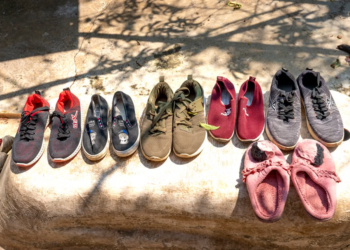
You arrive at a Cambodian house, step through the doorway, and suddenly realize your shoes have become a social problem. They are still perfectly good shoes, but they probably should not go any farther.
For many Cambodians, taking off shoes before entering a home is simply part of good manners. There may be no sign, no announcement and certainly no security guard enforcing the rule. You just notice the small collection of sandals and shoes waiting outside the door and understand what is expected. The custom is practical, but it also says something about how Cambodian homes are understood and how respect is expressed in everyday life.
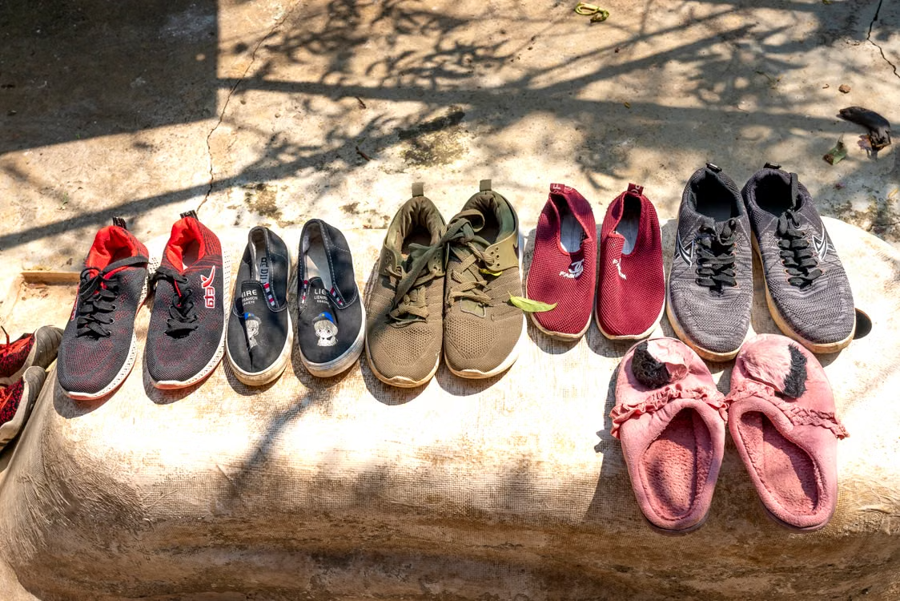
The house begins at the doorway
Cambodian etiquette generally treats the entrance to a home as a boundary between the outside world and the domestic space. Shoes have been walking through streets, markets, muddy paths and other places, so bringing them onto the household floor can be seen as bringing dirt into a space that should remain clean.
Tourism Cambodia specifically advises visitors to leave their shoes at the entrance when entering a Cambodian home, noting that hosts appreciate the gesture even when they may politely tell guests to keep their shoes on.
That last detail is particularly Cambodian. Your host may say, in effect, “No, no, keep your shoes on,” while everyone else is already barefoot.
The polite response is usually to follow the household’s lead.
Cleanliness matters, but it is also about respect
It is tempting to explain the custom purely in terms of hygiene. There is certainly a practical element to it. Cambodia’s streets can be dusty, muddy or wet depending on the season, and footwear collects a remarkable amount of evidence of where you have been.
But cleanliness is not the whole story.
A Cambodianess article describing a foreign resident’s experience in Cambodia notes that she initially found the custom puzzling before understanding it as a gesture of respect. The same account describes the idea that shoes can bring unclean things into the home.
This distinction is useful. Removing your shoes is not necessarily a grand ritual. It is a small act that acknowledges that the interior of someone’s home deserves a different kind of behavior from the street outside.
And once you start noticing it, you see the same principle in other settings.
From houses to pagodas
The custom becomes more formal in religious spaces.
Shoes are always removed before entering Buddhist pagodas and temple buildings used for worship. Tourism Cambodia explicitly lists removing shoes when entering homes and places of worship among basic Cambodian etiquette.
Here the meaning goes beyond keeping floors clean. Removing footwear is part of approaching a sacred space appropriately.
The same habit can therefore move quite naturally between domestic and religious life. A Cambodian does not necessarily need to think through a complicated rule each time. The gesture has become almost automatic: shoes belong outside when the space inside calls for cleanliness, respect or both.
There are, of course, differences between homes and religious buildings. Not every Cambodian household follows exactly the same practice, and modern apartments, offices and other indoor spaces can have different expectations. It is better to think of shoe removal as a widespread social convention rather than an absolute rule.
A tiny gesture with a social message
There is something revealing about the custom because it happens without much conversation.
You take off your shoes. You enter. You sit down.
That little sequence quietly acknowledges that you are entering someone else’s space on their terms. In Cambodia, good manners often work this way. Respect is expressed through small physical gestures and adjustments rather than through lengthy explanations.
For a foreign visitor, the easiest way to understand the rule is therefore not to ask whether shoes are technically allowed. Look at the doorway.
If everyone else’s shoes are outside, the cultural instruction is already there.
Conclusion
Taking off your shoes in a Cambodian home may look like an insignificant habit. It is not a complicated ceremony, and most people probably do not stop to analyze it. Yet the gesture reflects a broader Khmer preference for keeping certain spaces clean, orderly and worthy of respect. The interesting part is precisely how ordinary it is. In Cambodia, cultural etiquette is often hiding in plain sight, waiting beside the doorway in a pile of sandals.