Estimated reading time: 7 minutes – Angkor’s history is rarely short on drama, and Jayavarman VIII certainly did not disappoint.
Jayavarman VIII ruled the Khmer Empire from 1243 to 1295 during one of the most intriguing periods in Angkorian history. A committed Shaivite, he reversed much of the Buddhist transformation associated with Jayavarman VII, restored Hindu worship and altered major temples. His reign also coincided with the appearance of Mongol power in mainland Southeast Asia, although no war took place between the Mongols and the Khmer.
Jayavarman VIII is one of the most fascinating and controversial kings of Angkor. He inherited an empire whose religious landscape had been dramatically transformed by Jayavarman VII, the great Buddhist ruler who built Angkor Thom, the Bayon and numerous other monuments.
Jayavarman VIII chose a very different path. A Shaivite Hindu, he restored Hinduism to a position of prominence and ordered or authorized major changes to Buddhist monuments. Some images were destroyed, others altered, and temples were adapted to Hindu worship. The traces of this religious reversal remain visible today.
His reign is also important for another reason. During the late 13th century, the expanding Mongol Empire reached mainland Southeast Asia. Yet here, as so often in popular accounts of history, the reality is more interesting than the headline. The Mongols did not conquer Angkor, and there was no major Mongol-Khmer war. Instead, Jayavarman VIII faced the new superpower through diplomacy, tribute and caution.
Jayavarman VIII at a glance
Jayavarman VIII ruled the Khmer Empire from 1243 to 1295. His predecessor was Indravarman II, and his successor was his son-in-law, Indravarman III, also known as Srindravarman. His posthumous name was Paramesvarapada, a name associated with Shiva and entirely appropriate for a king who strongly favored Shaivism.
His reign lasted more than half a century, making it one of the longer reigns of the late Angkorian period.
But Jayavarman VIII is remembered less for building a spectacular new capital than for changing the religious character of the one he inherited.
That change was substantial.
From Jayavarman VII’s Buddhism to Hindu restoration
To understand Jayavarman VIII, we first have to understand the extraordinary religious transformation carried out by his predecessor.
Jayavarman VII, who ruled in the late 12th and early 13th centuries, was a Mahayana Buddhist king. Under his rule, Buddhism became central to royal ideology, and Angkor Thom was established as the great royal city. The Bayon stood at its heart as the monumental expression of this new Buddhist vision.
Jayavarman VIII reversed that direction.
As a Shaivite, he restored Hindu worship and sponsored the transformation of Buddhist monuments. At the Bayon and elsewhere, Buddhist imagery was removed, damaged or replaced. Hindu images and symbols were installed in their place.
The scale of the intervention appears to have been considerable. Yet historians have become more cautious about attributing every damaged Buddhist image at Angkor directly to Jayavarman VIII. Some scholarly research has questioned the traditional picture of a single, neatly organized campaign of destruction. The archaeological record is more complicated, with modifications occurring at different times and under different circumstances.
That caution is important. Jayavarman VIII was certainly associated with the Hindu restoration, but Angkor’s religious history was not a simple case of one king ordering every Buddha removed with military efficiency.
The Bayon: a temple rewritten in stone
Few monuments illustrate the religious changes of Jayavarman VIII better than the Bayon.
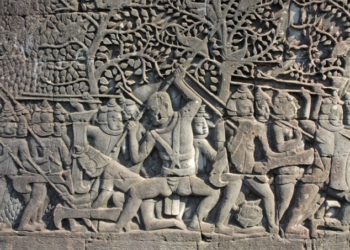
The temple was created under Jayavarman VII as the religious centerpiece of Angkor Thom. Its famous face towers are among the most recognizable images of Cambodia, while its bas-reliefs provide an extraordinary record of warfare, markets, ceremonies and everyday life.
But the Bayon did not remain exactly as Jayavarman VII left it.
During the reign of Jayavarman VIII, the temple was transformed into a Hindu sanctuary. Buddhist imagery was removed or altered, while Hindu imagery was introduced. The Bayon therefore gives visitors something more valuable than a perfectly preserved monument. It gives them a monument that changed its mind.
The fate of the central Buddha is particularly striking.
A large image of the Buddha, originally installed at the heart of the Bayon, was dismantled and thrown into a well. The fragments were eventually recovered and reconstructed in the 20th century. The statue is now displayed near the temple, an archaeological survivor of a rather turbulent religious career.
A religious restoration, but also a political statement
It is tempting to interpret Jayavarman VIII’s actions purely as religious intolerance. That interpretation is understandable, but probably too simple.
Religion and kingship were inseparable at Angkor. Royal monuments expressed political legitimacy as much as personal faith. Changing the religious identity of a temple could therefore also mean changing the political message attached to the previous ruler.
Jayavarman VIII inherited an enormous legacy from Jayavarman VII. Rather than simply continuing it, he replaced much of its religious symbolism with imagery connected to the Hindu traditions of earlier Khmer kings.
The destruction or alteration of Buddhist images can therefore be understood partly as an attempt to rewrite royal memory.
The stones were still there. The message had changed.
Jayavarman VIII and Hindu temples
Jayavarman VIII’s reign was not exclusively about altering older Buddhist monuments. Hindu religious institutions continued to receive royal or aristocratic patronage.
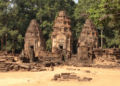
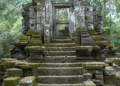
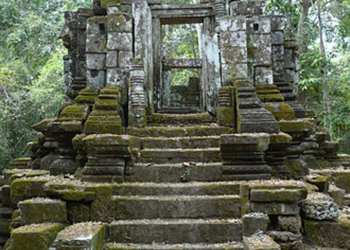
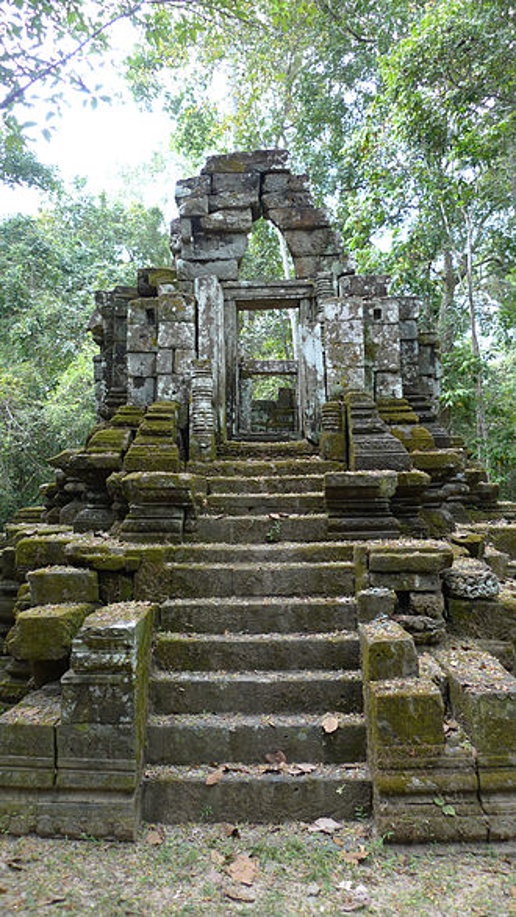
One particularly important monument associated with the final years of his reign is Mangalartha, also known as Prasat Top or the East Top in some descriptions.
The temple was constructed in 1295, during the final year of Jayavarman VIII’s reign. Archaeological research identifies Mangalartha as the last major stone temple built at Angkor.
Its date is historically valuable because it provides a precise marker for the end of an era.
By 1295, the great age of monumental stone construction was beginning to fade. Angkor would continue to be inhabited and used, but the extraordinary building program associated with earlier kings was no longer operating on the same scale.
Mangalartha is therefore more than a small late temple. It stands near the end of the classical Angkorian architectural tradition.
The Mongols arrive on Cambodia’s doorstep
The religious transformation of Angkor was not the only major development during Jayavarman VIII’s long reign.
Far beyond Cambodia, the Mongol Empire had become the dominant political power across much of Asia. Under Kublai Khan, the Yuan dynasty controlled China and was expanding its influence toward mainland Southeast Asia.
This is where a commonly repeated story about Jayavarman VIII needs some correction.
No Mongol-Khmer war
Some accounts, including the English-language Wikipedia article on Jayavarman VIII, (which talks about a “Mongol-Khmer war” in 1268) and state that Mongol forces “attacked the Angkor empire” in 1283. That wording gives the impression of a major Mongol invasion of Cambodia. The historical evidence does not support such a simple interpretation.
There was no major Mongol-Khmer war, no Mongol conquest of Angkor, and no Mongol army that captured the Khmer capital.
George Cœdès, one of the major historians of Southeast Asian history, described the Mongol appearance in Cambodia in notably different terms. He wrote that the Mongols appeared in Cambodia “in a rather benign fashion.” A Mongol force associated with General Sogatu, who was campaigning against Champa, sent officers toward Cambodia. These men were captured and never returned. Cambodia subsequently considered it prudent to offer tribute to Kublai Khan.
The distinction matters.
The Mongols were certainly a serious threat. Their military campaigns had already demonstrated their power across Asia, and Cambodia had every reason to avoid provoking them. But the Khmer response was diplomatic rather than military.
Jayavarman VIII effectively chose the sensible option: pay tribute and avoid a war that did not need to happen.
It was not a heroic battlefield victory, but it was probably the more useful achievement.
Why the confusion persists
The confusion probably comes from treating several connected events as one Mongol invasion of Cambodia.
The Mongols were fighting in mainland Southeast Asia, particularly against Champa and Đại Việt. Their armies and diplomatic missions came into contact with the Khmer world. Cambodia subsequently entered a tributary relationship with the Yuan court.
But these facts do not amount to a Mongol conquest of Angkor.
The distinction is especially important when discussing Jayavarman VIII because the king’s reign coincided with a dramatic transformation of Asian geopolitics. Angkor was not isolated from the rest of the continent, but neither was it simply swept away by the Mongols.
Indeed, the fact that Angkor was still functioning when the Chinese envoy and traveler Zhou Daguan arrived shortly after Jayavarman VIII’s reign is itself a useful reminder that the Khmer capital had survived the encounter with Mongol power.
Jayavarman VIII and the wider Asian world
The Mongol episode places Jayavarman VIII firmly within the wider history of medieval Asia.
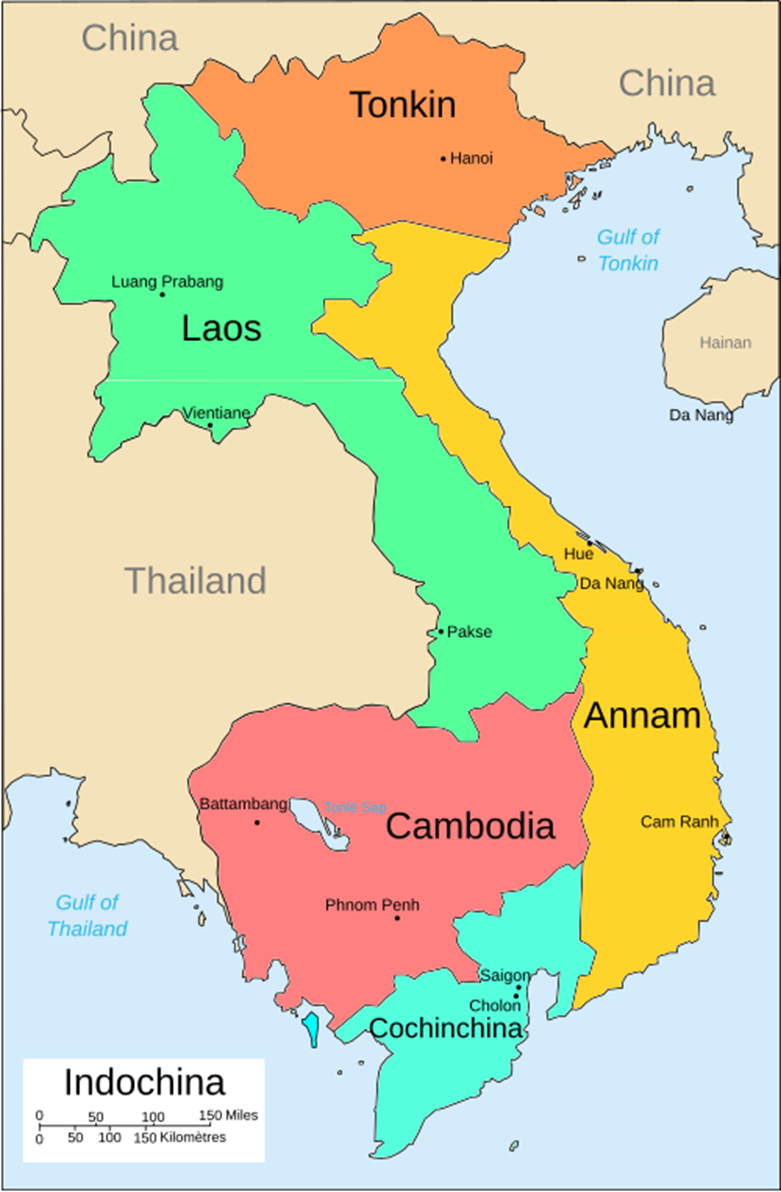
During his reign, Cambodia was dealing not only with religious questions at home but also with changing relationships with Champa, Đại Việt and the emerging Tai powers to the west.
The Khmer Empire remained powerful, but the political landscape was becoming more competitive.
This is one reason why the late 13th century should not be presented simply as the beginning of Angkor’s sudden collapse. Angkor was still a functioning urban and religious center. Its political and economic system, however, was changing.
The old model of an enormous agrarian empire dominated by a powerful divine king and monumental temple building was gradually giving way to something different.
Jayavarman VIII ruled at precisely this turning point.
The end of Jayavarman VIII’s reign
In 1295, after more than fifty years on the throne, Jayavarman VIII abdicated or was removed from power.
His son-in-law, Indravarman III, succeeded him.
The political change was also significant religiously. The Hindu restoration associated with Jayavarman VIII did not become the permanent religious settlement of Angkor.
Buddhism returned, although not simply in the Mahayana form promoted by Jayavarman VII.
Over time, Theravada Buddhism became increasingly important and eventually dominant in Cambodia. This represented a profound transformation of Khmer religious life and helped shape the cultural landscape that survives today.
In other words, Jayavarman VIII succeeded in reversing Jayavarman VII’s Buddhist program, but he could not reverse history indefinitely.
What remains of Jayavarman VIII?
Jayavarman VIII left relatively few monumental works that can compete with the Bayon, Angkor Wat or Ta Prohm in scale and fame.
His legacy is nevertheless everywhere.
It can be found in damaged Buddha images, modified temple sculptures, Hindu additions to Buddhist monuments and the complex architectural layers of the Bayon.
This is precisely what makes him so interesting.
When visitors walk through Angkor today, they are not seeing one historical moment. They are seeing centuries of religious and political intervention layered on top of one another.
A Buddhist temple could become a Hindu temple. A Hindu sanctuary could later become Buddhist again. A royal image could be destroyed, buried and eventually reconstructed by archaeologists.
Angkor was never frozen in time.
Jayavarman VIII is one of the kings who made sure of that.
Why Jayavarman VIII matters
Jayavarman VIII matters because his reign reveals the political, religious and diplomatic complexity of late Angkor.
He was a committed Shaivite who restored Hinduism after the Buddhist reign of Jayavarman VII. He altered some of Angkor’s most important temples and left a visible mark on the Bayon. At the same time, he governed an empire confronting a changing regional balance and the appearance of Mongol power in Southeast Asia.
His response to the Mongols is particularly revealing. Rather than fighting a war that could have been disastrous, he chose diplomacy and tribute. The Khmer did not defeat the Mongols on a battlefield because there was no such great battle to win.
Sometimes, in medieval politics as in modern life, the cleverest victory is the conflict you manage not to have.
Conclusion
Jayavarman VIII was one of the pivotal kings of late Angkor, a Shaivite ruler who reversed much of Jayavarman VII’s Buddhist legacy while guiding the Khmer Empire through a rapidly changing Asian political landscape. His religious transformations remain carved into the temples of Angkor, while his cautious dealings with the Mongols demonstrate that Cambodia’s medieval rulers could respond to enormous external pressures with diplomacy rather than war.
About the author
Pascal Médeville is a writer and digital publisher based in Cambodia. His work focuses on Cambodian history, culture, language, heritage and everyday life, with particular interest in the stories behind the country’s monuments, traditions and historical figures. He writes and publishes extensively about Cambodia through Wonders of Cambodia.