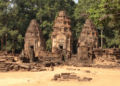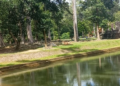
Across the quiet water of Angkor Thom, the eastern façade of Bayon reveals a remarkable blend of stone, sky, and Khmer history.
The eastern façade of Bayon Temple has a quieter character than the famous maze of towers and smiling faces within. Seen across the moat, its weathered stone rises behind lawns, trees, and reflective water, creating a scene in which architecture and landscape seem almost inseparable. Watch the video and take a closer look at one of Angkor’s most extraordinary monuments.
Introduction
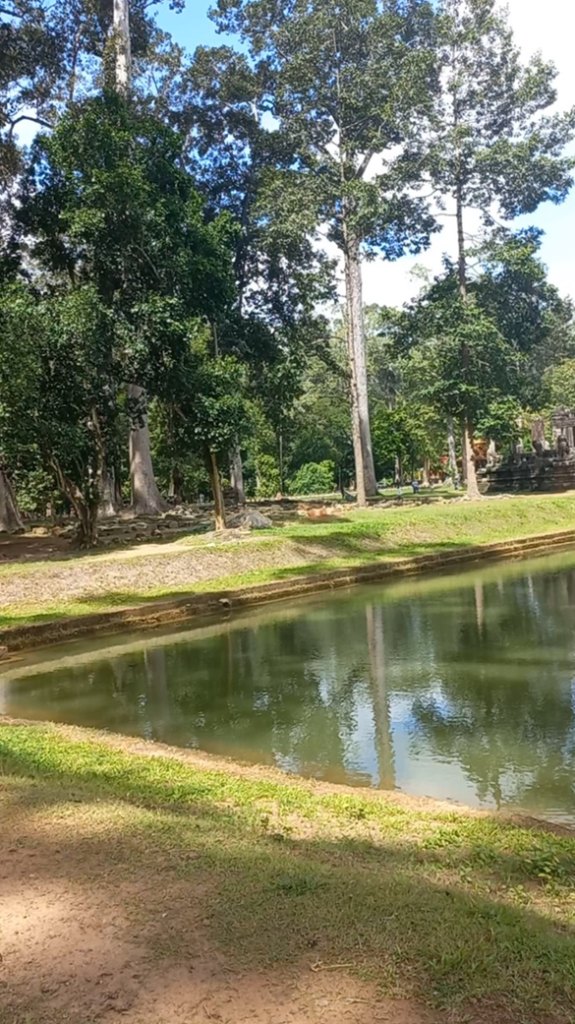
Bayon Temple’s eastern façade appears almost serenely detached from the bustle of Angkor. In the video, the monument stretches across the water, its weathered towers and stone galleries framed by broad lawns, mature trees, and an immense Cambodian sky.
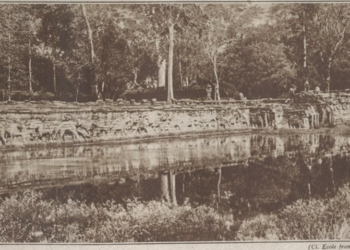
There is something particularly attractive about seeing Bayon from this distance. The moat provides a natural mirror, while the movement of the camera gradually reveals the relationship between the temple and the surrounding landscape. Rather than confronting the visitor with an overwhelming mass of stone, this view allows the monument to breathe.
The atmosphere is peaceful, almost contemplative. Water, grass, trees, clouds, and ancient sandstone occupy the same frame. It is a reminder that Angkor was never simply a collection of temples. It was a vast cultural landscape in which architecture, water management, religion, royal power, and everyday life were closely connected.
Discover the Place
Bayon stands at the heart of Angkor Thom, the great fortified capital associated with King Jayavarman VII. The city covers roughly 900 hectares and was enclosed by massive laterite walls and a broad moat. Its present layout largely took shape during the late 12th and early 13th centuries, following Jayavarman VII’s establishment of Angkor Thom as his capital.
Built during Jayavarman VII’s reign, Bayon was originally associated with Mahayana Buddhism. The temple occupies the center of Angkor Thom and was conceived within a religious and political landscape shaped by Buddhist cosmology. UNESCO describes it as the culmination of Jayavarman VII’s monumental and religious ambitions.
The eastern side is particularly significant for visitors because it provides the traditional approach to the temple. Entering from the east leads toward a complex world of galleries, terraces, passages, towers, and sculptures. The interior can feel almost labyrinthine, a striking contrast with the spacious view presented in this video.
And then there are the faces.
Bayon’s famous towers once carried hundreds of monumental faces, creating the extraordinary visual identity for which the temple is known. Their precise symbolism remains the subject of scholarly discussion. They have been associated with Buddhist figures, particularly Avalokiteshvara, and have also been interpreted in relation to royal power and the person of Jayavarman VII. UNESCO notes that the surviving faces have been classified into several groups, reflecting the complexity of the temple’s iconography.
From the eastern approach, however, these famous faces are not necessarily the first thing that captures the eye. The larger impression comes from the relationship between the temple and the surrounding space.
Hidden Details
One easily overlooked feature of Bayon is how unusual its architectural organization is. Unlike many major Khmer temples, it does not have a conventional enclosing wall of its own. Instead, it sits within the much larger enclosure of Angkor Thom.
The temple also changed over time. What visitors see today is the result of several building phases and later transformations. Originally Buddhist, Bayon was subsequently modified during periods of religious change, including the Hindu revival under Jayavarman VIII, before Buddhism returned to an important place at the site.
The eastern façade itself has also required careful conservation. UNESCO notes that restoration work has included the East façade, alongside other structures at Bayon. This is a useful reminder that the monument we admire today is not simply surviving by luck. It is also the result of decades of research, conservation, and painstaking work.
For photographers, the eastern side offers another advantage: water. On calm mornings, the moat can produce beautiful reflections, particularly when the light is soft and the sky carries a few clouds. The scene changes considerably with the seasons, from greener surroundings during the wetter months to warmer, drier tones during the dry season.
Travel Tips
The Angkor Archaeological Park is best explored early in the day, when temperatures are more comfortable and the light is generally gentler. Bayon is open from 7:30 a.m. to 5:30 p.m., according to the APSARA National Authority.
Allow enough time to see Bayon from several perspectives. The eastern approach is worth appreciating before entering the temple itself. Once inside, take time to examine the bas-reliefs, galleries, decorative details, and face towers rather than simply searching for the most famous photographs.
Bayon is also conveniently located near several major monuments of Angkor Thom, including the Baphuon, the Royal Enclosure, the Terrace of the Elephants, and the Terrace of the Leper King.
Watch the Video
Experience the atmosphere of Bayon’s eastern façade for yourself by watching the video below. Bayon Temple’s Eastern Façade | Angkor, Cambodia
For more videos exploring Cambodia’s temples, landscapes, history, and everyday life, follow the Wonders of Cambodia YouTube channel.
Conclusion
Bayon is often remembered for its mysterious stone faces, but the temple has other moods as well. Seen from the east, across the quiet water, it becomes part of a much larger landscape of trees, sky, reflections, and ancient Khmer engineering.
That quieter perspective is perhaps one of the pleasures of Angkor. The monuments reveal themselves differently depending on where you stand, when you arrive, and how long you are willing to look.
Continue exploring Cambodia with Wonders of Cambodia, where every temple has another story waiting just beyond the obvious.
Information Box
Location: Angkor Thom, Angkor Archaeological Park
Province: Siem Reap
Category: Khmer architecture, temples, history, travel
Filmed by: Pascal Médeville for Wonders of Cambodia
YouTube Video: Bayon Temple’s Eastern Façade | Angkor, Cambodia