The Siamese-Cambodian War of 1591–1594 pitted the Ayutthaya Kingdom against a defiant Cambodia still haunted by the glories of Angkor. Beyond sieges and swords, this conflict reveals a dramatic moment when Southeast Asia’s political landscape was being rewritten. Here’s how a resurrected Khmer court fought — valiantly if vainly — to preserve its fading realm.
History rarely behaves politely. In the late 16th century, as the Khmer kingdom tried to pick itself up from centuries of decline, its western neighbor — Ayutthaya — decided to send a reminder of who truly ruled the region. The Siamese–Cambodian War (1591–1594) was not the first blow Cambodia suffered from Siam, nor would it be the last, but it marked a definitive turning point in their long and intricate rivalry.
For today’s reader interested in Southeast Asian history — whether a scholar, traveler, or armchair historian — this war offers more than dusty chronicles. It’s a window into the transition from the Angkorian legacy to the early modern geopolitics of the region. And frankly, it’s a gripping story: bold kings, doomed defenses, and a capital, Longvek, that fell under bitter siege.
So fasten your mental krama — the plaid scarf of Cambodian identity — and let’s revisit those tumultuous years when Siam marched east and Cambodia fought for survival.

Thailand and Cambodia Before the Storm
By the 1500s, Cambodia was still living in Angkor’s architectural shadow. The ancient capital, once the largest city in the world, had been abandoned for almost a century. Power had shifted southward to Longvek, a fortified capital on the Tonle Sap River. The Cambodian court under King Satha (or Chey Chettha) tried to modernize administration and strengthen defenses, but the kingdom’s aura had dimmed.
Meanwhile, the Ayutthaya Kingdom (in modern Thailand) was thriving under King Naresuan, who had recently thrown off Burmese domination. Flush with military confidence, Naresuan sought to reaffirm Siam’s supremacy in the region. Cambodia — prosperous in trade and mostly independent at the time — became his natural target. After all, geopolitical ambition has been a regional sport since well before ASEAN.
The First Campaign: 1591 – A Test of Strength
King Naresuan first launched an invasion in 1591, ostensibly to punish Cambodia for alleged raids and insults at the border. But the truth, as often, was less about grievances and more about glory. The campaign aimed to test Longvek’s resolve.
The Siamese army advanced along two fronts — one via Battambang, another through the eastern plains. Despite Longvek’s fortifications and stubborn resistance, Cambodian defenses under King Satha miraculously held, forcing Naresuan to retreat after heavy losses.
This early defense boosted Cambodian morale. Chronicles describe how monks and ordinary citizens joined hands to strengthen city walls and pray for divine protection. Longvek might have survived this time, but fate, like a tiger, was only crouching.
The Second Campaign: 1593–1594 – Siege and Fall of Longvek
Two years later, Naresuan returned — with discipline, determination, and elephants. This second campaign was far better organized. The Siamese forces, equipped with modern firearms and supported by vassals, advanced again toward Longvek.
By early 1594, Longvek was encircled. Cambodian defenders, under King Satha and a general named Ponhea An, fought fiercely, but supplies dwindled. The Tonle Sap, lifeline of the capital, became a blockade zone. Chronicles describe desperate night sorties and even attempts to hide royal regalia.
Eventually, Longvek fell. King Satha fled eastward toward Laos, leaving the city — and most of its royal family — to Siamese control. Thousands were deported, artisans and monks among them, contributing later to the cultural infusion visible in Ayutthaya’s art and architecture.
This was not merely a military loss. It was an act of cultural transplantation. The Khmer identity would endure, but Cambodia entered two centuries of internal fragmentation and foreign interference.
Aftermath: Cambodia’s Twilight and Siam’s Ascendance
After Longvek’s fall, Cambodia entered a period of chaos. Competing princes sought Siamese or Vietnamese protection, giving rise to a pattern of external influence still felt in later centuries. The brief rise of Lovek as capital was followed by the emergence of Oudong and, finally, Phnom Penh.
Siam, meanwhile, emerged as the dominant power in mainland Southeast Asia, its confidence strengthened by victory. Naresuan’s campaigns elevated Ayutthaya to a regional empire, controlling much of present-day Thailand, Laos, and parts of Cambodia.
Interestingly, art and craftsmanship crossed borders with the captives. Khmer stonecarvers and bronze casters contributed greatly to Ayutthaya’s religious art, blending Angkorian elegance with Thai aesthetics. A few centuries later, the exchange would reverse again, as Thailand’s own artisans influenced Khmer revival styles. History, as always in Southeast Asia, tends toward beautiful irony.
Historical Sources and Interpretations
Historians still debate details of the Siamese–Cambodian War. Thai and Cambodian chronicles offer differing tones — triumphal versus tragic — but cross-reading them provides a more nuanced truth.
European missionaries who visited the region in the late 1500s also recorded contemporary impressions: Portuguese observers noted the siege, the use of firearms, and the resilience of the Khmer people even in defeat.
For Cambodian historians, Longvek’s fall marks the end of the middle period — the moment Angkor’s spiritual inheritance slipped into survival mode. For Thai historians, it showcases Naresuan’s heroism and consolidation of Siam’s identity. For the rest of us, it’s a sobering case study of how nations rise and fall when geography meets ambition.
Legacy of the Siamese–Cambodian War
In Cambodia, dynastic instability became the new normal. Frequent appeals to Siam and later to Vietnam eroded sovereignty, setting the stage for the complex geopolitical dance of the 17th and 18th centuries.
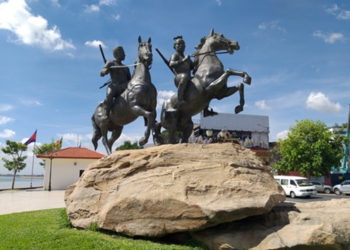
Today, Cambodians remember Longvek as both a symbol of lost grandeur and endurance. A few kilometers north of modern Phnom Penh, the ruins of Longvek’s walls and moat still whisper of a time when the kingdom stood between past glory and future survival. Modern Thai history textbooks, by contrast, celebrate the campaign as an early assertion of regional unity.
The Siamese–Cambodian War thus left a memory that is part shared heritage, part historical scar — a reminder of how differently two neighbors can remember the same event.
The Siamese–Cambodian War of 1591–1594 was more than a clash of armies; it was the ceremonial closing of Cambodia’s medieval chapter. Ayutthaya triumphed militarily, but both kingdoms emerged profoundly transformed. From Angkor’s lingering shadow arose the modern map of mainland Southeast Asia — a region whose borders still echo the ambitions of kings long gone.
Sources & further reading / To know more
- Thai Royal Chronicles of Ayutthaya: Offers Siamese perspectives on King Naresuan’s campaigns and political motives.
- Cambodian Royal Chronicles: Chronicles of Longvek that record the fall from within, rich in local lore and royal lamentations.
- Portuguese and Spanish Accounts (16th century): Eye-witness observations of Southeast Asian warfare from early European explorers.
- David Chandler, A History of Cambodia: A modern synthesis connecting Longvek’s fall to Cambodia’s later political evolution.
- Chris Baker & Pasuk Phongpaichit, A History of Ayutthaya: Detailed study of Naresuan’s reign and military reforms.
- George Coedès, The Indianized States of Southeast Asia: Classic work linking Angkor’s decline to broader regional transformations.
Pascal Médeville is a writer and digital publisher based in Cambodia. He explores Southeast Asian history, language, and gastronomy through his projects such as Wonders of Cambodia and Khmerologie. His writing blends scholarship with accessible storytelling, inviting readers to rediscover the region’s forgotten chapters.