(Estimated reading time: 9-10 minutes — just enough to finish your iced coffee before the ice gives up on life.)
Sanskrit never became a “spoken” language of the Cambodian masses, yet for centuries it was the voice of kings, gods and scholars in the Khmer world. From the earliest inscriptions of Angkor Borei to the vocabulary of modern Phnom Penh, this classical Indian language has left fingerprints everywhere — on temple stones, royal titles, religious terms and even personal names.

Sanskrit may sound like a language reserved for distant Himalayan monasteries and slightly intimidating yoga teachers, but in Cambodia it is much closer to home than most people realize. For more than a thousand years, Sanskrit was the prestige language of the Khmer realm, carved on temple walls, sung in rituals and used to give grandeur to royal decrees.
Modern Khmer still carries a deep Sanskrit imprint: in religious terms, royal titles, administrative vocabulary and even the names of rivers and cities. If you speak Khmer, you already use Sanskrit every day — you just may not have been formally introduced yet.
This article is for curious travelers, language learners, history lovers and any Cambodian who has ever wondered why their name sounds suspiciously like something from the Mahabharata. You will get a clear overview of how Sanskrit came to Cambodia, how it mingled with Old Khmer, and where you can still hear and see it today — without needing a degree in philology or a working knowledge of Devanagari.
How Sanskrit Reached the Khmer World
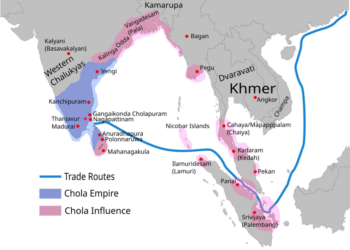
Sanskrit arrived in mainland Southeast Asia with merchants, monks and Brahmins, not conquering armies. Between the first and thirteenth centuries, Cambodia was part of a dense web of trade and religious exchange linking India, Sri Lanka and the Mekong region. Along with textiles and beads came ideas: Hindu and later Buddhist cosmologies, rituals, and the prestigious language used to express them.
For Khmer elites, adopting Sanskrit did not mean becoming “Indian.” It meant tapping into a powerful cultural toolbox: a sophisticated liturgical language, ready-made political concepts and a rich vocabulary for kingship, merit and cosmic order. Old Khmer remained the spoken language of daily life; Sanskrit was the formal, sacred and international register.
The rise of bilingual inscriptions
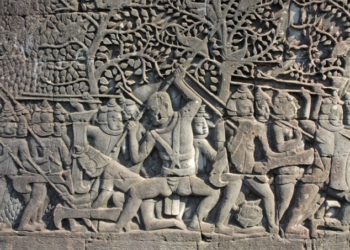
The earliest dated Cambodian inscription, from Angkor Borei around the 7th century, already shows a world where Sanskrit and Old Khmer cohabit. Over the next centuries, hundreds of stelae and lintels were inscribed in pure Sanskrit, pure Old Khmer, or a mixture of both, sometimes even with parallel passages in each language.
Typically, Sanskrit handled grand invocations to gods, royal eulogies and cosmic metaphors, while Old Khmer took care of land grants, lists of offerings and temple staff positions. In short: Sanskrit did the poetry, Khmer did the paperwork — a division of labor that any modern bureaucracy would recognize.
What Sanskrit Did to the Khmer Language
Modern Khmer is often described as having absorbed thousands of Sanskrit and Pali loanwords, especially in religion, administration and scholarship. Estimates vary (and linguists politely argue in footnotes), but the impact on the higher registers of the language is undisputed.
Words related to religion and spirituality provide obvious examples:
- ព្រះ preah (holy, sacred, used as an honorific) from Sanskrit roots for “splendid, exalted.”
- សាសនា sasna (religion) from Sanskrit śāsana (teaching, instruction).
- វិហារ vihea (temple, monastery) from Sanskrit vihāra.
Governmental and scholarly vocabulary is equally rich in Sanskrit origins:
- រដ្ឋ roath (state) from Sanskrit rājya / related political lexicon.
- សេនា sena (army) from Sanskrit sena.
- វិទ្យា vityea (knowledge, science) from Sanskrit vidyā.
Many of these words are now so naturalized that Khmer speakers rarely perceive them as foreign — a bit like French-origin words in English (“government”, “justice”, “university”), except with more palm trees.
From Angkorian stone to modern street
Epigraphic studies show that the proportion and type of Sanskrit loanwords in Khmer evolved over time. Early inscriptions often favored long Sanskrit passages, sometimes in “Prakritized” forms, while later Angkorian texts gradually expanded Khmer usage, peppered with newly borrowed Sanskrit vocabulary.
By the tenth century, inscriptions in Khmer become more frequent and denser in Sanskrit loans, especially in royal administration, temple organization and ritual terminology. Even when full Sanskrit texts decline, the prestige lexicon remains. By the fourteenth century, Khmer had fully replaced Sanskrit as the official language, but the inherited vocabulary stayed.
If you want a concrete, non-epigraphic example, just look at the name of the Mekong. The Khmer form មេគង្គ Mekong can be traced back to Sanskrit elements mahā (great) and gaṅgā (river), via regional intermediaries — essentially “the great Ganga” transplanted to mainland Southeast Asia.
Sanskrit on Stone: Inscriptions and Scripts
Khmer, Sanskrit and the Angkorian stone library
Cambodia is exceptionally rich in inscriptions, with around 1,200 known texts from the 6th to the 19th century, many of them bilingual. Among these, a significant portion is composed entirely in Sanskrit, while others mix Sanskrit and Old Khmer within the same inscription.
These inscriptions document everything from temple foundations to donations, royal genealogies and curses against potential thieves of temple land. Interestingly, some warnings and maledictions are deliberately phrased in Sanskrit for stylistic and rhetorical effect, even when Khmer could have done the job. Apparently, being cursed in Sanskrit carried extra weight.
Brahmi-derived scripts in the Khmer world
Khmer script, first attested in the early 7th century, originates in South Indian forms of the Brahmi script family. The same written system served to record both Old Khmer and Sanskrit, with specific conventions for representing Sanskrit phonology.
Epigraphic and iconographic evidence suggests that Sanskrit texts in Cambodia were also widely transmitted in manuscript form, most likely on palm leaves, following South Indian practice. No pre-modern Sanskrit manuscripts from Cambodia have survived, but inscriptions mention the copying, donation and storage of such texts with a level of care that shows their intellectual prestige.
Where Sanskrit Hides in Cambodia Today
In temples, rituals and daily piety
If you attend a Buddhist ceremony in Cambodia, you are already stepping into a Sanskrit-rich environment, even if the main liturgical language is Pali. Many ritual terms, mantras, and honorifics used around temples are of Sanskrit origin, often transmitted through Pali or older Sanskrit-based practices.
Common temple-related words like វិហារ vihara (temple/monastery) (pronounced [vi-hea] in modern Khmer) and terms for sacred objects, virtues and ceremonies show clear Sanskrit roots, even though their Khmer pronunciation and usage have evolved. In practice, modern Cambodians navigate an overlapping Sanskrit-Pali-Khmer religious lexicon without needing to label each word’s ancestry.
In names, titles and high-register Khmer
Sanskrit is particularly visible in Cambodian personal names and royal titles. Many Khmer names draw on Sanskrit or Pali roots that evoke virtues, auspicious qualities or cosmic concepts, often combined with native Khmer elements.
Royal and honorific titles provide another rich area. From the Angkorian period to the modern monarchy, prestige titles frequently incorporate Sanskrit-derived elements for “glory”, “righteousness”, “protector” or “world ruler”, adapted to Khmer phonology. Even if contemporary speakers do not analyze them etymologically, the elevated tone remains.
Learning Khmer with a Sanskrit Lens (and vice versa)
Why this matters for language learners
For learners of Khmer, recognizing Sanskrit loanwords can make the language feel less arbitrary and more connected to a broader regional history. If you know some Sanskrit or Pali, you will often spot familiar roots in Cambodian religious vocabulary, administrative terms and proper names.
Conversely, for students of Sanskrit and Indian cultural history, Cambodia offers a fascinating case study in how a classical language can be adopted, adapted and partially localized in a non-Indian context, without erasing the local language. The “Sanskrit in Cambodia” story is not about replacement, but about layering.
Practical tips for spotting Sanskrit in Khmer
- Pay attention to religious and temple vocabulary: words linked to sacredness, merit, compassion or meditation often have Sanskrit or Pali ancestry.
- Notice polysyllabic, slightly “ornate” words in formal speeches, royal ceremonies or official documents; many are Sanskrit-based.
- Compare related words: everyday synonyms are often native Khmer, while the higher-register equivalent is Sanskrit-derived.
Several modern projects, including online corpora of Khmer inscriptions and university collaborations, are making these connections more accessible to Cambodian students and researchers. So if you feel an urge to become the family expert on Khmer-Sanskrit etymology, the timing is excellent.
Sanskrit in Cambodia is less a ghost of a dead language than a quiet, persistent presence woven into Khmer vocabulary, royal ideology and religious life. From the earliest Angkorian inscriptions to the words spoken in today’s pagodas and palaces, it has shaped how Cambodians name the sacred, the powerful and the learned — leaving traces that reward anyone curious enough to look and listen closely.
Pascal Médeville is a writer and digital publisher based in Cambodia, where he spends an unreasonable amount of time reading inscriptions, questioning etymologies and drinking iced coffee. He runs “Wonders of Cambodia”, a platform dedicated to Khmer history, culture and language, and often writes about the intersections between ancient texts and contemporary Cambodian life.