Wonders of Cambodia
  • Home
  • Culture
  • Cuisine
  • Tourism
  • Business
  • Life in Cambodia
  • 中文
  • ខ្មែរ
  • Français
  • Tiếng Việt
  • e-Books
No Result
View All Result
  • Home
  • Culture
  • Cuisine
  • Tourism
  • Business
  • Life in Cambodia
  • 中文
  • ខ្មែរ
  • Français
  • Tiếng Việt
  • e-Books
No Result
View All Result
Wonders of Cambodia
No Result
View All Result
Home Culture History

King Ang Duong: Architect of Modern Cambodia’s Survival and Identity

Pascal Medeville by Pascal Medeville
March 18, 2026
in History, Who's who
Reading Time: 6 mins read
0
1958 Cambodian stamps commemorating King Ang Duong

King Ang Duong អង្គឌួង (1796–1860) is one of Cambodia’s most pivotal monarchs, renowned for his efforts to restore, modernize, and defend his kingdom during a period of intense foreign pressure and internal instability. His reign, from 1848 until his death in 1860, laid the groundwork for modern Cambodian governance, legal standards, and national identity, while his diplomatic balancing between neighboring powers and emerging European colonial interests shaped the fate of the kingdom for generations.

Early Life and Background

Born on 12 June 1796 in Oudong, Ang Duong was the son of King Ang Eng and Queen Vara, who was of Thai descent. From an early age, Cambodia was caught between the military and political ambitions of Siam (now Thailand) and Vietnam, each seeking to exert control over the country. This dual vassalage became a defining theme in Ang Duong’s life.

During his youth — especially after age 16 — Ang Duong spent nearly three decades in Bangkok. There he received an education steeped in classical literature, Buddhist principles, and the traditions of both Khmer and Thai courts. His literary aptitude was remarkable: he became known for composing poetry, translating Cambodian folktales like Vorvong & Sorvong into Thai, and even authoring works such as Neang Kakey — the latter remains influential in Cambodian literature and theatre today.

Path to the Throne

The early 19th century was a tumultuous era for Cambodia. The country suffered invasions, civil strife, and a continual struggle between Siam and Vietnam for dominance. The Vietnamese, seeking to colonize and civilize Cambodia according to their own vision, forced the adoption of Vietnamese customs, fueling recurrent rebellion from the Khmer population.

Amid this chaos, Siam and Vietnam eventually agreed to a form of joint hegemony and, after years of war and shifting alliances, Ang Duong was crowned king at Oudong in 1848. His coronation was a rare moment of political consensus and a critical point from which he sought to rebuild the realm.

Political and Administrative Reforms

King Ang Duong’s reign is particularly noted for his drive to centralize authority and modernize Cambodia’s political institutions. Realizing that internal weakness made Cambodia vulnerable to foreign domination, he:

  • Implemented the first major revision of Cambodia’s legal code in centuries, establishing a platform for more consistent governance.
  • Pursued a policy of national unity, working tirelessly to overcome the deep divisions that had plagued the kingdom.
  • Sought to curb the influence of regional governors and the aristocracy, trying to forge a more centralized and assertive administration.

These reforms were instrumental in restoring a measure of internal order — a remarkable achievement considering the kingdom’s dire circumstances.

Cultural Renaissance and Economic Innovation

Beyond governance, Ang Duong is celebrated as a champion of Cambodian culture. He promoted the arts, supervised the revitalization of classical Khmer dance, and fostered the publication of Khmer literature and poetry. His court became a hub for artists, poets, and scholars, contributing to a cultural renaissance after decades of neglect and decline.

Economically, Ang Duong introduced the machine-made Cambodian Tical — a national currency made from precious metals, which streamlined domestic and regional trade. This innovation drew the attention of French observers and distinguished Cambodia’s economy from its neighbors.

Managing Foreign Relations

One of Ang Duong’s greatest challenges was managing Cambodia’s exposure to the ambitions of Siam and Vietnam. Both sought to annex Cambodian territory and assimilate its people culturally and politically. Faced with the reality of exploitative “protection” from both neighbors, Ang Duong adopted a pragmatic strategy:

  • He initially sought Western support to counterbalance regional threats, reaching out to the British in Singapore. When this attempt proved fruitless, he turned to the French.
  • Ang Duong sent secret communications to Napoleon III, proposing some form of protection or alliance that would preserve Cambodia’s sovereignty.

Contrary to assertions from some colonial-era French historians, Ang Duong did not actively seek to subject Cambodia to outright French colonial rule; rather, he hoped for an unequal, yet protective, relationship that would shield Cambodia from being completely absorbed by Siam or Vietnam.

Limitations and Legacy

Despite Ang Duong’s vision and personal energy, his efforts were often hamstrung by the kingdom’s poverty, limited resources, and endemic internal dissent. Rebellions among ethnic minorities, rivalries within the royal family, and continued pressure from neighboring states and colonial powers all sapped his ability to enact lasting change.

Nevertheless, the legacy of Ang Duong’s reign is profound:

  • His sons, King Norodom and King Sisowath, would found the two major branches of Cambodia’s royal family, shaping the nation’s political future.
  • When Ang Duong died in 1860, the groundwork he laid allowed Norodom to negotiate the 1863 Treaty that established Cambodia as a French protectorate, thus — paradoxically — preserving Cambodian identity and autonomy (albeit in constrained form) at a moment when outright annexation by either Siam or Vietnam seemed imminent.

Under French rule, Cambodia survived as a distinct nation rather than being dissolved into its more powerful neighbors. Many historians and modern Cambodians recognize that, without Ang Duong’s foresight, Cambodia’s unique heritage and statehood might not have endured.

Family and Succession

King Ang Duong fathered many children — records indicate at least 18 legitimate sons and daughters with his wives and a much larger number of descendants through concubines and consorts. His legacy was perpetuated through the Norodom and Sisowath dynasties, both central to Cambodian history over the next century.

Commemoration

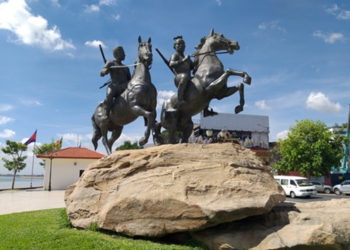
Today, Ang Duong is revered in Cambodia as a symbol of national resilience and a preserver of national identity. Statues, such as the one in Kampot, serve as enduring monuments to his leadership and vision, drawing locals and visitors alike to reflect on Cambodia’s history and the king’s pivotal role within it.
His reign is remembered not only for its reforms and diplomatic balancing acts but for his vision in steering a deeply fragile society toward survival, continuity, and eventual recovery as a nation-state.

Conclusion

King Ang Duong stands as a remarkable figure in Cambodian history: a reformist king, cultural patron, and diplomatic strategist whose actions were crucial to the preservation of Cambodia during one of its darkest eras. Despite formidable obstacles, he reinforced the foundations of Cambodian identity, protected its sovereignty as best he could, and provided a pathway for the kingdom’s continuity under the looming shadow of colonialism. His life and legacy continue to inform Cambodia’s sense of itself and inspire its ongoing efforts to define its place in the world.

Don’t miss our upcoming articles!

We don’t spam!

Check your INBOX or SPAM folder to confirm your subscription.

Tags: 19th century CambodiacambodiaCambodian monarchyhistory of CambodiaKhmer CultureKing Ang Duongnational identity of CambodiaNorodom dynastySisowath dynastySoutheast Asiaអង្គឌួង
ShareTweet
Previous Post

Picture of the day: Globe amaranth

Next Post

Stung Treng Province: The Gateway to Cambodia’s Northern Wilderness

Pascal Medeville

Pascal Medeville

Author of the blog Wonders of Cambodia, I share my passion for Cambodia through stories, cultural insights, and personal reflections on the country. I'm also the founder of Simili Consulting, where we provide high-quality, professional translation services to international clients.

Related Posts

Rows of mature rubber trees in a plantation in Tbong Khmum Province, Cambodia, with a dirt road in the foreground and green vegetation surrounding the estate
History

French Introduction of Rubber Plantations to Cambodia: How Colonial Ambition Changed the Kingdom’s Landscape

July 19, 2026
Stone pyramid temple of Prasat Thom at Koh Ker, Cambodia, seen from the front with steep central stairway and green vegetation covering its tiers.
History

Who’s Who: Jayavarman IV, The King Who Moved Angkor

July 18, 2026
Kai Yuan Tong Bao (開元通寶) Tang dynasty copper‑alloy cash coins, heavily corroded, shown at high magnification in two paired front‑and‑back views with square central holes and partially legible Chinese characters, to document examples found at Angkor
History

History: Chinese Coins Reveal Hidden Stories of Angkor

July 18, 2026
Sideshow by William Shawcross
Books

Book: Sideshow: Kissinger, Nixon and the Destruction of Cambodia

July 7, 2026
Fourteenth century Sukhothai bronze Buddha statue seated cross-legged in meditation, right hand resting on knee, left hand in lap, with flame-like finial on top of the head.
History

Meet the Neighbors: A Short History of the Thai People

July 6, 2026
Black‑and‑white panoramic view of Pre Rup’s upper terrace at Angkor, showing the central stepped sandstone prasat flanked by two smaller brick towers under a dramatic cloudy sky.
History

Rajendravarman II: Warrior-King Who Reunified Angkor and Reshaped the Khmer Empire

July 19, 2026
Next Post
Stung Treng Province: The Gateway to Cambodia’s Northern Wilderness

Stung Treng Province: The Gateway to Cambodia’s Northern Wilderness

  • Trending
  • Comments
  • Latest
The French Protectorate of Cambodia (1863–1953): An Overview

The French Protectorate of Cambodia (1863–1953): An Overview

July 13, 2025
The Franco-Siamese Treaty of 23 March 1907: Borders, Politics, and the Return of Angkor

The Franco-Siamese Treaty of 23 March 1907: Borders, Politics, and the Return of Angkor

February 11, 2026
Cambodian-Vietnamese War (1978-1989)

Cambodian-Vietnamese War (1978-1989)

July 13, 2025
The Legend of Preah Ko Preah Keo: Guardians of Cambodia’s Lost Treasures

The Legend of Preah Ko Preah Keo: Guardians of Cambodia’s Lost Treasures

February 23, 2026
Kampot Province

Takeo Province: A Cradle of Cambodian History and Culture

3
Kratié Town on the Mekong: Colonial Echoes, River Life, and Irrawaddy Dolphins

Kratié Town on the Mekong: Colonial Echoes, River Life, and Irrawaddy Dolphins

3
Banteay Meanchey Province: A Gateway to Cambodia’s Rich Heritage

Banteay Meanchey Province: A Gateway to Cambodia’s Rich Heritage

2
Stung Treng Province: The Gateway to Cambodia’s Northern Wilderness

Stung Treng Province: The Gateway to Cambodia’s Northern Wilderness

2
Sandstone lintel at Prasat Neang Khmao in Takeo, Cambodia, showing a central mythic face flanked by naga bodies, floral scrolls, and tiny seated figures above, carved in 10th century Khmer Koh Ker style on a brick temple façade.

Wonders of Cambodia – Pictures of the Week: Flavors, Heritage and Everyday Beauty (July 13th~July 19th, 2026)

July 20, 2026
出土于吴哥遗址的唐代开元通宝铜钱样本,展示正反两面。钱币为圆形方孔铜钱,表面磨损和锈蚀较为明显,部分铭文仍可辨认,为研究唐代中国与吴哥王朝之间的贸易和文化交流提供了重要考古证据。

吴哥出土的中国古钱币,揭开了一个鲜为人知的历史真相

July 20, 2026
Traditional roasted chicken served at Phnom Chisor, Cambodia, prepared from naturally fed free-range chickens with herbs and local seasonings.

Picture of the day: Phnom Chisor Roasted Chicken: Cambodia’s Natural Flavor

July 20, 2026
Two halves of a ripe red-fleshed dragon fruit on a white plate, showing vibrant magenta flesh dotted with tiny black seeds, with whole dragon fruits in the background.

Dragon Fruit in Cambodia: A Complete Guide to the Kingdom’s Vibrant Superfruit

July 19, 2026

Recent News

Sandstone lintel at Prasat Neang Khmao in Takeo, Cambodia, showing a central mythic face flanked by naga bodies, floral scrolls, and tiny seated figures above, carved in 10th century Khmer Koh Ker style on a brick temple façade.

Wonders of Cambodia – Pictures of the Week: Flavors, Heritage and Everyday Beauty (July 13th~July 19th, 2026)

July 20, 2026
出土于吴哥遗址的唐代开元通宝铜钱样本,展示正反两面。钱币为圆形方孔铜钱,表面磨损和锈蚀较为明显,部分铭文仍可辨认,为研究唐代中国与吴哥王朝之间的贸易和文化交流提供了重要考古证据。

吴哥出土的中国古钱币,揭开了一个鲜为人知的历史真相

July 20, 2026
Traditional roasted chicken served at Phnom Chisor, Cambodia, prepared from naturally fed free-range chickens with herbs and local seasonings.

Picture of the day: Phnom Chisor Roasted Chicken: Cambodia’s Natural Flavor

July 20, 2026
Two halves of a ripe red-fleshed dragon fruit on a white plate, showing vibrant magenta flesh dotted with tiny black seeds, with whole dragon fruits in the background.

Dragon Fruit in Cambodia: A Complete Guide to the Kingdom’s Vibrant Superfruit

July 19, 2026
Wonders of Cambodia

Exploring Culture, Nature, and Spirit in the Land of Wonder.

Follow Us

Browse by Category

  • Architecture
  • Architecture
  • Art
  • Books
  • Business
  • Business
  • Cinema
  • Costume
  • Costume
  • Cuisine
  • Culture
  • Defense
  • Du lịch
  • e-Books
  • Education
  • Expat life
  • Fauna
  • Festival
  • Flora
  • Food providers
  • Français
  • Geography
  • Handicraft
  • Health
  • Histoire
  • History
  • Hotels
  • Khmer Stories
  • Khmer stories
  • Knowledge
  • Language
  • Last posts
  • Lịch sử
  • Life in Cambodia
  • Literature
  • Meet the neigbhors
  • Music
  • Pictures
  • Politics
  • Population
  • Press review
  • Professional services
  • Proverbs
  • Reference
  • Reference
  • Religion
  • Restaurants
  • Temples
  • Textile
  • Tiếng Việt
  • Tourism
  • Tourisme
  • Transport
  • Uncategorized
  • Vidéo
  • Video
  • Vie quotidienne
  • Who's who
  • ខ្មែរ
  • ទេសចរណ៍៖
  • បគ្គលល្បី
  • ប្រវត្តិសាស្ត្រោ
  • សៀវភៅ
  • 中文
  • 书籍
  • 历史
  • 商业
  • 旅游
  • 生活

Recent News

Sandstone lintel at Prasat Neang Khmao in Takeo, Cambodia, showing a central mythic face flanked by naga bodies, floral scrolls, and tiny seated figures above, carved in 10th century Khmer Koh Ker style on a brick temple façade.

Wonders of Cambodia – Pictures of the Week: Flavors, Heritage and Everyday Beauty (July 13th~July 19th, 2026)

July 20, 2026
出土于吴哥遗址的唐代开元通宝铜钱样本,展示正反两面。钱币为圆形方孔铜钱,表面磨损和锈蚀较为明显,部分铭文仍可辨认,为研究唐代中国与吴哥王朝之间的贸易和文化交流提供了重要考古证据。

吴哥出土的中国古钱币,揭开了一个鲜为人知的历史真相

July 20, 2026
  • About Us
  • Advertise
  • Privacy & Policy
  • Contact Us

© 2025 - Made with 💫 by TechFlow.

No Result
View All Result
  • Home
  • Culture
  • Cuisine
  • Tourism
  • Business
  • Life in Cambodia
  • 中文
  • ខ្មែរ
  • Français
  • Tiếng Việt
  • e-Books

© 2025 - Made with 💫 by TechFlow.