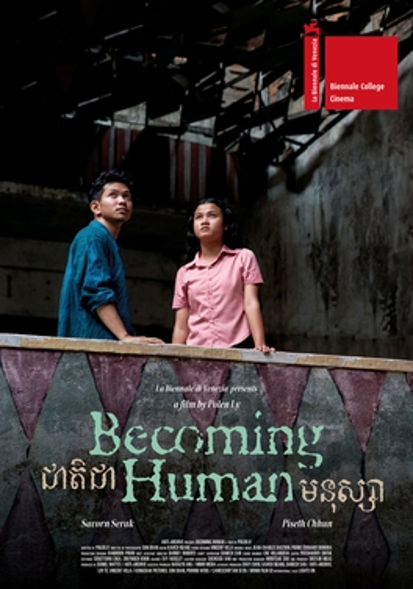
Cambodia has selected Becoming Human (ជាតិជាមនុស្សា) – the first feature film by director Ly Polen – as its official submission for the Best International Feature Film category at the 99th Academy Awards.
The selection is a major moment for Cambodian independent cinema: a micro-budget, Khmer-language production shaped in Battambang that has already travelled from Venice to leading Asian and international festivals.
The Oscar entry does not mean that the film has been nominated. It now enters the Academy’s international-feature selection process, alongside submissions from other countries, with the shortlist and five eventual nominees to be announced later in the awards season.
At the center of Becoming Human is Thida, a spirit guardian associated with an old cinema facing demolition. As the building – and the world she knew – disappears, she must decide whether to seek rebirth as a human or remain a homeless ghost.
Her encounter with Hai, a young man from the living world, creates the film’s emotional bridge between past and present. Their connection unfolds against a Cambodia marked by rapid transformation, uncertainty and the persistent traces of earlier loss.
The film is not designed as a conventional horror story. Its ghost is a vehicle for reflection: on attachment to place, the vulnerability of human lives, and what survives when homes, cinemas, landscapes and communities are altered beyond recognition.
In his director’s statement, Ly Polen explains that the project emerged from a personal and generational question: what does it mean to be human in a country shaped by both trauma and transformation? His parents’ generation lived through genocide; his own has grown up in relative peace, yet continues to witness the loss of homes, livelihoods, voices and natural landscapes through unjust development.
This makes Thida’s haunting more than a supernatural device. She embodies a past that has not simply disappeared, while Hai represents a younger generation also confronted with displacement and uncertainty. Their relationship brings together two fragile lives, separated by time but linked by the need to move forward.
Ly’s idea of “becoming human” is therefore not limited to reincarnation. It is about developing resilience without denying pain and finding hope through care for others. As he puts it, compassion and community can help people move from fragility towards the strength needed to thrive.
Becoming Human had its world premiere at the 82nd Venice International Film Festival in August 2025, in the Biennale College Cinema section. The 99-minute film was subsequently shown at the Busan International Film Festival and the BFI London Film Festival, helping bring a distinctly Cambodian independent production to wider audiences.
The film was produced within the Anti-Archive orbit, part of an increasingly visible Cambodian independent-cinema movement. International sales rights were acquired by Italy’s Lights On before the Venice premiere, giving the production an important route to festival programmers and distributors outside Cambodia.
Its festival journey also brought awards: it received the Golden Hanoman Award and the NETPAC Award at the 2025 Jogja-NETPAC Asian Film Festival in Indonesia.
Critical reaction to Becoming Human has been positive overall, with some reservations about its pace. IndieWire gave Ly Polen’s debut a B-, praising its evocative exploration of memory, identity and place, while comparing its contemplative approach to filmmakers Apichatpong Weerasethakul and Tsai Ming-liang.
Some viewers may also find the film demanding because many of its allusions are left implicit rather than explained. Its references to Cambodian historical trauma, spiritual beliefs, disappearing cinema culture and contemporary displacement give the film depth, but they can be difficult to fully grasp without some familiarity with the country’s history and cultural context.
The film’s atmosphere, visual patience and emotional treatment of displacement have been widely appreciated. At the same time, its slow, indirect narrative may challenge viewers expecting a straightforward ghost story: it works more as a meditative art film than conventional supernatural drama.
Cambodia’s Oscar selection committee, known as COSC, assesses eligible films on story, direction, acting, cinematography, sound, music and universal theme. Where more than one title advances beyond the committee’s first-round vote, members score films across those seven areas to determine the country’s submission.
Choosing Becoming Human signals confidence in a form of cinema that is intimate, poetic and rooted in local experience rather than driven by commercial scale. The production’s small budget and modest crew are central to its achievement, not an obstacle hidden from view.
Ly described the selection as both an honor and a source of encouragement for Cambodian independent filmmakers. He said he hoped it would help inspire the local film community and support more stories from underrepresented communities in Cambodia.
Whether or not it reaches the Academy shortlist, Becoming Human already represents an important step for contemporary Cambodian filmmaking. It takes a familiar Cambodian spiritual world – the guardian spirit, the abandoned building, offerings, rebirth – and places it in dialogue with urgent contemporary concerns about development, memory and belonging.
Its central question is quietly radical: how can people carry the past without being imprisoned by it? Ly Polen’s answer is neither simple optimism nor nostalgia. It lies in the difficult work of recognizing shared fragility and choosing compassion amid constant change.