Estimated reading time: 8 minutes – just enough to finish a coffee before your next temple run.
Jayavarman IV is the Khmer king who dared to turn his back on Angkor and build a rival capital in the jungle at Koh Ker. Was he a usurper, a visionary, or both? Let us sort legend from inscription and see why this “rebel king” deserves a closer look.
Introduction: Meeting the “Rebel” of Angkor
If you enjoy Cambodian history with a bit of intrigue, Jayavarman IV is your man. He ruled in the 10th century, during the Angkor period, and had the audacity to leave the royal city and create his own capital at Koh Ker. For centuries he carried the unflattering label of “usurper king” in many history books. Recent research, however, has started to paint a more nuanced, and frankly more interesting, portrait.
This article is for travelers, curious readers, and Cambodia lovers who want to attach a real human story to those steep pyramids and silent lingas in the forest. If you have walked around Koh Ker and thought “who on earth built this, and why so far from Angkor,” you are in exactly the right place.
By the end, you will know who Jayavarman IV was, why he moved the capital, what he built, and how historians now interpret his legacy. You will also get a few practical angles for visiting Koh Ker with fresh eyes, especially if you are based in Siem Reap and need an excuse to escape the usual circuit.
A king with a complicated family tree
Jayavarman IV (Khmer: ជ័យវរ្ម័នទី៤) ruled part, then all, of the Khmer Empire in the first half of the 10th century, with his effective reign usually given as 928 to 941 CE. He did not initially rule from Angkor but from Koh Ker, known in inscriptions as Chok Gargyar or Lingapura.
He was not a nobody grabbing power out of nowhere. Inscriptions and modern scholarship show that Jayavarman IV was the son of Mahendradevi, a daughter of king Indravarman I, and he married Jayadevi, a half-sister of Yasovarman I. In other words, he was deeply plugged into the royal family, although through a maternal line and a rather intricate marriage that would give any genealogist a mild headache.
Because the Khmer Empire did not follow a simple “eldest son inherits everything” rule, his claim to the throne was ambiguous enough to cause tension, but solid enough that modern historians consider it legitimate. The empire at that time reads like a family WhatsApp group gone wrong: brothers, cousins, uncles, each with a plausible argument and a private army.
For a long time, Jayavarman IV was branded as the dark sheep who usurped power from Angkor. Inscription-based research in recent decades, notably by Cambodian historian Chen Chanratana and others, shows a more refined picture. They argue that he did not simply “steal” the throne but acted within the fuzzy, competitive rules of Angkorian succession.
During part of his life, Jayavarman IV ruled in parallel with other kings based at Angkor, particularly Harshavarman I and Ishanavarman II. Only after Ishanavarman II’s death around 928 did Jayavarman IV become the uncontested ruler. The title “usurper” says more about later historians seeking a clear villain than about the actual political realities of 10th‑century Cambodia.
The Great Move: From Angkor to Koh Ker
Why leave the comfort of Angkor?
One of the most striking facts about Jayavarman IV is that he moved the royal center away from Angkor, to Koh Ker, roughly 100-120 kilometers to the northeast. Imagine a French king deciding that Paris is overrated and relocating the court to a forested plateau in the Massif Central. It was that kind of statement.
Inscriptions record that around 921, before he reigned alone, Jayavarman IV left Yashodharapura (Angkor Thom) and established himself at Chok Gargyar, taking the sacred Devaraja cult with him. Moving the Devaraja, the central royal linga, was a bit like moving both the throne and the national flag. It signaled a serious claim to royal legitimacy and a new center of gravity for the kingdom.
Political strategy and construction fever
Why did he move? The sources are suggestive but not explicit. Scholars highlight several intertwined motives:
- Dynastic conflict in Angkor: Rivalries among Yasovarman I’s sons contributed to instability in the capital, creating an opening for a powerful relative like Jayavarman IV.
- Regional power base: Evidence suggests he already had strong local power in the Koh Ker region before becoming sole king, making the move as much pragmatic as symbolic.
- A grand architectural project: Modern historians argue that he saw Koh Ker as a huge canvas for construction, similar to how Yasovarman I had earlier reshaped Angkor.
In short, this was not a sulky prince running away to sulk in the forest. It was an ambitious king combining politics, religion, and architecture to stamp his mark on the empire.
Koh Ker: The City of Jayavarman IV
Lingapura, “City of the Linga”
At its peak under Jayavarman IV, Koh Ker was more than a single pyramid in the forest. It was a planned capital known as Lingapura, “City of the Linga,” with a network of temples, reservoirs, and satellite sites. Inscriptions mention that during his reign the kingdom counted twelve cities or pura, suggesting a structured political and administrative landscape.
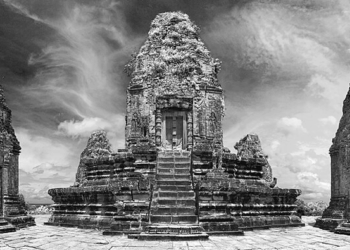
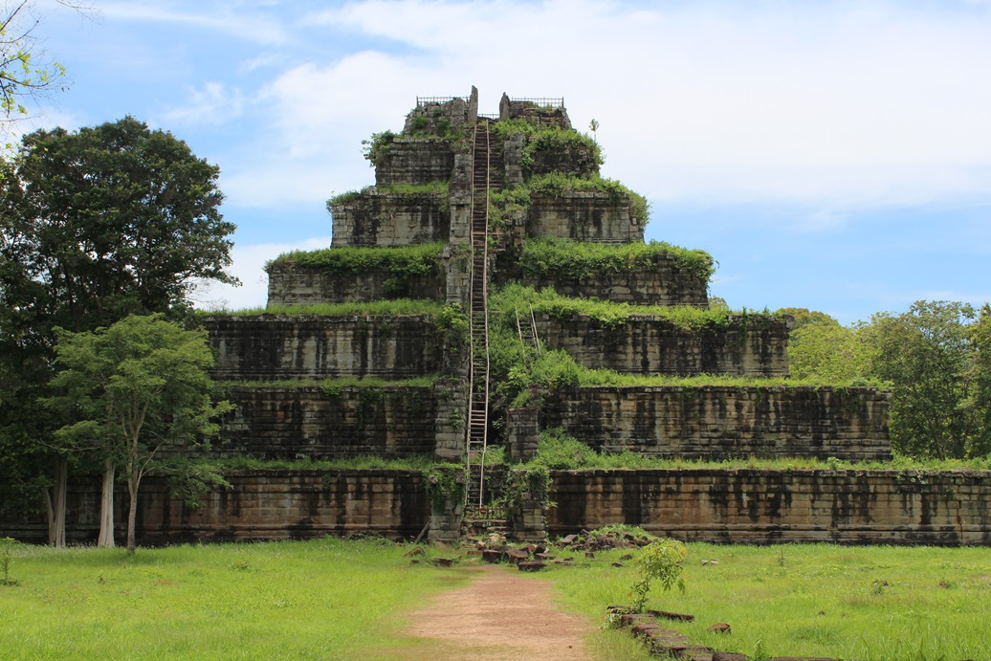
The architecture of Koh Ker is distinctive in the Angkorian world. The site is dominated by a seven‑tier pyramid, Prasat Thom, which probably supported a giant linga at its summit, emphasizing Jayavarman IV’s royal cult. The temples of Koh Ker are famous for their powerful, almost muscular sculptures: large Garuda figures, dynamic warriors, and monumental lingas that seem designed to impress even the most cynical courtier.
A twenty‑year building sprint
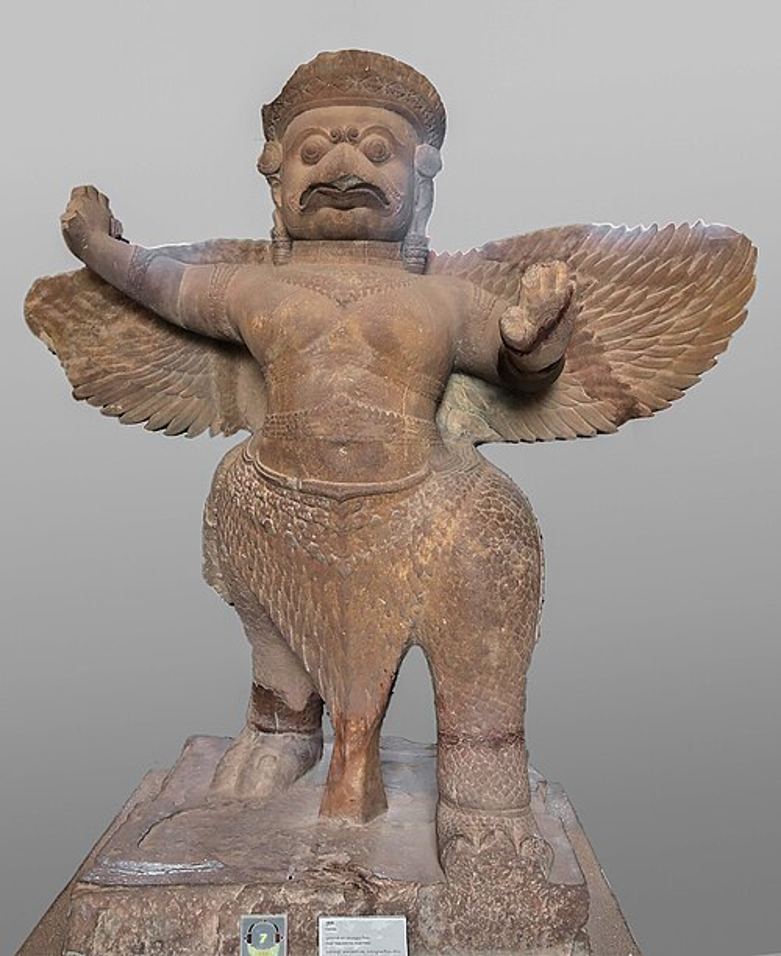
What makes Jayavarman IV particularly impressive is the sheer volume of construction attributed to his relatively short reign. Scholars note that in about two decades, Koh Ker was transformed from a regional center into a royal capital dense with temples and shrines. His inscriptions even boast that his buildings surpass those of earlier kings, which shows that royal humble‑bragging has a long history. Many of the finest and largest Angkorian sculptures known today were produced under Jayavarman IV, including a monumental Garuda now standing at the National Museum in Phnom Penh. Even when later kings moved the capital back to Angkor, the artistic legacy of Koh Ker continued to influence Khmer sculpture and temple decoration.
Jayavarman IV’s Reign and Legacy
Jayavarman IV ruled as sole king from roughly 928 until his death in 941, and he received the posthumous name Paramashivapada. After his death, his son Harshavarman II reigned briefly, still linked to Koh Ker, but his time on the throne was short. Soon afterward, Rajendravarman I, another member of the wider royal family, took power and brought the capital back to Angkor.
From a purely chronological viewpoint, Jayavarman IV’s experiment as a “Koh Ker king” lasted only a few decades. Yet those decades left a permanent imprint on the landscape of Cambodia, and on the history of the Khmer Empire, which reached its high classical phase in later centuries.
From villain to “alternative” founder
Modern epigraphic and archaeological work has given Jayavarman IV a partial rehabilitation. Historians now emphasize:
- His legitimate ties to previous kings through his mother and his marriage.
- The political complexity of the era, with overlapping claims rather than a single clean dynasty.
- The remarkable artistic and urban achievements at Koh Ker.
Instead of a simple usurper, we get an image of a rival heir who created a temporary yet spectacular royal alternative to Angkor. If Angkor Wat is the serene, timeless face of the Khmer Empire, Koh Ker under Jayavarman IV is its bold, experimental phase.
Visiting Koh Ker Today: Following Jayavarman’s Footsteps
From Siem Reap to the “other” capital
For travelers based in Siem Reap, Koh Ker is now a realistic and rewarding day trip, often combined with Beng Mealea or Preah Vihear for the more ambitious. The drive north‑east introduces a different countryside than the flat rice fields around Angkor, and the relative lack of crowds gives the site a quiet, contemplative atmosphere that suits its royal ghost.
Keeping Jayavarman IV in mind changes how you walk the site. Every steep step of Prasat Thom becomes a climb not just to a viewpoint, but into the mind of a 10th‑century king determined to outdo his predecessors. The giant lingas, the bold sculptures, the unusual pyramid shape all make more sense when seen as the visual signature of a monarch who needed to assert himself, fast.
Practical tips with a historical twist
A few simple ways to make the most of Koh Ker in the spirit of Jayavarman IV:
- Read an inscription translation before you go: Even a short overview of the “Jayavarman IV: King Usurper?” scholarship will enrich your visit.
- Look for the power symbols: Pyramidal forms, giant lingas, royal cult temples all speak the language of political legitimacy.
- Compare with Angkor: After seeing Koh Ker, return to Angkor Thom or Pre Rup and notice what feels different in scale, composition, and royal messaging.
History is often written by the winners, but at Koh Ker you are walking inside the brief victory of the “other” king.
Jayavarman IV was long treated as a footnote: a usurper who briefly hijacked Angkorian history. In reality, he was a fully legitimate, if contested, Angkorian king who built a bold alternative capital at Koh Ker and left a lasting artistic legacy. Understanding his life turns a remote temple site into the stage of a royal drama and makes every visit to Koh Ker feel like a private audience with the rebel of Angkor.
Pascal Médeville is a writer and digital publisher based in Cambodia, with a special fondness for Khmer history, forgotten capitals and dusty inscriptions. He writes regularly about the wonders of Cambodia, from Angkor to remote temple cities like Koh Ker, helping readers connect places, people and stories.