Wonders of Cambodia
  • Home
  • Culture
  • Cuisine
  • Tourism
  • Business
  • Life in Cambodia
  • 中文
  • ខ្មែរ
  • Français
  • Tiếng Việt
  • e-Books
No Result
View All Result
  • Home
  • Culture
  • Cuisine
  • Tourism
  • Business
  • Life in Cambodia
  • 中文
  • ខ្មែរ
  • Français
  • Tiếng Việt
  • e-Books
No Result
View All Result
Wonders of Cambodia
No Result
View All Result
Home Cuisine

Dragon Fruit in Cambodia: A Complete Guide to the Kingdom’s Vibrant Superfruit

Pascal Medeville by Pascal Medeville
July 19, 2026
in Cuisine, Flora
Reading Time: 5 mins read
0

Estimated reading time: 8 minutes. Enough time to enjoy a fresh dragon fruit without staining your shirt.

Dragon fruit has become one of Cambodia’s most successful tropical crops, combining striking looks with excellent flavor and impressive health benefits. Whether you are visiting local markets, exploring Cambodian farms, or simply curious about this colorful fruit, this guide explains everything you need to know about dragon fruit in Cambodia, from cultivation and varieties to taste, nutrition, and practical buying tips.
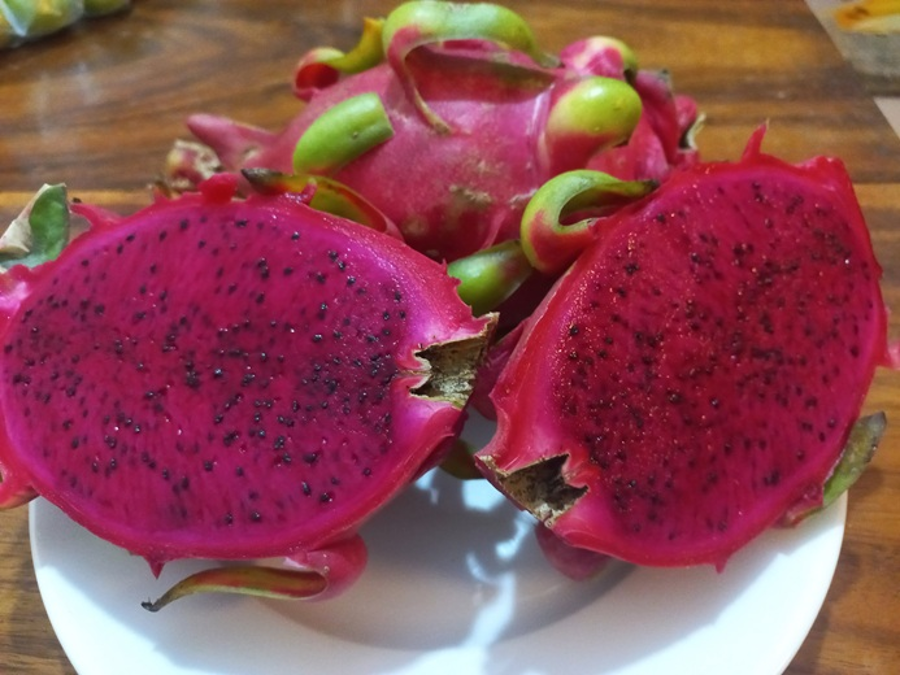
Fresh red-fleshed dragon fruit from Cambodia, bursting with color and natural sweetness (©Pascal Médeville, July 2026, Phnom Penh)

Introduction

Few fruits attract as much attention as dragon fruit. With its bright pink skin, green scales, and almost surreal appearance, it looks more like a creation from a fantasy novel than something growing under the Cambodian sun. Yet this remarkable fruit has become a familiar sight across the Kingdom, where farmers have embraced it as both a profitable crop and a symbol of modern tropical agriculture.

Whether you are a traveler discovering Cambodia’s markets, an expatriate shopping for fresh produce, or simply a fruit enthusiast, understanding dragon fruit helps you appreciate one of Southeast Asia’s most successful agricultural stories. From choosing the ripest fruit to learning why Cambodia’s growing conditions are so favorable, there is much more to dragon fruit than its unforgettable appearance.

Why Dragon Fruit Thrives in Cambodia

Dragon fruit, also known as pitaya or pitahaya, known in Khmer as “srâka neak” (ស្រកានាគ, literally “dragon’s scales”) belongs to the cactus family. Although many people associate cacti with deserts, this climbing cactus flourishes in tropical climates with warm temperatures, moderate rainfall, and abundant sunshine.

Cambodia offers almost ideal growing conditions. Provinces such as Battambang, Kampong Cham, Siem Reap, and parts of Kandal have become important production areas, where farmers cultivate dragon fruit alongside traditional crops.

Unlike some fruit trees that require years before becoming productive, dragon fruit plants begin producing relatively quickly. Once mature, they can deliver several harvests each year, making them an attractive investment for local growers seeking crop diversification.

The Main Dragon Fruit Varieties

The most common variety features brilliant pink skin with white flesh speckled with tiny black seeds. It offers a refreshing, mildly sweet flavor that many people compare to kiwi and pear.

Red-fleshed dragon fruit is sweeter, richer in antioxidants, and famous for leaving memorable stains on white clothing. There is also a yellow-skinned variety, also with white flesh speckled with tiny black seeds. Its flavor is very similar to the variety with pink skin and white flesh.
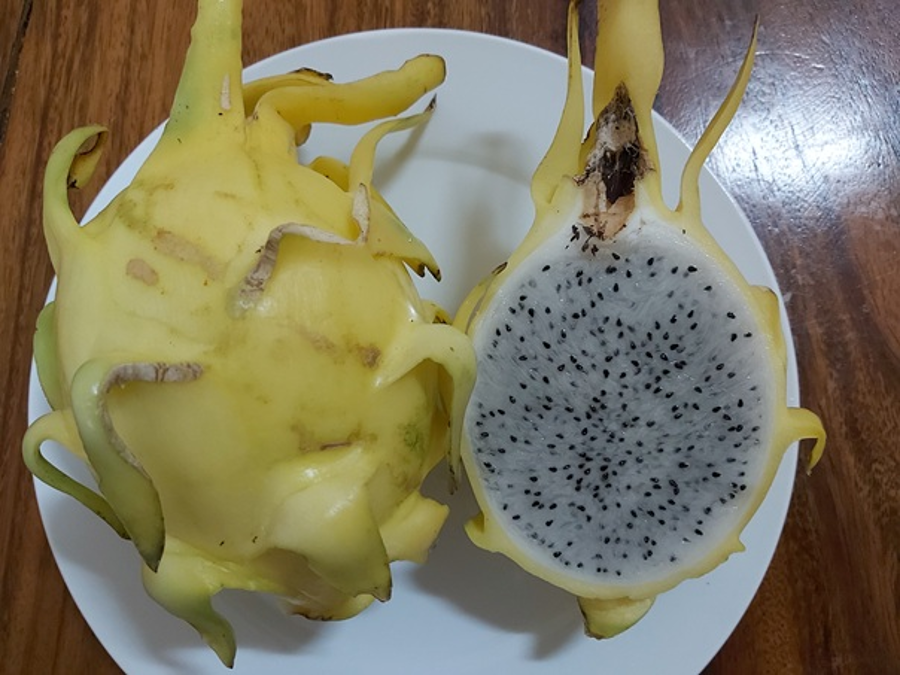
Yellow dragon fruit from Cambodia, revealing its sweet white flesh speckled with tiny black seeds (©Pascal Medeville, June 2022, Phnom Penh)

How Dragon Fruit Is Grown

Dragon fruit grows on climbing cactus vines supported by concrete or wooden posts. Farmers prune and train the branches to maximize sunlight and simplify harvesting.

Harvest Season in Cambodia

Peak harvest generally runs from May to October, although irrigation and modern techniques allow production during much of the year.

How to Choose the Best Dragon Fruit

Select fruits with bright skin, fresh green scales, slight softness, and no bruises or wrinkles.

How Does Dragon Fruit Taste?

Its flavor is delicate, refreshing, and lightly sweet, with a texture somewhere between kiwi and ripe pear.

Nutritional Benefits

Dragon fruit provides vitamin C, fiber, magnesium, potassium, iron, antioxidants, and plenty of hydration while remaining low in calories.

Popular Ways to Enjoy Dragon Fruit

Eat it fresh, blend it into smoothies, add it to fruit salads, desserts, or breakfast bowls.

Dragon Fruit Farming and Cambodia’s Economy

Dragon fruit has become an increasingly valuable commercial crop, helping Cambodian farmers diversify income and expand export opportunities.

Visiting Dragon Fruit Farms

Several farms around Battambang and Siem Reap welcome visitors interested in seeing cultivation and harvesting methods.

Tips for Storing Dragon Fruit

Store whole fruit at room temperature for several days or refrigerate once ripe. Consume cut fruit within two to three days.

Conclusion

Dragon fruit has become one of Cambodia’s agricultural success stories, combining beauty, nutrition, and economic opportunity. Whether purchased at a local market or enjoyed in a smoothie, it is one of the Kingdom’s most rewarding tropical fruits.

About the author

Pascal Médeville is a writer and digital publisher based in Cambodia. He specializes in Cambodian culture, agriculture, travel, and local gastronomy, helping readers discover the country’s remarkable places, traditions, and products through informative and engaging articles.

Don’t miss our upcoming articles!

We don’t spam!

Check your INBOX or SPAM folder to confirm your subscription.

Tags: Cambodia agricultureCambodian fruitsCambodian local produceCambodian marketsdragon fruit Cambodiahealthy fruitspitayatropical fruitស្រកានាគ
ShareTweet
Previous Post

French Introduction of Rubber Plantations to Cambodia: How Colonial Ambition Changed the Kingdom’s Landscape

Pascal Medeville

Pascal Medeville

Author of the blog Wonders of Cambodia, I share my passion for Cambodia through stories, cultural insights, and personal reflections on the country. I'm also the founder of Simili Consulting, where we provide high-quality, professional translation services to international clients.

Related Posts

Brown clay pot filled with Cambodian sausage, two eggs, diced potatoes, and chopped onion, served on a woven rattan stand at a Phnom Penh café breakfast setting.
Cuisine

Picture of the day: Clay Pot Cambodian Breakfast in Phnom Penh

July 18, 2026
Bowl of Cambodian kako tnaot soup with palm fruit, fish, and leafy greens in a creamy broth on a woven mat, traditional Khmer comfort food
Cuisine

Picture of the day: Kako Tnaot, A Comforting Cambodian Palm Fruit Soup

July 16, 2026
Close up of a white plate filled with Cambodian stir fried momordica bitter melon slices mixed with scrambled egg pieces, captured from above on a wooden table.
Cuisine

Picture of the day: Bitter melon and egg stir fry

July 14, 2026
Close-up of several bright green winged bean pods on a white plate, showing their distinctive frilled edges and glossy surface.
Cuisine

Winged Bean in Cambodia: Discovering ពពាយ (Psophocarpus tetragonolobus), the Forgotten Super Vegetable

July 12, 2026
Close-up of white tuberose (Polianthes tuberosa, ចន្ធូ) buds on green stems in Cambodia against a dark background, highlighting their smooth texture and emerging blossoms.
Flora

Picture of the day: Tuberose Blossoms in Cambodia

July 12, 2026
Close-up of Cambodian stir-fried winged beans with sliced pork on a white plate, glistening with light sauce and showing crisp green texture and home-style presentation.
Cuisine

Picture of the day: Winged Bean Sautéed with Pork in Cambodia

July 12, 2026

Leave a Reply Cancel reply

Your email address will not be published. Required fields are marked *

  • Trending
  • Comments
  • Latest
The French Protectorate of Cambodia (1863–1953): An Overview

The French Protectorate of Cambodia (1863–1953): An Overview

July 13, 2025
The Franco-Siamese Treaty of 23 March 1907: Borders, Politics, and the Return of Angkor

The Franco-Siamese Treaty of 23 March 1907: Borders, Politics, and the Return of Angkor

February 11, 2026
Cambodian-Vietnamese War (1978-1989)

Cambodian-Vietnamese War (1978-1989)

July 13, 2025
The Legend of Preah Ko Preah Keo: Guardians of Cambodia’s Lost Treasures

The Legend of Preah Ko Preah Keo: Guardians of Cambodia’s Lost Treasures

February 23, 2026
Kampot Province

Takeo Province: A Cradle of Cambodian History and Culture

3
Kratié Town on the Mekong: Colonial Echoes, River Life, and Irrawaddy Dolphins

Kratié Town on the Mekong: Colonial Echoes, River Life, and Irrawaddy Dolphins

3
Banteay Meanchey Province: A Gateway to Cambodia’s Rich Heritage

Banteay Meanchey Province: A Gateway to Cambodia’s Rich Heritage

2
Stung Treng Province: The Gateway to Cambodia’s Northern Wilderness

Stung Treng Province: The Gateway to Cambodia’s Northern Wilderness

2
Two halves of a ripe red-fleshed dragon fruit on a white plate, showing vibrant magenta flesh dotted with tiny black seeds, with whole dragon fruits in the background.

Dragon Fruit in Cambodia: A Complete Guide to the Kingdom’s Vibrant Superfruit

July 19, 2026
Rows of mature rubber trees in a plantation in Tbong Khmum Province, Cambodia, with a dirt road in the foreground and green vegetation surrounding the estate

French Introduction of Rubber Plantations to Cambodia: How Colonial Ambition Changed the Kingdom’s Landscape

July 19, 2026
Decorative lintel of a modern pagoda near Phnom Chisor temple showing a seated Buddha framed by elaborate turquoise naga carvings and floral Khmer motifs above a doorway.

Picture of the day: Naga Guardian Lintel at Phnom Chisor Pagoda

July 19, 2026
Stone pyramid temple of Prasat Thom at Koh Ker, Cambodia, seen from the front with steep central stairway and green vegetation covering its tiers.

Who’s Who: Jayavarman IV, The King Who Moved Angkor

July 18, 2026

Recent News

Two halves of a ripe red-fleshed dragon fruit on a white plate, showing vibrant magenta flesh dotted with tiny black seeds, with whole dragon fruits in the background.

Dragon Fruit in Cambodia: A Complete Guide to the Kingdom’s Vibrant Superfruit

July 19, 2026
Rows of mature rubber trees in a plantation in Tbong Khmum Province, Cambodia, with a dirt road in the foreground and green vegetation surrounding the estate

French Introduction of Rubber Plantations to Cambodia: How Colonial Ambition Changed the Kingdom’s Landscape

July 19, 2026
Decorative lintel of a modern pagoda near Phnom Chisor temple showing a seated Buddha framed by elaborate turquoise naga carvings and floral Khmer motifs above a doorway.

Picture of the day: Naga Guardian Lintel at Phnom Chisor Pagoda

July 19, 2026
Stone pyramid temple of Prasat Thom at Koh Ker, Cambodia, seen from the front with steep central stairway and green vegetation covering its tiers.

Who’s Who: Jayavarman IV, The King Who Moved Angkor

July 18, 2026
Wonders of Cambodia

Exploring Culture, Nature, and Spirit in the Land of Wonder.

Follow Us

Browse by Category

  • Architecture
  • Architecture
  • Art
  • Books
  • Business
  • Business
  • Cinema
  • Costume
  • Costume
  • Cuisine
  • Culture
  • Defense
  • Du lịch
  • e-Books
  • Education
  • Expat life
  • Fauna
  • Festival
  • Flora
  • Food providers
  • Français
  • Geography
  • Handicraft
  • Health
  • Histoire
  • History
  • Hotels
  • Khmer Stories
  • Khmer stories
  • Knowledge
  • Language
  • Last posts
  • Lịch sử
  • Life in Cambodia
  • Literature
  • Meet the neigbhors
  • Music
  • Pictures
  • Politics
  • Population
  • Press review
  • Professional services
  • Proverbs
  • Reference
  • Reference
  • Religion
  • Restaurants
  • Temples
  • Textile
  • Tiếng Việt
  • Tourism
  • Tourisme
  • Transport
  • Uncategorized
  • Vidéo
  • Video
  • Vie quotidienne
  • Who's who
  • ខ្មែរ
  • ទេសចរណ៍៖
  • បគ្គលល្បី
  • ប្រវត្តិសាស្ត្រោ
  • សៀវភៅ
  • 中文
  • 书籍
  • 历史
  • 商业
  • 旅游
  • 生活

Recent News

Two halves of a ripe red-fleshed dragon fruit on a white plate, showing vibrant magenta flesh dotted with tiny black seeds, with whole dragon fruits in the background.

Dragon Fruit in Cambodia: A Complete Guide to the Kingdom’s Vibrant Superfruit

July 19, 2026
Rows of mature rubber trees in a plantation in Tbong Khmum Province, Cambodia, with a dirt road in the foreground and green vegetation surrounding the estate

French Introduction of Rubber Plantations to Cambodia: How Colonial Ambition Changed the Kingdom’s Landscape

July 19, 2026
  • About Us
  • Advertise
  • Privacy & Policy
  • Contact Us

© 2025 - Made with 💫 by TechFlow.

No Result
View All Result
  • Home
  • Culture
  • Cuisine
  • Tourism
  • Business
  • Life in Cambodia
  • 中文
  • ខ្មែរ
  • Français
  • Tiếng Việt
  • e-Books

© 2025 - Made with 💫 by TechFlow.