History in Cambodia is not simply a sequential record to be studied in dusty books; it is a palpable presence that still resonates in the forests, the villages, and the stones of temples battered by centuries of monsoon. To approach Cambodian history is to accept a tapestry woven of light and shadow—moments of radiant civilization and cultural abundance, tragically interlaced with long intervals of silence, obscurity, and foreign dominion. It is a history profoundly tied to the Mekong, to rice, to the rhythm of the rains, and to the devotion of a people whose endurance has outlasted empires.
This introduction will not attempt to compress all the complexities of Cambodian history into a rigid chronology, but rather unfold it as a living narrative, attentive to continuity as much as to rupture. The journey begins in antiquity, with the dawn of civilizations that flourished in the lands between India and China, and it progresses through Angkor’s monumental achievements, the centuries of decline and recolonization, the tumult of the twentieth century, and the quiet resilience of the Cambodia that stands today.

The Beginnings: Early Cultures and Indian Influence
Cambodia, like its neighbors, lies upon a cultural and geographical crossroads. To the north, China exerted its influence through trade routes and migrating communities. From the west and the south, across the waters of the Indian Ocean, came merchants, priests, and adventurers from India, bearing with them religious texts, epics, and political ideas. In this fertile basin of exchange, local Khmer groups absorbed and refashioned foreign traditions.
Archaeology shows that early communities along the Mekong cultivated rice and engaged in bronze work from as far back as 1500 BCE. By the first centuries CE, more complex chiefdoms and small kingdoms emerged—such as Funan, often regarded as the first pre-Angkorian polity. Funan became known to Chinese observers who described it as a maritime power, prospering from coastal trade. Whether Funan was a centralized kingdom or rather a loose confederation remains debated, but its importance lies in being the first stage of state formation in Cambodia.
In Funan and in its successor, Chenla, Indian ideas seeped into the Khmer mind. Sanskrit inscriptions, Hindu deities, and Buddhist teachings arrived, not to displace Khmer culture, but to mingle with it. Kings modeled themselves as god-kings, divine rulers endowed with cosmic legitimacy. Temples rose to honor Shiva, Vishnu, and the Buddha, but always embedded in a distinctly Khmer landscape of rice fields, rivers, and mountains.
Angkor: The Radiance of Empire
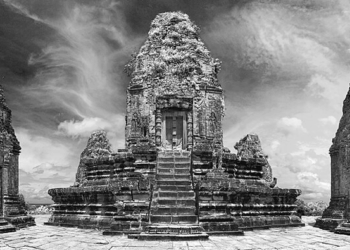
To evoke Cambodian history without Angkor is unthinkable, like describing Egypt without the Nile. From the 9th to the 15th century, Angkor was the greatest manifestation of Khmer power and imagination, a civilization that left behind cityscapes and temples so vast that even today they inspire awe and disbelief.
Founded by King Jayavarman II in 802 CE after uniting fragmented chiefdoms, the Khmer Empire grew into a dominion stretching far beyond present Cambodia, reaching into Thailand, Laos, and Vietnam. Angkor became its beating heart. Each successive ruler added to the grandeur: canals to irrigate rice, reservoirs (barays) that shimmered like inland seas, palaces, and grand temples that seem less built than dreamed.
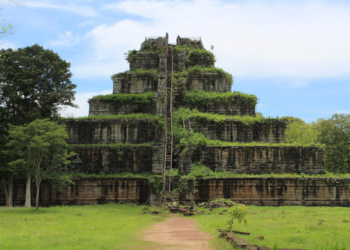
At the center stands Angkor Wat, that eternal sunrise in stone. Originally a Hindu temple dedicated to Vishnu, it later embraced Buddhist devotion, embodying Cambodia’s capacity for continuity amid change. Angkor Thom, Bayon, Ta Prohm—each site carries a distinct voice, whether the enigmatic smiles of the Bayon’s stone faces or the tree roots coiling over Ta Prohm like memory reclaiming matter.
Angkor was not only architecture: it was water mastery. The Khmer redirected rivers and carved an engineered landscape capable of sustaining millions. This agricultural abundance underpinned military strength and cultural florescence. Poets, sculptors, and scholars flourished at court, leaving inscriptions that detail royal deeds, cosmological visions, and daily life.
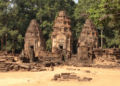
Yet, magnificence carries fragility. After centuries of dominance, the empire faced external invasions and internal strain. By the 15th century, Angkor fell to Siamese armies. The Khmer court retreated south, nearer to Phnom Penh, leaving their stone masterpieces abandoned to the jungle. Angkor entered silence, but never oblivion.
The Era of Decline and Fragmentation
The centuries following Angkor are often termed Cambodia’s “dark age.” Fragmented polities, shifting allegiances, and foreign interventions confined Khmer sovereignty to narrow limits. Hemmed in by stronger neighbors—Siam to the west, Vietnam to the east—Cambodia struggled to preserve autonomy.
Phnom Penh emerged as a strategic trading center on the Mekong-Tonlé Sap confluence, but the kingdom remained vulnerable. Court politics turned unstable; royal succession was contested; neighbors exploited divisions. At times Cambodia fell under Siamese suzerainty; at other times Vietnamese influence prevailed. This oscillation endured for centuries, eroding the once-mighty kingdom into a small buffer state.
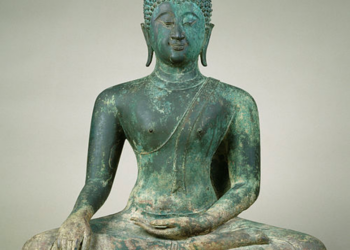
Yet even in decline, culture survived. Buddhism, which replaced Angkor’s Hindu cults as the state religion, became both anchor and refuge. Monasteries preserved learning; monks ensured literacy in Pali and Khmer; pagodas became centers of village cohesion. Despite foreign pressures, Khmer society endured through its religious and agricultural resilience.
Colonial Cambodia: The French Protectorate
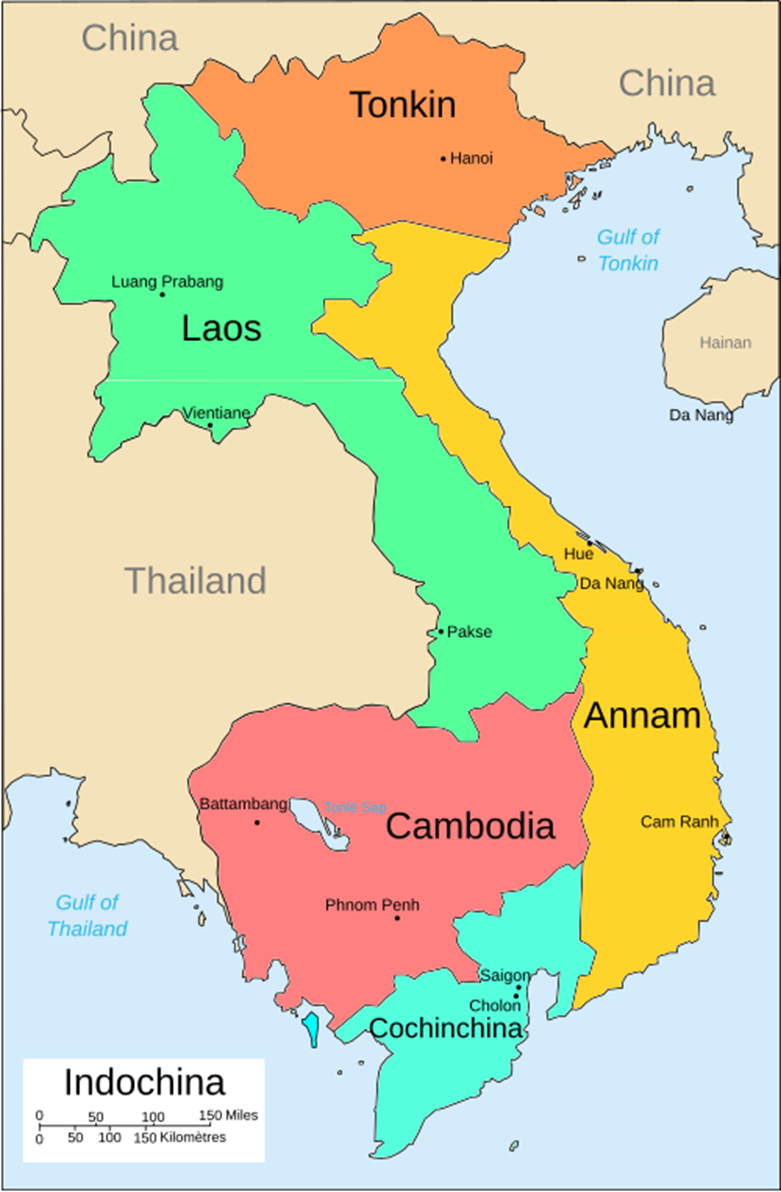
By the mid-19th century, Cambodia was on the brink of disappearance, squeezed by Siam and Vietnam. In 1863, King Norodom sought French protection. Thus began nearly a century of French colonial rule, formally ending only in 1953.
Colonialism, as always, arrived with paradox. France proclaimed itself the protector of Khmer sovereignty, but in practice Cambodia became subject to the paternalistic management of Paris. Administrators reorganized revenue, imposed taxes, and inevitably sought to mold Cambodian institutions in Europe’s image.
At the same time, French scholars rediscovered Angkor. Archaeologists from the École française d’Extrême-Orient cleared, catalogued, and restored temples, branding Angkor as France’s gem in Asia even as living Cambodians struggled under colonial rule. Railroads, schools, and modern bureaucracy were introduced, though literacy remained confined and economic exploitation deep.
Yet colonial rule inadvertently created the grounds for modern nationalism. Exposure to French ideas of liberty and revolution, combined with resentment against foreign domination, awakened intellectuals. By the early 20th century, Cambodian voices began calling for independence.
Independence and Sihanouk’s Era
Independence came in 1953 through the charismatic leadership of King Norodom Sihanouk. He transformed himself into the symbol of modern Cambodia, steering the nation away from French control. For a fleeting moment in the 1950s and 1960s, Cambodia enjoyed peace, neutrality, and cultural revival. Phnom Penh’s boulevards bustled with cinemas, cafés, and universities. Cambodian music blended traditional melodies with Western rock, creating a golden age still fondly remembered.
But destiny was unkind. Cambodia’s position, squeezed amid Cold War rivalries and Vietnam’s escalating conflict, brought turmoil. Sihanouk’s attempt to preserve neutrality faltered under political pressures. In 1970, a coup removed him, installing General Lon Nol and aligning Cambodia closer to the United States. The once-stable countryside collapsed into war.
The Khmer Rouge Tragedy
Few chapters in world history equal the horror of Cambodia’s 1975–1979 ordeal under the Khmer Rouge. Led by Pol Pot, this radically Maoist movement seized Phnom Penh with promises of revolution but delivered an apocalypse.
The Khmer Rouge evacuated cities, abolishing money, markets, schools, and religion. They sought to recreate Cambodia as a self-sufficient agrarian utopia, enforcing it through terror. Intellectuals, monks, teachers, and even children suspected of dissent were executed. Almost two million Cambodians perished from execution, starvation, disease, and forced labor. The social fabric torn apart under Angkor’s stones now ripped anew.
Cambodia emerged from those years traumatized, its people decimated, its memory scarred. In 1979, Vietnamese forces invaded and toppled the regime, but recovery was slow and difficult. For a decade, civil war raged between opposing factions, and the nightmare of landmines haunted the countryside.
The Road to Recovery
The Paris Peace Accords of 1991 reopened the path to peace. The United Nations Transitional Authority supervised elections in 1993, restoring monarchy under Norodom Sihanouk as king. Despite political turbulence, Cambodia gradually stabilized. Phnom Penh revived; schools reopened; the wheel of daily life resumed its ordinary rhythm of markets, pagodas, and rice harvests.
Today, Cambodia carries two souls: the imprints of its tragic recent past, and the deeper continuity of Khmer civilization stretching back millennia. Angkor, long forgotten in the jungle, now stands as both a global heritage site and a source of national pride. Tourism flourishes, though with risks of commodification. Urban youth embrace new cultures even as rural life continues much as it did centuries ago. Above all, Cambodia endures.
Continuity and Identity
To interpret Cambodian history is to discover continuity amidst rupture. The Mekong still floods and retreats, dictating the rice cycle. The pagoda bell still tolls, calling villagers to merit-making. The Apsara dancer’s gestures still retrace sacred narratives passed down from Angkor’s bas-reliefs.
But alongside this resilience lies fragility: the memory of domination by neighbors, the trauma of the Khmer Rouge, the precariousness of modern development. Cambodia’s identity remains a synthesis of survival and renewal. The Khmer genius lies in taking the fragments of devastation and constructing, once more, a living culture.
Conclusion: Facing the Future with Memory
An introduction to Cambodian history cannot be exhaustive, but it must convey this essential truth: Cambodia is much more than Angkor’s temples, much more than the tragedy of the Khmer Rouge. Its history is a continuum of adaptation, negotiation, struggle, and creation. Every village rice field, every pagoda courtyard, every market stall is inscribed with this legacy.
In the quiet evenings after the monsoon rain, when the red dust of the countryside settles and cicadas hum, one feels how deeply history permeates the land. It is not in the abstract figures of kings alone but in the unbroken rhythm of the Khmer people—their persistent labor, their songs, their festivals, and their faith.
Cambodia’s destiny, like its past, will always oscillate between light and shadow. Yet the endurance that allowed a people to outlast empires, colonial rule, and unimaginable tragedy may well sustain them as they craft their 21st-century future.