
Introduction
Jayavarman II (Khmer: ជ័យវរ្ម័នទី២) (ca.770-850) is widely regarded as the founder of the Khmer Empire, a civilization that flourished in Southeast Asia and reached its zenith between the 9th and 15th centuries. Revered as the man who unified Cambodia and established its enduring capital at Angkor, Jayavarman II is a pivotal figure whose legacy shaped Cambodian identity, religious life, and monumental architecture for centuries to come. His reign set the political, spiritual, and cultural foundations upon which the legendary Khmer civilization was built, including the spectacular temples of Angkor Wat.
Early Life and Rise to Power
The formative years of Jayavarman II remain veiled in mystery. Most historical accounts derive from later inscriptions and royal chronicles rather than contemporaneous documentation. He is believed to have been born in the region that would become Cambodia, possibly in the late 8th century, at a time when the area was fragmented among various competing polities such as Chenla and was under strong influence from neighboring Java (modern-day Indonesia). Some sources suggest he spent time in Java, either as a prisoner or as someone who sought education and military training, before returning to Cambodia to seize power.
Jayavarman II’s rise reflects the tumultuous climate of 8th-century Southeast Asia, marked by both internal division and external threats. Regional rulers vied for dominance, leading to periods of instability and localized rule. Jayavarman II emerged as a unifying force during this era of fragmentation.
The Unification of Cambodia
Upon his return to Cambodia, Jayavarman II launched a series of military campaigns to assert control over scattered principalities and independent rulers. Through conquest, diplomacy, and strategic alliances, he gradually consolidated his rule. He is credited with subduing various regions, including Vyadhapura, Sambhupura, and possibly Water Chenla, eventually declaring himself sovereign over a unified Cambodian kingdom.
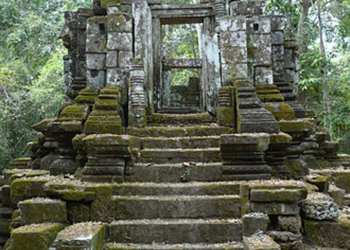
To strengthen his authority and distance his rule from foreign influence, Jayavarman II relocated his capitals several times — first at Indrapura (modern-day Kampong Cham), then at Hariharalaya (the site of present-day Roluos near Siem Reap), and eventually at Mahendraparvata on the Phnom Kulen plateau. This last move had great symbolic significance, as the sacred mountain became associated with royal authority and religious legitimacy.
The Devaraja Cult
One of Jayavarman II’s most enduring contributions was the establishment of the Devaraja (God-King, Khmer: ទេវរាជ) cult. In 802 CE, at Mahendraparvata, he performed an elaborate ritual conducted by Brahmin priests, declaring himself a universal monarch (chakravartin) and the earthly embodiment of Shiva, the supreme Hindu deity. This ceremony, which signaled the end of political fragmentation, was not only a religious act but also a strategic move to legitimize the king’s divine right to rule.
The Devaraja cult became the ideological cornerstone of Khmer kingship, fusing Hindu divine kingship concepts with indigenous Cambodian political traditions. It mandated that the king was both a temporal and a spiritual leader, divinely ordained to rule and protect his people. The establishment of this cult fostered loyalty among the populace and provided a framework for royal authority that persisted for centuries.
Architectural and Cultural Legacy
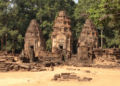
Though Jayavarman II was not directly responsible for the grand temples and urban developments that epitomized the Angkorian era, he laid the essential groundwork. His relocation of the royal capital to the northwestern part of Cambodia, particularly at Hariharalaya and Phnom Kulen, presaged the later construction of the Angkor complex. Temples such as Preah Ko, Bakong, and Lolei — built by his successors — trace their architectural lineage to his reign.
Jayavarman II’s rule encouraged the sponsorship of large-scale irrigation works, which enabled the intensification of rice agriculture and supported a growing population. This agricultural surplus was vital for sustaining Angkor’s monumental construction and urban expansion, ushering in a golden age for Khmer civilization. Additionally, the adoption of Sanskrit and Khmer as languages of administration and religious discourse can be traced to reforms initiated during his reign.
Relations with Java and Regional Dynamics
Jayavarman II’s purported connections with Java have been the subject of much scholarly debate. While some early colonial historians imagined Jayavarman II as a liberator from Javanese suzerainty, more recent interpretations suggest a complex interaction between the two regions. The influences visible in Khmer art and architecture, especially in early temple construction, point to both exchange and adaptation rather than outright domination.
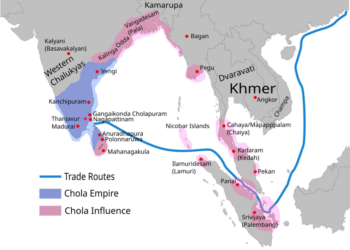
The wider context of Southeast Asian maritime and overland trade meant that Jayavarman II’s Cambodia was integrated into regional networks. The assimilation of Hindu and Buddhist ideas via trade and migration reflected the cosmopolitan nature of the period, as the Khmer kingdom developed a unique synthesis of indigenous and Indianized cultural elements.
Legacy and Historical Significance
Jayavarman II reigned for several decades, dying sometime in the mid-9th century. His legacy was not merely in military conquest or statecraft; he transformed the nature of Cambodian kingship. The Devaraja cult and the religious-political model he legitimized were adopted and expanded by his successors, enabling the construction of the temples and monumental cities for which the Khmer Empire became renowned.
Without Jayavarman II’s unifying vision, there likely would have been no Angkor Wat or Bayon, no golden age of Khmer art and architecture. His successors — Indravarman I, Yasovarman I, Suryavarman II, and Jayavarman VII — built upon his foundations, creating vast urban landscapes supported by advanced hydraulic systems and adorned with temples that celebrated the divinity of the king.
Jayavarman II is remembered in Cambodian history as the “first of the great Angkorian kings,” his reign marking the commencement of an era that would shape Cambodian culture, religion, and national consciousness well into the modern era. He is regarded not only as a political unifier but as a cultural and spiritual architect whose impact echoes in Cambodian identity to this day.
Conclusion
Jayavarman II’s life and reign stand as a watershed in Southeast Asian history. By unifying a fragmented land, legitimizing centralized rule through religious innovation, and laying the physical and ideological groundwork for the Angkorian civilization, he transformed Cambodia into one of the greatest powers of pre-modern Asia. The grandeur of Angkor, the legacy of the Devaraja cult, and the enduring sense of Cambodian cultural unity can all be traced to the vision and actions of Jayavarman II.