(Estimated reading time: 8 minutes – just enough to follow Preah Leak into exile and back, without missing your coffee.)
Preah Leak, the devoted brother of Preah Ream in the Cambodian Reamker, is everywhere and nowhere at once: on temple walls, in classical dance, in shadow theatre, yet rarely center stage. This article explores who Preah Leak is, why he matters, and how his quiet loyalty shapes Cambodia’s version of the Ramayana.
Introduction: The Brother Who Holds the Story Together
Ask most Cambodians about the Reamker and they will name Preah Ream, Neang Seda and Hanuman long before they mention Preah Leak. Yet this younger brother walks every step of the exile, shares the dangers of the forest, and stands on the battlefield at Lanka. Without him, the story would lose much of its emotional depth and moral balance.
This article is for readers who want to go beyond “Rama, Sita and the monkey army” and understand how the Khmer adaptation of the Ramayana gives a distinctive role to the younger brother, Preah Leak. Whether you are a student, a researcher, a fan of mythology or simply curious about Cambodian culture, you will find here a compact guide to his character, symbolism and presence in Cambodian arts.
We will look at who Preah Leak is in the Reamker narrative, how he differs from the Indian Lakshmana, where you can actually see him in sculpture and performance, and why he is a perfect entry point into Cambodian ideas of loyalty, duty and brotherhood.
Who Is Preah Leak in the Reamker?
Younger Brother, Constant Companion
In the Reamker, Preah Leak (Khmer: ព្រះលក្ស្មណ៍, known as Lakshmana in the Ramayana) is the younger or half‑brother of Preah Ream, the Cambodian Rama. When court intrigue sends Preah Ream into exile, Preah Leak chooses to follow him into the forest, together with Neang Seda. He is not forced, bribed or tricked into it; he simply cannot imagine abandoning his brother at such a moment.
From that point, Preah Leak becomes part of the core trio of the exile narrative: the prince, his wife and the loyal brother. He guards their hermitage, shares the hardships of ascetic life and participates in the great war against Krong Reap, the Cambodian Ravana.
Preah Leak corresponds to Lakshmana in the Indian Ramayana, yet the Khmer tradition adapts and shades the character in its own way. In many Cambodian summaries and retellings, he is quickly introduced as the loyal younger brother, with emphasis on his concern for Preah Ream and Neang Seda when they leave the safety of the palace.
As in the Indian epic, he is a warrior figure, often shown with weapons and princely jewelry, but in Khmer performance he also carries a strong emotional tone of protective affection, a kind of idealized younger sibling who lives for a higher duty rather than his own ambitions.
Preah Leak’s Role in the Story
Companion of Exile and Custodian of Duty
The Reamker, as preserved in Khmer texts from the 16th-17th centuries, begins its main plot with the exile of Preah Ream, Neang Seda and Preah Leak into the forest. This triple exile is important: it makes the brother’s solidarity part of the very foundation of the story.
Preah Leak’s role in exile is practical and moral at the same time. He protects the hermitage, keeps watch during the dangers of the forest and acts as a voice of fidelity to dharma, reminding the audience that rightful loyalty sometimes means voluntary hardship. In schoolbook terms he would be the “supporting character,” but the ethic he represents is central.
Warrior on the Battlefield of Lanka
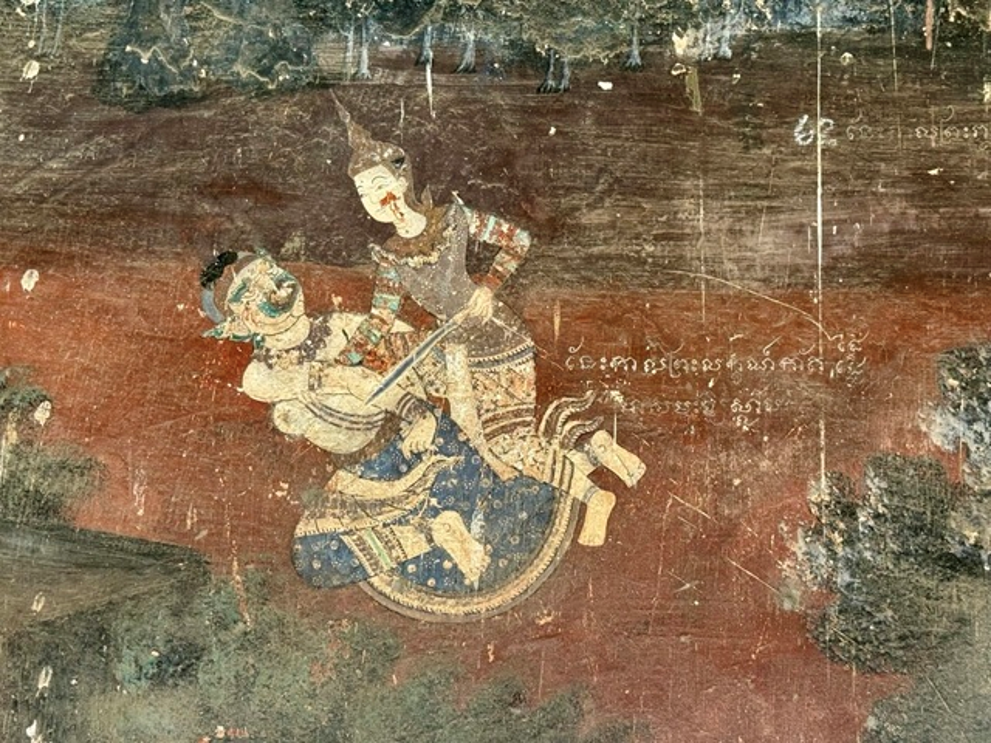
When Neang Seda is abducted by Krong Reap, the narrative moves from the forest to the battlefield. Preah Leak is not left behind, nor reduced to commentary; he is sent by his brother to fight powerful foes in the battle of Lanka. In one visual depiction, he faces Enthachi, an opponent who tries to trick him through a magical decoy.
This fighting role underlines that Preah Leak is not just an emotional support character. He is a prince, a trained warrior and a legitimate actor in the great conflict between the forces of Preah Ream and those of the ogre king Krong Reap. His courage on the battlefield completes his earlier loyalty in exile and helps turn brotherly devotion into visible action.
Preah Leak in Cambodian Art and Performance
From Angkor Walls to Royal Ballet
The Reamker is not confined to palm‑leaf manuscripts; it appears on temple walls and in the repertoire of the Royal Ballet of Cambodia. Bas‑reliefs at Angkor Wat and other sites show scenes from the Rama story where princes, monkeys and giants clash and negotiate. While Preah Ream is usually the visual focus, Preah Leak often stands behind him, recognizable by similar princely attire and posture.
In court dance and the Royal Ballet, characters of the Reamker are represented through elaborate costumes and codified gestures. Preah Leak appears in group scenes with his brother, sharing the graceful, controlled movements that express noble birth, discipline and suppressed emotion. He is not the acrobatic Hanuman nor the terrifying Krong Reap; he is the calm center of loyalty and restraint.
Preah Leak on the Shadow Screen
Lakhon Khol, the male masked dance‑drama, and shadow theatre (sbek thom) also adapt episodes of the Reamker. In shadow puppetry, Preah Leak is carved as a princely figure with elaborate headdress, often shown alongside Preah Ream and Neang Seda when the exile is performed.
For visitors, these performances offer a practical way to “meet” Preah Leak. You might not understand every line of classical Khmer dialogue, but you can see how the staging consistently places him near his brother whenever loyalty, counsel and protective action are needed. A simple tip: when you watch a Reamker scene, look not only at the hero in front, but at the brother just behind him.
Symbolism: Loyalty, Dharma and the “Second Hero”
The Ethics of the Younger Brother
Preah Leak embodies a specific type of Cambodian ethical ideal: the younger sibling who supports rightful authority without jealousy and without asking for his own share of glory. In a royal culture where succession questions could be sensitive, the image of a loyal younger prince was politically and morally valuable.
His voluntary decision to follow Preah Ream into exile dramatizes the principle that true loyalty is not dependent on comfort, status or visible rewards. For modern readers (and perhaps for modern younger siblings), he can be read as the quiet counter‑hero: the one who chooses service over self‑promotion.
Balancing Heroism and Compassion
In the Reamker, Preah Ream is identified with Vishnu, protector of cosmic order, and stands as the shining hero who must defeat Krong Reap and restore righteousness. Preah Leak balances this grand, almost divine heroism with a more human scale of brotherly affection and everyday duty.
He is therefore the “second hero” of the story, not in the sense of a rival, but as a complementary figure. Where Preah Ream can embody royal justice and cosmic order, Preah Leak embodies reliable companionship, shared hardship and the everyday practice of dharma at close range.
Preah Leak for Modern Readers and Creators
For contemporary Cambodians, the Reamker remains a reference point in literature, dance, visual art and even popular media. Preah Leak’s character offers a useful model for teaching values such as loyalty to family, respect for rightful authority and commitment to shared hardship.
From an educational perspective, highlighting Preah Leak in classes or cultural programs can broaden the conversation beyond the more famous figures and help students see how supporting characters carry key moral messages. In a world obsessed with main characters and solo success, he quietly argues for the dignity of the reliable partner.
A Goldmine for Writers, Artists and Filmmakers
If you write fiction, design comics or produce videos based on the Reamker, Preah Leak is a gift. Canonically, we know that he follows his brother into exile, protects Neang Seda, fights in Lanka and remains unwaveringly loyal. Between these fixed points, there is plenty of room for creative exploration.
You might imagine his inner conflicts, his view of palace politics before the exile, or his personal relationship with Hanuman and the monkey army. You can keep the core virtues that the tradition assigns to him, while developing new angles that speak to today’s audience: the sibling who feels overshadowed yet chooses loyalty, the warrior who prefers duty to prestige, the prince who finds meaning in being number two.
Preah Leak may not be the first name that comes to mind when people discuss the Reamker, but he holds the story together from exile to victory, embodying loyalty, courage and the quiet heroism of the younger brother. Paying attention to him opens a more nuanced understanding of Cambodian culture, where great epics are carried not only by shining kings and magical monkeys, but also by the steadfast companion who walks one step behind.
Pascal Médeville is a writer and digital publisher based in Cambodia, where he explores Khmer history, literature and visual culture both online and offline. He writes regularly about Cambodian epics such as the Reamker, classical dance, temples and the many ways mythology still shapes daily life in the kingdom. When he is not chasing footnotes, he produces multilingual content for his platform Wonders of Cambodia.