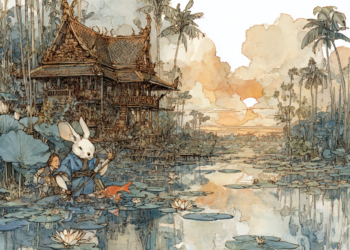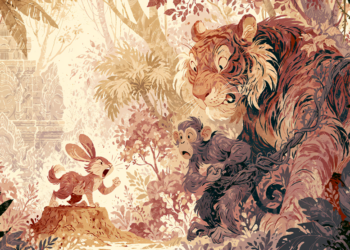
Why is part of the great baray at Preah Khan of Kampong Svay dry today? According to Khmer tradition, the answer lies in a tragic princess, a loyal crocodile, and a legend that still echoes through Cambodia’s ancient temples.
Cambodia’s ancient temples are more than magnificent monuments. They are living landscapes where history and legend intertwine. Among the most fascinating tales preserved by local tradition is the story of Neang Pov, a princess whose tragic fate is said to explain several mysterious features of Preah Khan of Kampong Svay, one of the largest archaeological complexes of the Khmer Empire.
Like many Khmer legends, this one blends royal drama, supernatural intervention, loyal animals, and just enough mystery to make visitors glance twice at the calm waters of an old reservoir. After all, you never know what might still be swimming below the surface.
The Story
Long ago, a king ruled the magnificent city of Preah Khan of Kampong Svay. His beloved daughter was a beautiful princess named Neang Pov.
Unlike most princesses, whose companions were peacocks or graceful elephants, Neang Pov had chosen a rather unusual pet. She lovingly raised a crocodile that lived in a pond within the royal palace. Far from being fearsome, the animal was completely devoted to its young mistress, who cared for it every day.
One day, the princess decided to take a pleasure trip across the immense baray, the great reservoir located near the royal city. The weather was calm, and nothing suggested that disaster was approaching.
Suddenly, the peaceful waters erupted.
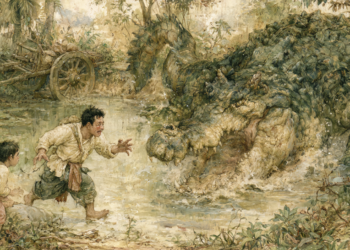
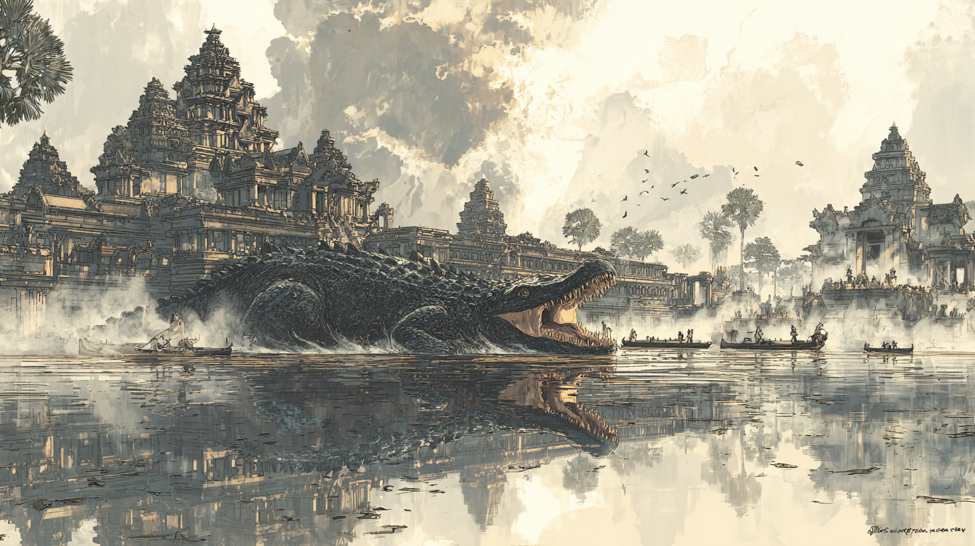
An enormous wild crocodile emerged from the depths and attacked the royal boat. Before anyone could react, the monstrous reptile swallowed Princess Neang Pov whole and disappeared beneath the water, leaving the horrified attendants powerless.
News of the tragedy soon reached the palace.
When the princess’s faithful crocodile learned that its beloved mistress had been killed, it resolved to avenge her. Yet it knew that the giant beast lurking in the baray was far stronger than itself.
The loyal animal therefore went before the Buddha and humbly begged permission to leave the royal pond in order to confront the killer.
Moved by such unwavering devotion, the Buddha granted the request. He also taught the crocodile a sacred magical formula that would allow it to grow into an enormous creature powerful enough to defeat its enemy.
There was only one condition: the spell had to be spoken only after the crocodile had left the palace grounds.
Unfortunately, patience was not among the crocodile’s virtues.
Unable to contain its excitement, it recited the magical formula before reaching the palace gate.
Instantly, its body began expanding. Larger. And larger. And even larger.
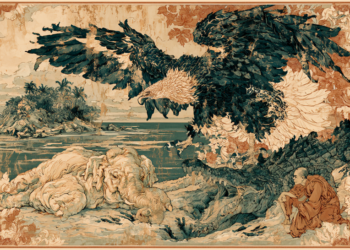
Within moments, the crocodile had grown so enormous that it became hopelessly wedged inside the gateway. Unable to free itself, the faithful creature died there before ever reaching the baray.
Sometimes, following instructions really does matter.
When the king learned that his beloved daughter had been devoured by the monstrous crocodile, his grief quickly turned into anger.
He ordered his workers to fill in the entire baray with earth so that the murderous beast would lose its watery refuge forever.
The work had barely begun when war suddenly broke out. The laborers abandoned their task, and the king’s order was never completed. The reservoir remained only half filled. And so it has stayed ever since.
A Landscape Shaped by Legend
According to local tradition, this legend explains why the western part of the great baray near Preah Thkol Temple is dry today.
The story extends beyond the reservoir itself.
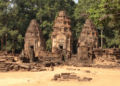
Visitors to Banteay Thom may notice unusual marks on the inner walls of one of its gateways. Local people say these were made by the loyal crocodile as it desperately struggled to escape after becoming trapped by its own magic.
Nearby stands a remarkable crocodile sculpture attached to the embankment leading toward the baray. Tradition identifies this sculpture as the faithful crocodile itself after its death.
Because of this enduring tale, the central sanctuary of Banteay Thom has long been known locally as Prasat Neang Pov, or “The Temple of Neang Pov.”
Some versions of the legend even identify the Buddha who blessed the crocodile with the large Buddha image now known as Prasat Chaktomukh.
The story does not end there.
Local elders once believed that during the final day of Khmer New Year ceremonies celebrated at Prasat Damrei, enormous crocodiles would occasionally appear in the waters of the baray, as though the ancient legend still lingered beneath the surface.
More Than a Fairy Tale
Whether taken as history, folklore, or sacred tradition, the legend of Neang Pov reveals how Cambodians have long understood their monuments through stories as much as through stone.
The tale transforms reservoirs into places of memory, temple gateways into silent witnesses, and even a carved crocodile into a guardian of the past. It reminds us that in Cambodia, every ancient monument has two histories: the one written by archaeologists and the one lovingly preserved by generations of local storytellers.
Perhaps that is the greatest magic of all.
(This folktale is recounted in Issue No. 3, Year 67 (July–September 2020) of Kambuja Suriya, the journal published by the Buddhist Institute of Phnom Penh.)