Published in 1986, Elizabeth Becker’s landmark history of Cambodia remains essential for understanding how war, ideology, and memory reshaped Khmer history and Cambodia’s modern identity.
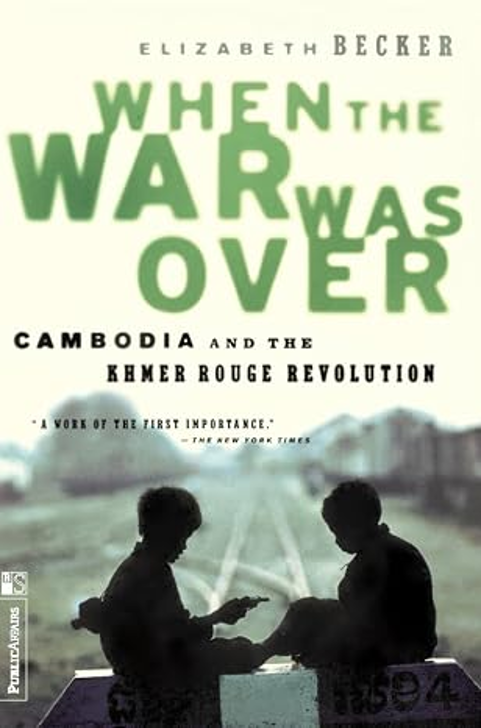
Phnom Penh after dusk, with the Mekong moving quietly beyond the traffic and temple lights, still carries the weight of a country that has lived through rupture and rebuilding. In that long shadow, When the War Was Over: Cambodia and the Khmer Rouge Revolution stands as a landmark book on modern Cambodian history. Elizabeth Becker’s account matters today because it helped explain the Khmer Rouge era to a global readership that knew far too little about Cambodia. By combining reporting, testimony, and historical reconstruction, the book shaped how the world understands Cambodia’s trauma, resilience, and the political forces that transformed daily life.
Elizabeth Becker is an American journalist who began reporting on Cambodia during the war for the Washington Post, later becoming one of the few foreign correspondents allowed into Democratic Kampuchea. Her background gave her unusual access to events, but also placed her outside Cambodian society, which shaped both her strengths and blind spots. The book first appeared in 1986, when the country was still recovering from the Khmer Rouge period and its aftermath, and that urgency gives the work a strong moral and political edge. It is not a detached archive of events, but a reporter’s reconstruction of catastrophe written in the heat of unresolved history.
The book runs to more than 600 pages in its later edition and includes bibliographical references and an index, which signals its ambition as a serious reference work as well as a narrative history. It traces Cambodia from colonial rule through war, revolution, and the Khmer Rouge years, drawing together political events, witness accounts, and the social consequences of violence. Three recurring themes stand out: the abuse of power, the destruction of social and cultural order, and the survival of ordinary Cambodians under extreme pressure. Becker’s strongest passages are the ones that evoke an emptied capital, staged encounters, and the strange silence of Phnom Penh under Khmer Rouge rule, where public space itself seems to have been rewritten.
What makes the book pioneering is its reach. It was among the earliest major English-language histories to connect Cambodia’s modern tragedy to colonial legacies, Cold War intervention, and Khmer Rouge ideology in one sustained account. The book has been reissued, including a 1998 edition by PublicAffairs, and it remains accessible in library and archive form today. Cambodian institutions and researchers continue to use it as a point of reference, while also critiquing its outsider perspective and the limits of any foreign account of national trauma. In that sense, the book still lives in debate, not just in citation.
Today, When the War Was Over still speaks to debates about heritage, tourism, identity, and cultural memory in Cambodia. It reminds readers that the country’s monuments and landscapes cannot be separated from the histories of violence that shaped the people who live among them. Students, guides, artists, researchers, and curious visitors will all find value in it, especially if they want to understand why memory in Cambodia remains deeply political. For me, the book is most valuable when read beside Cambodian voices, because that is where Wonders of Cambodia does its work: placing history back in human hands.