Estimated reading time: 7 minutes. History is rarely tidy. This particular neighborhood had merchants, temples, sailors, kings and quite a lot of fighting.
Long before modern borders divided mainland Southeast Asia, Champa and Cambodia shared a complicated neighborhood of trade, religion, diplomacy and war. From ancient maritime networks to the dramatic conflicts of the Angkorian age, their relationship reveals a region far more interconnected than today’s maps suggest.
Introduction
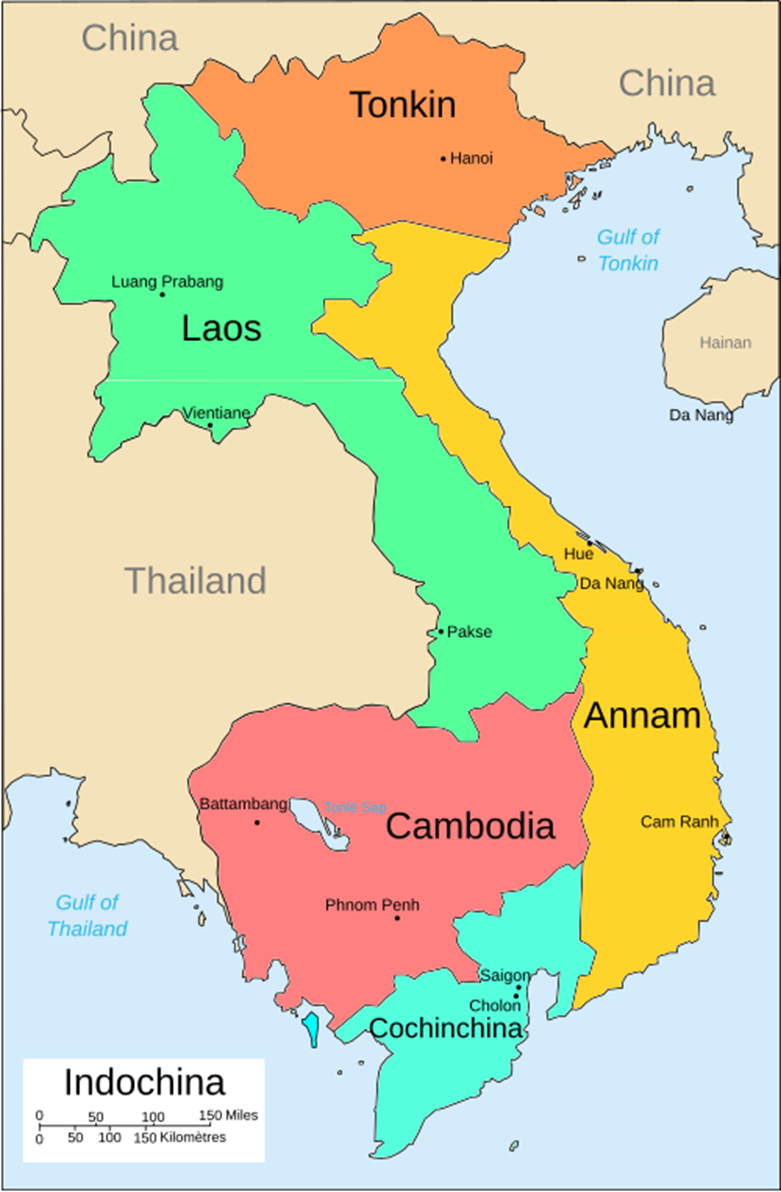
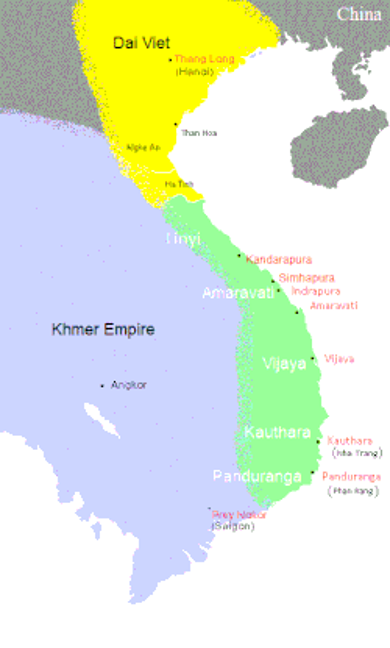
If you look east from Cambodia today, you eventually reach Vietnam. But the political map of the past looked very different. For centuries, much of central and southern coastal Vietnam was home to Champa, a collection of Cham polities whose history stretched across more than a millennium. Champa was not always a single, centralized kingdom in the modern sense. It was a shifting constellation of coastal centers, river valleys and political territories linked by language, religion, commerce and royal traditions.
For Cambodia, Champa was both neighbor and competitor, but also part of the same wider Southeast Asian world. Khmer and Cham rulers fought, negotiated, traded and occasionally formed alliances. At times, Cham forces reached Angkor itself. At other moments, Khmer armies moved deep into Cham territory. Their relationship is therefore much more interesting than the familiar story of two kingdoms simply being enemies.
Understanding Champa also helps explain Cambodia’s place in the history of mainland Southeast Asia. The story connects Angkor with the South China Sea, India, China and the maritime trading networks that tied the region together.
What Was Champa?
Champa was a group of Cham-speaking polities that developed along the central and southern coast of present-day Vietnam. Rather than behaving like a permanently unified state, these political centers could rise, decline and compete with one another. Historians therefore often speak of “Champa” as a broader political and cultural tradition rather than a kingdom with an uninterrupted centralized government.
Its geography shaped its character. The Cham territories stretched along a narrow coastal zone backed by mountains, with river valleys providing access to the interior and ports opening onto the South China Sea. This position made Champa particularly well suited to maritime commerce.
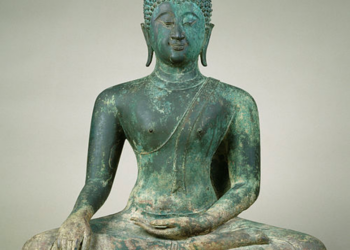
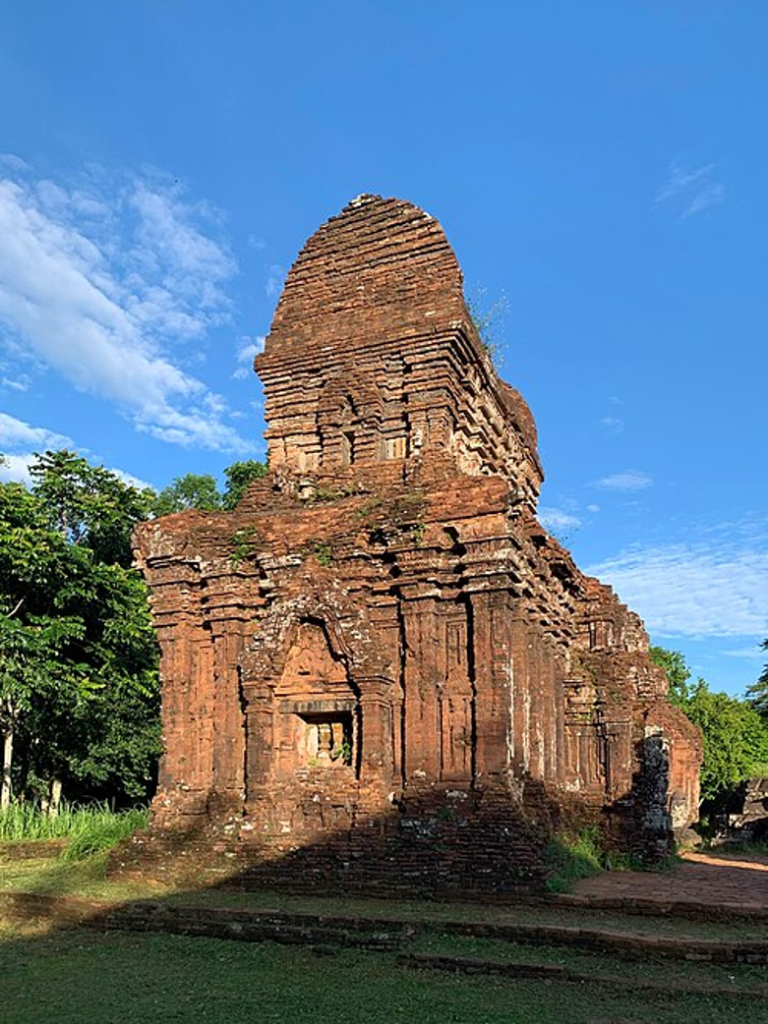
The Cham world was also deeply influenced by India. Hinduism, particularly Shaivism, became central to royal ideology, while Buddhism also found an important place in parts of Champa. Sanskrit was used for inscriptions and elite culture. The spectacular sanctuary of Mỹ Sơn, in present-day Quảng Nam Province, illustrates this religious and political world. UNESCO describes Mỹ Sơn as a religious and political center of Champa for much of its history, with monuments developed from the fourth to the thirteenth centuries.
A Maritime Neighbor of Cambodia
The relationship between Champa and Cambodia makes more sense when viewed through geography rather than modern borders.
Cambodia’s great political centers developed around the Mekong basin and the Tonle Sap, while Champa occupied important sections of the central Vietnamese coast. Between them were mountains and river systems, but the sea provided another route connecting their worlds.
Trade was particularly important. Champa’s position on maritime routes linking China, Southeast Asia and the Indian Ocean gave its ports access to international commerce. Cham sailors and merchants operated in a region where political power was closely connected with control of ports, river mouths and trade routes.
Cambodia, meanwhile, was developing one of the most powerful inland states in Southeast Asia. Angkor’s influence extended across large portions of the mainland at various periods. The two political worlds therefore had different geographical strengths. Champa was oriented strongly toward the sea, while Angkor’s power was rooted in the enormous agricultural and hydraulic landscape around the Tonle Sap and Mekong systems.
Yet these were not sealed worlds. Goods, religious ideas, artistic styles and people crossed the boundaries.
That is why similarities between Khmer and Cham art can sometimes be striking. Both cultures absorbed Indian religious traditions, used Sanskrit in elite inscriptions and developed monumental architecture dedicated to Hindu and Buddhist beliefs. This was not necessarily imitation. It was part of a larger Southeast Asian cultural conversation.
Cambodia and Champa: Friends, Rivals and Occasional Enemies
Relations between Cambodia and Champa were never permanently fixed.
There were periods of conflict, but there were also political alliances and interactions involving rulers and factions on both sides. Modern historical imagination sometimes turns these relationships into a simple Khmer-versus-Cham rivalry. The reality was considerably messier.
This is especially important when discussing the twelfth century. Political divisions existed within both Khmer and Cham territories, and rival factions could seek support from across the border. Conflicts in this period involved shifting alliances in which Khmer and Cham groups could sometimes fight alongside one another or against factions from their own broader political community.
In other words, medieval Southeast Asian politics did not always respect the neat categories we like to impose on them centuries later.
The Cham Attack on Angkor
The most dramatic episode in Cambodia-Champa relations came in 1177.
Cham forces launched an attack that reached Angkor, the capital of the Khmer Empire. The event was extraordinary because Angkor was not an easily accessible coastal settlement. Yet Cham forces apparently used waterways to penetrate deep into Khmer territory and attack the capital.
The attack was a major shock to the Khmer Empire. It exposed vulnerabilities in the Khmer political system and helped create the circumstances in which Jayavarman VII would emerge as the dominant Khmer ruler.
And here the story takes an unexpected turn.
Jayavarman VII and the Cham Connection
Jayavarman VII is remembered in Cambodia as one of the greatest rulers of the Angkorian period. His reign produced Angkor Thom, the Bayon, Ta Prohm, Preah Khan and a remarkable network of roads, hospitals and religious foundations.
His relationship with Champa, however, was complicated.
Evidence suggests that Jayavarman VII had spent a significant period in the Cham political world before becoming king. His eventual struggle to restore Khmer power was therefore connected to a political environment in which Khmer and Cham elites were already interacting. Historical evidence points to shifting Khmer-Cham alliances during the period preceding his accession.
After the Cham capture of Angkor in 1177, Jayavarman VII fought to recover the Khmer capital. He eventually defeated the forces that had taken Angkor and became king around 1181 or 1182, depending on the chronology used by historians.
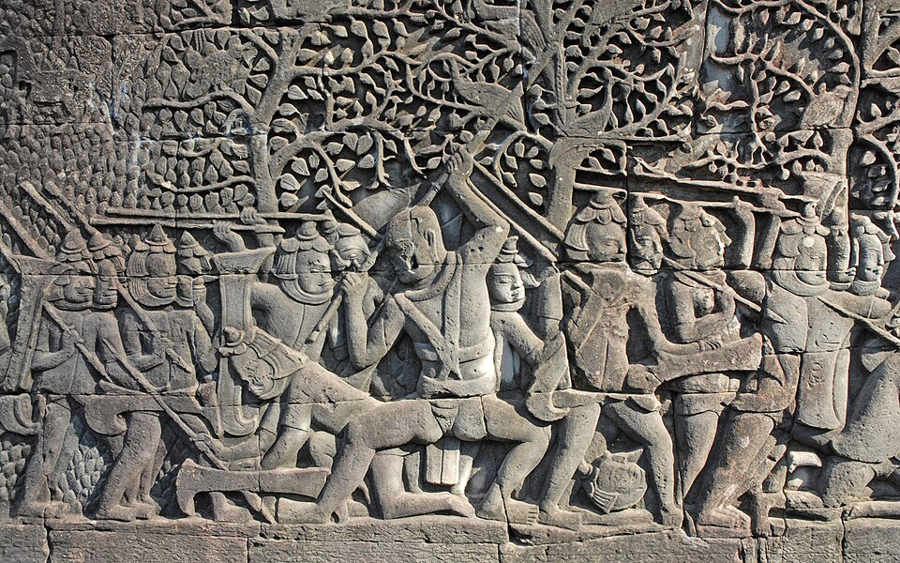
The irony is considerable: Champa helped create one of the defining crises of Angkorian history, while Cham political connections also formed part of the world through which Jayavarman VII had operated.
From War to Khmer Control of Parts of Champa
Jayavarman VII did not stop at restoring Angkor.
During the later twelfth and early thirteenth centuries, Khmer power extended into parts of Champa. The precise political arrangements remain complex, but Khmer influence over central and southern Cham territories became substantial for a period.
Evidence indicates Khmer control in parts of central and southern Champa between roughly 1203 and 1220. Khmer-style religious images and Sanskritic ritual traditions appeared in Cham temples during this period.
This episode should not be understood as the permanent conquest of all Champa. Champa remained politically active, and Cham rulers eventually recovered their independence.
The period nonetheless demonstrates how closely the political histories of Cambodia and Champa could become intertwined.
The sanctuary of Mỹ Sơn bears traces of the turbulent history of this period, including damage associated with warfare and subsequent restoration.
Beyond the Battlefield
It is tempting to remember Champa mainly because Cham armies attacked Angkor. That would be rather like remembering a neighbor only because you once had an argument over the fence.
The deeper story is one of cultural interaction.
Khmer and Cham elites shared religious concepts derived from the wider Indic world. Sanskrit served as an important language of royal and religious expression. Architecture, sculpture and ritual practices developed within a broader network of Southeast Asian traditions rather than in isolation.
The Bayon itself contains famous scenes of Cham figures and military encounters, while Khmer artistic influence also appeared in parts of Champa during periods of Khmer political control.
There were also connections through commerce. Champa’s maritime orientation connected it to China and other parts of Southeast Asia, while Cambodia was linked to regional trading networks through both inland and maritime routes. The two societies therefore occupied different positions within the same interconnected world.
What Happened to Champa?
Champa did not disappear overnight.
Its political centers continued to exist for centuries after the great conflicts with Angkor. The Cham world gradually faced increasing pressure from expanding Vietnamese states, while internal divisions and changing regional politics weakened its political independence.
The traditional date associated with the end of Champa as a major independent kingdom is 1471, when the Vietnamese conquest of Vijaya dealt a devastating blow to Cham political power.
But the Cham people did not vanish.
Cham communities survived, and Cham culture, language, religious traditions and artistic heritage remain part of the cultural landscape of Southeast Asia today. The descendants of the Cham live principally in Vietnam and Cambodia, among other places.
This is an important distinction. A kingdom can disappear from the political map without its people disappearing from history.
Why Champa Matters to Cambodia Today
For visitors to Cambodia, learning about Champa adds another dimension to the history of Angkor.
Angkor did not develop in an empty landscape. It was part of a competitive and interconnected Southeast Asian world that included Champa, the kingdoms of present-day Thailand and Myanmar, maritime Southeast Asia, India and China.
The relationship with Champa is particularly useful for understanding why Angkor’s history cannot be reduced to temple building. Behind the stone faces of the Bayon were political struggles, military campaigns, diplomatic calculations and international connections.
It also helps explain why Cambodia’s cultural history extends beyond its present borders. Ancient Khmer influence reached into territories that are now part of several modern countries, just as Cham influence reached across the region.
For travelers, Mỹ Sơn in central Vietnam and Angkor in Cambodia can therefore be viewed as two remarkable chapters of the same larger Southeast Asian story. They belong to different cultures, but both demonstrate how local societies transformed ideas arriving through long-distance cultural and commercial networks.
Conclusion
The history of Champa is not merely a story about a vanished kingdom or an old enemy of Angkor. It is the story of a sophisticated maritime civilization that shared Cambodia’s historical neighborhood for more than a thousand years. The wars between Champa and Cambodia were real and sometimes devastating, but so were their cultural, political and commercial connections. To understand Angkor more fully, it is worth looking east and remembering the neighbors.
About the author
Pascal Médeville is a writer and digital publisher based in Cambodia and the author of Wonders of Cambodia. His interests include Cambodian history, culture, archaeology, heritage and everyday life, with a particular focus on making the country’s complex past accessible to curious readers.