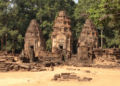
The Dangrek genocide, often referred to as the Preah Vihear pushback or the Dangrek massacre, was a brutal forced return of tens of thousands of Cambodian refugees from Thailand down the mined slopes of the Dangrek Mountains in June 1979. Most of the victims were civilians, many of them Sino‑Khmer families who had already survived the Khmer Rouge years and famine, only to face deadly “pushback” at the very edge of hoped‑for safety.

From the fall of the Khmer Rouge to the border
In early 1979, Vietnamese forces overthrew Democratic Kampuchea and advanced across Cambodia, dislodging the Khmer Rouge from many strongholds, including positions near the Thai border. After years of forced labor, executions, and starvation, large numbers of Cambodians in the northwest tried to flee conscription, reprisals, and hunger by heading toward Thailand in search of asylum.
Among those on the move were Dega (Montagnard) groups, already at odds with the Vietnamese communist regime, who hoped to reach the West through Thailand. Many of them, however, were intercepted by Khmer Rouge units under commanders such as Son Sen, confined in camps, and hemmed in by mine belts laid to prevent escape, which added another layer of danger even before people reached the actual border.
By mid‑1979, roughly 140,000 Cambodian refugees had entered Thailand, a population equal to about one percent of Thailand’s total, straining infrastructure and provoking fears in Bangkok about security, political fallout, and the regional balance of power. The Thai leadership worried about both mass influx and the presence of armed Khmer Rouge elements mingled with civilians.
“Humane deterrence” and closing the frontier
In March 1979, Thailand officially closed and mined key stretches of its border with Cambodia to discourage further arrivals. Refugee camps began to mushroom in the ambiguous strip of no‑man’s‑land between the two countries, where Thai authorities increasingly treated new arrivals not as refugees but as illegal immigrants.
Bangkok adopted a policy sometimes described as “humane deterrence”: camps received only bare‑bones supplies, and new refugees were denied contact with international agencies that might have arranged resettlement. The intention was to dissuade further crossings without resorting to direct, visible mass violence, but the logic of deterrence in a militarized zone laid the groundwork for the far more drastic measures that followed.

The June 1979 pushback down the escarpment
In June 1979, Thai forces rounded up an estimated 43,000 to 45,000 Cambodian refugees from areas such as Aranyaprathet and other border districts, loaded them onto buses, and transported them some 300 kilometers to the Dangrek range near Preah Vihear. Many were families with young children and elderly relatives, and a significant number were of Chinese‑Khmer origin, including survivors like Mengly Jandy Quach, who later recounted the ordeal in testimony and memoir.

Instead of being transferred to better‑equipped camps, the refugees were driven to the edge of the Dangrek escarpment and ordered to descend toward Cambodian territory along steep, forested, and poorly marked paths. The area had been heavily mined and booby‑trapped over the years by Khmer Rouge and Vietnamese forces, turning the descent into a deadly maze where one misstep could mean death or dismemberment, while armed escorts enforced movement at gunpoint.
Death toll, suffering, and the label “genocide”
Thousands of refugees died during and after the pushback, though exact figures remain contested among researchers and human‑rights advocates. Victims were killed or maimed by landmines and unexploded ordnance, fell from cliffs or ravines, or succumbed to dehydration and diarrheal disease after being forced to move in extreme conditions with minimal food, water, or medical care.
Because the victims were overwhelmingly civilians pushed into a known minefield and war zone, and because of the scale and organized nature of the operation, some scholars, activists, and survivor communities have described the episode as the Dangrek genocide or a “second killing field”. Others prefer terms such as massacre, mass atrocity, or crime against humanity, underscoring how legal classification remains debated even as the human cost is undeniable.
International outrage and the camp system
News of the tragedy in the Dangrek Mountains rapidly stirred public opinion, especially among church groups, NGOs, and international media, which relayed accounts of the forced return and its consequences. In July 1979, a major meeting in Geneva under UN auspices, with participation from more than 60 states and humanitarian organizations, sought to address the broader Indochinese refugee crisis and the specific abuses at the Thai-Cambodian frontier.
Thai foreign‑policy figures faced criticism that the humanitarian emergency was being leveraged as a diplomatic tool against Vietnam, which Bangkok wanted to pressure into withdrawing from Cambodia. In October 1979, Prime Minister Kriangsak Chamanan visited the border and was reportedly shocked by the suffering he witnessed, contributing to a partial shift toward a more cooperative relief effort.
By late 1979, UNICEF and the World Food Programme, together with NGOs, developed a large‑scale humanitarian response along the border, creating camps such as Sa Kaeo (established rapidly in October) and the major hub of Khao‑I‑Dang (opened in November). High‑profile visits, including Rosalynn Carter’s trip to Sa Kaeo, helped bring global attention and resources, though they also drew more desperate people to the frontier in search of aid.
Security fears, the K5 Plan, and renewed closures
After elections in Thailand, the new government under Prem Tinsulanonda reversed the relatively more open stance and closed the border again in January 1980, citing fears that Khmer Rouge cadres were infiltrating through the camps. These fears had some basis: several sites, including the notorious Site 8, were dominated by Khmer Rouge networks, blurring the line between civilian protection and rear‑base support for an armed movement.
To signal that refuge was temporary and conditional, Thai authorities popularized the term “evacuees” instead of refugees, making clear that people were expected either to be resettled elsewhere or eventually returned. Inside Cambodia, meanwhile, the Vietnamese‑backed government introduced the K5 Plan, conscripting large numbers of Cambodians—often under harsh conditions—to build a defensive “bamboo wall” along the border, which prompted further flight by those seeking to escape forced labor and renewed militarization.
Memory, nationalism, and Preah Vihear
The Dangrek pushback became a powerful symbol in Cambodian national memory, reinforcing longstanding bitterness toward Thailand. For many Cambodians, especially those who had lost relatives on the escarpment, the episode epitomized betrayal at the very moment they sought refuge from the horrors of Democratic Kampuchea.
These memories have continued to resonate in later crises, including the anti‑Thai riots in Phnom Penh in 2003 and recurring tensions over border demarcation and temple areas. The choice of the Preah Vihear-Dangrek sector for the forced return is often read not only as a pragmatic decision but also as a gesture freighted with symbolism, given the International Court of Justice ruling in the early 1960s that awarded the Preah Vihear temple to Cambodia, a decision many Thai nationalists still resent.

The massacre at Dangrek fits into a longer pattern of violent episodes along this frontier, stretching from pre‑modern conflicts to modern border skirmishes and diplomatic standoffs. It illustrates how refugees can become pawns in wider contests over territory, historical grievance, and regional power, even when they are unarmed civilians simply trying to survive.
Landmines, “Ghost Mountain”, and ongoing legacies
The Dangrek Mountains and adjacent Cambodian regions remained saturated with landmines and unexploded ordnance for decades after 1979, the legacy of Khmer Rouge, Vietnamese, and Thai military activity. Clearance operations have reduced, but not eliminated, the danger, and civilians—including shepherds, children, and deminers—continue to be killed or injured, long after the world’s attention moved on.
Survivor testimonies, oral‑history projects, and recent documentaries such as those about “Ghost Mountain” have helped bring the Dangrek genocide back into focus as a distinct chapter of Cambodia’s broader tragedy. Taken together, these accounts underline that the violence did not end with the fall of the Khmer Rouge: it shifted to borders, minefields, and diplomatic calculations in which human lives were expendable.
Do you want to know more?
A practical research list on the Dangrek genocide / Preah Vihear pushback can be built around four clusters: the main overview, refugee‑studies work, Thai policy and border politics, and survivor‑driven projects. Below is a mixed list of online and offline sources you can mine further (without reproducing their copyrighted text).
Core overviews
– “Dangrek genocide / Preah Vihear pushback” – Wikipedia entry and its internal references (articles, reports, books, NGO documents).
– Documentation Center of Cambodia (DC‑Cam), Hill Tribes Memory Community Center, “Refugee Camps: A Cambodian Perspective” (includes a section on the Dangrek incident and survivor voices).
Refugees, camps, and border war
– Khao‑I‑Dang Refugee Camp, in Care in Crisis: Ethnographic Perspectives on Care in Humanitarian Contexts (chapter PDF at Berghahn Books; useful for context on camp systems and Thai–UN management).
– Academic and library guides on the Cambodian genocide that include sections on border camps, e.g. Cornell University’s “Tuol Sleng and the Cambodian Genocide” guide (for bibliographies and call numbers to novels, memoirs, and studies).
– General syntheses of the Cambodian genocide and refugee flows (e.g. museum and encyclopedia resources such as Illinois Holocaust Museum’s Cambodian Genocide page, Britannica entries, or EBSCO “Cambodia” research starter).
Thailand’s policy and international response
– Puangthong Rungswasdisab, “Thailand’s Response to the Cambodian Genocide” (Yale Cambodian Genocide Program; PDF version widely available online).
– Analyses of the Thai–Cambodian border dispute and Preah Vihear in historical perspective, such as long‑form articles on Preah Vihear conflict and the Dangrek massacre in Cambodian/Thai history magazines or blogs.
– Contemporary media and radio pieces on Thai refugee policy and the “second killing fields”, including in‑depth interviews with survivors like Bunseng Taing.
Survivor‑driven projects and documentaries
– Ghost Mountain: The Second Killing Fields of Cambodia – documentary film and related Preah Vihear Foundation materials (project site, videos, educational resources).
– Interviews with Bunseng Taing and other survivors in public‑media programs and podcasts focusing on both the Khmer Rouge period and the Dangrek pushback.
– Short articles and essays on “Ghost Mountain” / “Preah Vihear killing fields” from NGOs, independent journalists, or memorial initiatives that compile testimonies and photographs from the site.
Memory, nationalism, and longer‑term context
– Articles that link the Dangrek massacre to later Thai–Cambodian tensions over Preah Vihear and border demarcation, often published in regional analysis platforms or long‑form blogs.
– Works on Cambodian refugee memory and community narratives (e.g. DC‑Cam projects, diaspora oral‑history initiatives, and memoirs by survivors such as Mengly Jandy Quach).
– General histories of Cambodia and the Third Indochina War that cover the 1979–80 border war, K5 Plan, and the militarization of the Dangrek range, which help situate the pushback in a broader timeline.
Many of the offline items (books, chapters, memoirs) can be located via the bibliographies of the Dangrek genocide entry and specialized guides (Cornell, Yale CGP, DC‑Cam), then requested through academic libraries, interlibrary loan, or ebook platforms.