

(Estimated reading time: 7 minutes. Enough time to step into a century of Cambodian history without leaving your chair.)
The National Museum of Cambodia is more than a collection of ancient artifacts. Its creation tells a fascinating story of colonial ambition, Khmer identity, and cultural preservation. From early archaeological efforts to its iconic red structure in Phnom Penh, this article explores how the museum came to life and why it remains central to Cambodia’s heritage today.
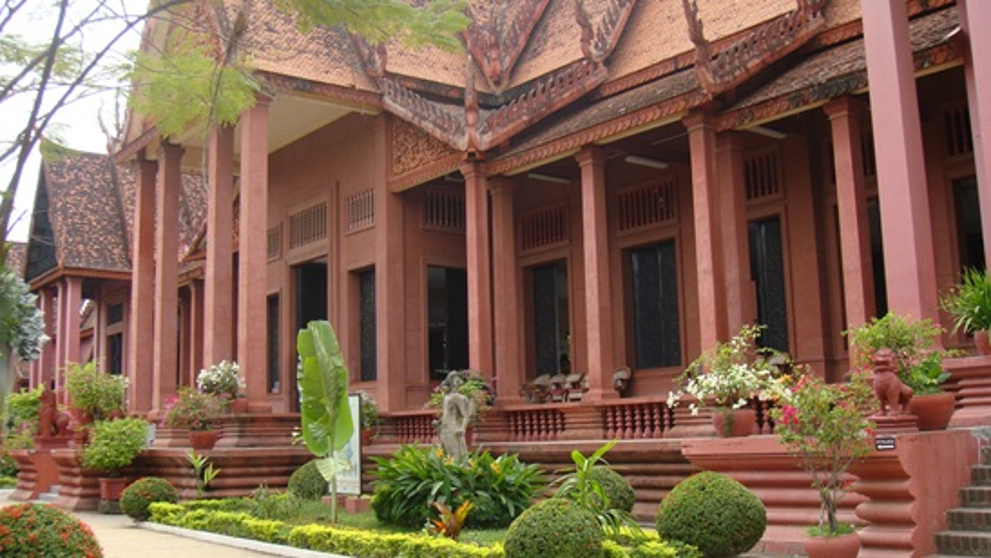
If you have ever visited Phnom Penh, chances are you have walked past the striking terracotta-red building near the Royal Palace. The National Museum of Cambodia is one of the city’s most recognizable landmarks, but its origin story is often overlooked.
This article explores the creation of the National Museum of Cambodia, tracing its roots from French colonial archaeology to its role as a guardian of Khmer heritage. Whether you are a traveler, a history enthusiast, or a content creator looking for depth, you will gain a clear understanding of how and why this institution came into being.
Early Interest in Khmer Antiquities
The creation of the National Museum of Cambodia is closely tied to the arrival of the French in Indochina during the 19th century. French scholars and administrators quickly became fascinated by the ruins of Angkor and other Khmer sites.
By the late 1800s, archaeological exploration was no longer a hobby. It had become a structured effort led by institutions such as the École française d’Extrême-Orient (EFEO), founded in 1900. Their mission included documenting, preserving, and studying Southeast Asia’s cultural heritage.
This academic curiosity had practical consequences. Artifacts were being discovered across Cambodia, but there was no proper place to store or display them locally. Many objects were even sent to France, raising concerns about the loss of cultural heritage.
The Need for a National Repository
By the early 20th century, it became clear that Cambodia needed a central museum. Such an institution would serve several purposes:
- Protect Khmer artifacts from damage or export
- Support archaeological research
- Educate the public, both local and international
- Reinforce cultural identity under colonial rule
The idea of a national museum in Phnom Penh began to take shape around this time.
One name stands out in the creation of the National Museum of Cambodia: George Groslier. A French historian, curator, and passionate advocate of Khmer arts, Groslier played a decisive role in turning the idea into reality.
Appointed as the first curator, he envisioned a museum that would not simply store artifacts but present them in a way that reflected Khmer aesthetics and traditions.
Rather than imposing a purely European design, Groslier insisted on incorporating traditional Khmer architectural elements. This decision would define the museum’s identity.
The museum was designed by George Groslier together with architect Charles Batteur. Construction began in 1917 and was completed in 1920.
Key features of the design include:
- Traditional Khmer roofs with tiered structures
- A central courtyard inspired by temple layouts
- Use of red terracotta tones that echo ancient brick temples
- Open galleries adapted to Cambodia’s tropical climate
The result is a building that feels both historical and functional, even though it was built in the 20th century.
Construction and Official Opening
Building the Museum (1917–1920)
The construction of the National Museum of Cambodia took place during a period of significant colonial investment in infrastructure. Phnom Penh was being developed as an administrative and cultural center.
The museum was strategically located near the Royal Palace and Sisowath Quay, placing it at the heart of the capital’s symbolic landscape.
Despite logistical challenges, including climate and material constraints, the project moved forward steadily. The design’s open-air galleries helped address ventilation issues, a practical adaptation to the local environment.
The museum officially opened in 1920. At the time, it was known as the Musée Albert Sarraut, named after the French governor-general of Indochina.
Its initial collection consisted largely of sculptures from Angkor and other Khmer sites. Many of these pieces had been gathered through EFEO expeditions.
The opening marked a turning point. For the first time, Cambodia had a dedicated space to preserve and showcase its artistic heritage within its own borders.
The Museum Through Turbulent Times
From Colonial Era to Independence
After Cambodia gained independence in 1953, the museum took on a new role. It became a symbol of national pride rather than a colonial institution.
Its name was changed to the National Museum of Cambodia, reflecting its importance in the country’s cultural identity.
During this period, efforts were made to expand collections and promote Cambodian heritage to both locals and international visitors.
The museum faced severe challenges during the Khmer Rouge period (1975–1979). Like many cultural institutions, it suffered from neglect and damage.
However, thanks to the dedication of a small number of staff and later restoration efforts, the museum survived. Many artifacts remained intact, which is remarkable given the circumstances.
Since the 1990s, international cooperation and local expertise have contributed to restoring the museum and preserving its collections.
What the Museum Represents Today
A Cultural Anchor in Phnom Penh
Today, the National Museum of Cambodia houses one of the world’s most important collections of Khmer art. It includes:
- Angkorian sculptures
- Pre-Angkorian artifacts
- Bronze and ceramic objects
- Religious and ceremonial items
More than a museum, it is a place where Cambodia’s history is made visible.
The museum is not frozen in time. It continues to evolve through:
- Conservation programs
- Educational initiatives
- Temporary exhibitions
- Collaboration with international institutions
For visitors, it offers a structured introduction to Khmer civilization. For researchers, it remains an essential resource.
If you plan to visit the National Museum of Cambodia:
- Go early in the morning or late afternoon to avoid the heat
- Combine your visit with the Royal Palace nearby
- Take time in the courtyard, it offers a calm contrast to the galleries
- Consider hiring a guide for deeper historical context
Even a short visit can significantly enrich your understanding of Cambodian history.
The creation of the National Museum of Cambodia reflects a complex intersection of colonial ambition, scholarly curiosity, and cultural preservation. What began as a French-led project has become one of Cambodia’s most important cultural institutions, safeguarding centuries of Khmer heritage while continuing to educate and inspire future generations.
Pascal Médeville is a writer and digital publisher based in Cambodia. He specializes in Cambodian history, culture, and heritage, with a particular interest in how the past is preserved and presented today. Through Wonders of Cambodia, he shares in-depth articles that connect historical insight with practical exploration.








Thank you Pascal,
I first visited Cambodia in 1969-1970 and then worked on Australian and Norwegian aid projects in Phnom Penh, Siem Reap and Kampot in 1989-1990, 1992-1993 and 1995-1997. Since then I have supervised Lao and Khmer postgraduate students in Australia. In 1989-1990 I was fortunate to have a very dusty unused office upstairs thought the right hand main door of the National Museum. The office contained a small collection of early French journals and publications which were useful for my research. I was made very welcome and was often the only foreigner in the museum.
I do appreciate your photos and information.
Best wishes,
Bill
Dear Bill,
Thank you very much for sharing your memories – what an incredible journey you’ve had with Cambodia. Your time working near the National Museum must have been truly special, especially with access to those old French publications.
I first came to Cambodia in 1992 and eventually made it my home in 2010. Since then, I’ve been dedicating my work to documenting and sharing its rich culture and history.
I really appreciate your kind words.
Best wishes,
Pascal