Australian-born historian Ben Kiernan has spent his career tracing how genocide happens, from the rice fields of Democratic Kampuchea to the killing fields of global history. This article introduces his work on the Cambodian genocide, his broader genocide studies, and why anyone interested in Cambodia—or mass violence — should know his name.

Why Ben Kiernan Matters (Especially If You Care About Cambodia)
If you spend enough time reading about Cambodia’s Khmer Rouge years, one name becomes stubbornly recurrent: Ben Kiernan. He is the historian who, for several decades, patiently collected documents, testimonies, and statistics to show not just that mass murder occurred under Pol Pot, but how, why, and against whom it was carried out.
This article is for readers who want more than slogans about “killing fields.” It is for students, researchers, and the incurably curious traveler who suspects that understanding Angkor without understanding 1975-1979 is like reading the final chapter of a novel first. We will walk through who Ben Kiernan is, how he helped document the Cambodian genocide, what he has argued about the nature of Khmer Rouge violence, and how his work widened into a global history of genocide.
Along the way, we will also glance at the criticisms that have followed him — this is academia, after all — and end with some pointers for those who want to read more. If you have ever tried to understand Cambodia’s traumatic twentieth century and felt lost in acronyms and ideologies, Kiernan’s work is one of the more solid maps available.
From Melbourne to Phnom Penh (and New Haven)
An Australian historian with a Cambodian focus
Ben Kiernan was born in Melbourne, Australia, in 1953, and trained as a historian at Monash University, where he completed his PhD in 1983 under the supervision of David Chandler, another major scholar of Cambodian history. Early in his twenties he visited Cambodia, leaving shortly before the Khmer Rouge expelled foreigners in 1975 — a narrow escape from a regime that would soon make him one of its particular enemies.
After teaching in Australia, notably at the University of Wollongong, he moved to Yale University in 1990, where he became A. Whitney Griswold Professor of History and later Professor of International and Area Studies. At Yale he would build what is probably his most visible institutional legacy: the Cambodian Genocide Program and, more broadly, the Genocide Studies Program.
Founding the Cambodian Genocide Program
In 1994 Kiernan founded the Cambodian Genocide Program (CGP) at Yale’s MacMillan Center, with the explicit goal of documenting the crimes of the Khmer Rouge regime and providing evidence that could support future prosecutions. Under his direction, the program helped establish the Documentation Center of Cambodia (DC-Cam) in Phnom Penh, training Cambodian staff and assembling archives of Khmer Rouge documents, photographs, and testimonies.
These archives, including the records of the Santebal, the Khmer Rouge secret police, became crucial evidence for later UN-backed trials of senior leaders for genocide and other crimes. In practical terms, this meant that “history” was not just written in quiet libraries; it was photocopied, translated, cross-checked, and eventually entered into courtrooms as proof that the killing was systematic rather than accidental.
The Pol Pot Regime: Race, Power, and Genocide
A definitive study of Democratic Kampuchea
Kiernan’s best-known single work on Cambodia is The Pol Pot Regime: Race, Power, and Genocide in Cambodia under the Khmer Rouge, 1975–1979, first published by Yale University Press in 1996 and later updated. The book combines archival documents, interviews with survivors, and demographic analysis to estimate both the death toll and the pattern of violence across different regions and communities in Cambodia.
The book argues that the Khmer Rouge regime was driven not only by radical social engineering and Marxist-Leninist ideology, but also by racialized hostility toward specific groups, including Vietnamese, Cham Muslims, and ethnic Chinese, among others. Kiernan’s careful estimates of excess deaths — both nationally and among minorities — were later described in a UN demographic expert report for the Khmer Rouge tribunal as “methodologically sound and transparent,” and the report concurred with his national and minority death toll estimates.

Myth, nationalism, and genocide
In a widely cited article, “Myth, Nationalism and Genocide,” Kiernan explores how Khmer Rouge propaganda drew on historical myths and nationalist fears to justify violence, presenting enemies as traitors, invaders, or racial contaminants. This analysis helped broaden the study of the Cambodian genocide beyond purely Cold War or class-based explanations, emphasizing the lethal mixture of ideology and ethno-nationalist paranoia.
For readers trying to understand why neighbors turned on neighbors in Democratic Kampuchea, Kiernan’s work underlines that it was not one single idea but a whole bundle of them — class struggle, racial suspicion, anti-urbanism, and an obsession with “purity” — that made the regime so deadly. It is unsettling reading, but useful if you want to move past the abstract phrase “auto-genocide” and see what policies and beliefs lay behind it.
From Cambodia to a World History of Genocide
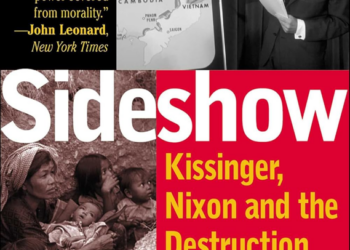
Kiernan did not stop at Cambodia. In 2007 he published Blood and Soil: A World History of Genocide and Extermination from Sparta to Darfur, an enormous comparative study tracing patterns of mass killing across centuries and continents. The book examines cases ranging from ancient Sparta and colonial conquests to the Holocaust and late twentieth-century atrocities, arguing that certain recurring elements — territorial expansion, racial or religious hatred, and agrarian or “back to the land” utopias — often accompany genocide.
Blood and Soil received the 2008 gold medal from the US Independent Publishers Association for best work of history, as well as the Sybil Halpern Milton Memorial Book Prize from the German Studies Association, recognizing its contribution to Holocaust and genocide studies in a broad comparative frame. For Cambodia watchers, the book is a reminder that what happened between 1975 and 1979 is both tragically specific and, at the same time, part of a longer, global pattern of how states try to remake societies by eliminating people.
Editing the Cambridge World History of Genocide
More recently, Kiernan served as general editor of the three-volume Cambridge World History of Genocide, published in 2023, which assembles contributions from multiple scholars to map genocides from antiquity to the present. The work includes a chapter on the genocides in Cambodia from 1975 to 1979, situating them within broader comparative frameworks and reflecting decades of research, including Kiernan’s own.
If The Pol Pot Regime is the deep dive, this Cambridge project is more like an atlas: less personal and more panoramic, but still vital for anyone trying to see where Cambodia fits into the grim geography of global mass violence. It also shows how far Kiernan has traveled intellectually — from painstakingly cataloguing Khmer Rouge documents in the 1990s to helping coordinate a global reference work on genocide.
Debates, Criticisms, and Shifting Positions
Early views and later reversals
Kiernan’s career has not been free of controversy. Critics have pointed to articles he wrote in the mid-1970s that appeared sympathetic to the Khmer Rouge or at least skeptical of early reports of their brutality, arguing that he was initially too trusting of revolutionary rhetoric. Over time, as evidence of mass killings accumulated, he became one of the most vocal and meticulous critics of the regime, a shift that some have praised as intellectual honesty and others have treated with lingering suspicion.
This tension has fueled a small but persistent literature around Kiernan himself, especially among scholars and commentators who prefer explanations of Khmer Rouge violence that stress communist ideology alone, rather than a mix of class, race, and nationalism. Some critics argue that by emphasizing racial hatred in Khmer Rouge policy, Kiernan risks underplaying Marxist-Leninist influences, while others see his focus on ethnic targeting as a crucial corrective.
For a casual reader, these academic quarrels may look like footnote wars. But they raise important questions: Was Democratic Kampuchea mainly about class struggle “gone wrong,” or was it also a racialized project? How we answer that affects how we compare Cambodia to other genocides, from the Holocaust to Rwanda.
Kiernan’s research invites us to accept complexity: that Pol Pot’s Cambodia can be both a communist revolution and a racially charged genocide, both a product of global Cold War currents and of very local histories of ethnic tension and myth. For anyone studying or writing about Cambodia today — not least from Phnom Penh — this refusal to oversimplify is one of the most useful aspects of his work.
Where to start if you are new to the topic
If you are just beginning to explore the history of the Khmer Rouge, The Pol Pot Regime remains the logical first stop: dense, yes, but readable and rich in concrete detail. Pairing it with shorter articles like “Myth, Nationalism and Genocide” can help you see how his detailed case study fits into broader arguments about how ideology and racism combine to produce mass violence.
Those already familiar with Cambodia who want to zoom out can turn to Blood and Soil or to the relevant sections of the Cambridge World History of Genocide. Reading Kiernan alongside other major scholars — such as David Chandler for political history or Elizabeth Becker for journalistic narrative — can give a more rounded picture, with each author illuminating different parts of the same dark landscape.
For researchers, students, and curious travelers
For students or researchers, the archives assembled by the Cambodian Genocide Program and DC-Cam remain essential: court documents, Santebal files, and interviews that show how carefully the violence was documented, even by its perpetrators. For the historically inclined traveler in Cambodia, Kiernan’s work can function as an invisible guidebook, providing context when you stand at Tuol Sleng, Choeung Ek, or in any provincial town that quietly lost a third of its population in four years.
And for those interested in genocide more broadly, Kiernan’s comparative writing illustrates a difficult truth: modernity did not make humanity grow out of mass killing; it merely supplied new ideologies, technologies, and bureaucracies to carry it out. That is a sobering thought — but also a strong argument for actually reading the historians who spend their lives documenting these patterns, rather than leaving them to gather dust in university libraries.
Ben Kiernan is, in many ways, the historian who followed the paper trail of Pol Pot’s revolution all the way from Cambodian rice paddies to UN courtrooms and global genocide studies. For anyone who wants to understand not only what happened in Cambodia from 1975 to 1979 but also how scholars reconstruct such catastrophes, his work is an indispensable — if sometimes unsettling — companion.
Sources & further reading / To know more
- The Pol Pot Regime – Ben Kiernan’s detailed study of Democratic Kampuchea, covering political decisions, ideology, and the estimated human toll of the Khmer Rouge years.
- “Myth, Nationalism and Genocide” – An article analyzing how historical myths and nationalist narratives fed into genocidal policies in Cambodia.
- Blood and Soil: A World History of Genocide – Kiernan’s wide-ranging comparative history of genocide from antiquity to the twenty-first century.
- Cambodian Genocide Program (Yale) – Information on the program Kiernan founded, with documentation projects and resources on Khmer Rouge crimes.
- Cambridge World History of Genocide – A three-volume reference work, edited by Kiernan, situating genocides (including Cambodia) in global historical perspective.
- Yale News feature on Ben Kiernan – A short overview of his role in uncovering Khmer Rouge archives and supporting the Khmer Rouge tribunal.
Pascal Médeville is a writer and digital publisher based in Cambodia, where he spends an inordinate amount of time reading dusty footnotes and shiny PDFs about Southeast Asian history. He writes mainly about Cambodia, Asian cultures, and the ways in which past violence still shapes today’s landscapes, both physical and mental. When not editing articles for Wonders of Cambodia, he can usually be found chasing down another obscure source on the Khmer Rouge years.
Related articles you might like
David Chandler, A History of Cambodia
Tuol Sleng Genocide Museum: How Cambodia Remembers the Khmer Rouge Years