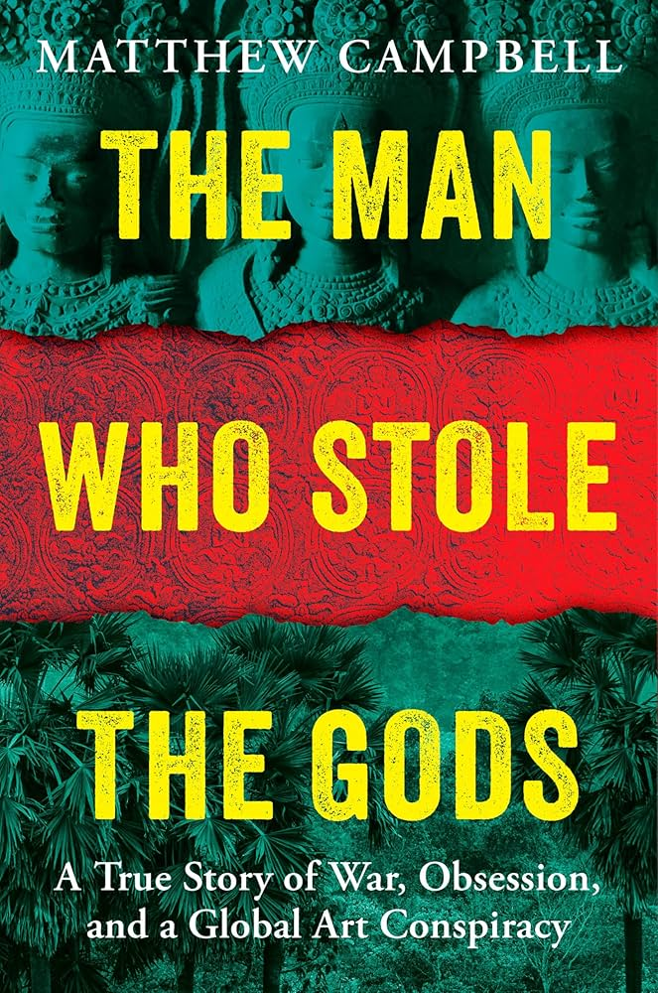
Matthew Campbell’s The Man Who Stole the Gods follows the journey of looted Khmer statues from remote Cambodian temples to the world’s most powerful museums.
Cambodia’s temples are not only spectacular monuments for travel photos; they are the heart of Khmer culture and a living record of centuries of faith and power. For much of the late twentieth century, however, some of the most sacred statues from these sites stood far away from Cambodia, displayed in quiet museum galleries in Europe and North America. In The Man Who Stole the Gods, Matthew Campbell reconstructs how these sculptures were taken, sold, and eventually traced back to the soil of Angkor and beyond.
The book opens in a Cambodia shattered by war and revolution. In the 1970s and 1980s, when the country was torn apart by conflict, looters moved through temple sites that had stood for centuries. Stone guardians of Hindu and Buddhist deities were wrenched from their pedestals in places like Koh Ker, Angkor, and remote provincial shrines. What might look to a visitor like timeless ruins were, in reality, being stripped of their most important figures. The story that Campbell tells is not abstract art history; it is a very concrete account of how statues left jungle sanctuaries in trucks and oxcarts, crossed borders, and entered a global trade that thrived on secrecy.
At the center of this narrative is Douglas Latchford, a British‑Thai dealer who presented himself as a connoisseur and protector of Khmer art. He co‑authored lavish books on Cambodian sculpture and worked closely with collectors, auction houses, and major museums. At the same time, he was quietly handling pieces that had been hacked out of temple walls, often only a few years earlier. The contrast is striking: on one side, the language of preservation and scholarship; on the other, the physical violence done to Cambodia’s cultural heritage. For readers interested in Cambodia, Southeast Asian history, or the ethics of travel and collecting, this double life makes the book particularly compelling.
Khmer culture, sacred art, and historical memory
One of the strengths of The Man Who Stole the Gods is the way it explains why these statues matter so much inside Cambodia. In many Khmer communities, temple sculptures are not just decorative art or archaeological “objects.” They are embodiments of deities, royal power, and collective protection. When a statue leaves its shrine, something more than stone is lost. By setting the story within the broader history of the Angkorian empire, French colonial archaeology, and the upheavals of the Khmer Rouge era, the book gives readers the context they need to understand this loss.
Campbell also shows how Cambodian historians, museum staff, lawyers, and village elders work together to identify and document looted pieces. Old photographs taken before the war become vital evidence. So do memories of local guardians, monks, and residents who remember exactly which statue stood where. This research, combined with growing international pressure around looted art, has led to the return of important Khmer sculptures from prominent collections. For anyone who loves Khmer culture, this part of the story carries a sense of cautious hope.
Why this book matters for today’s visitors to Cambodia
For modern travelers, The Man Who Stole the Gods offers a different way to see famous sites such as Angkor Wat, the National Museum in Phnom Penh, or smaller regional museums. It invites visitors to think not only about architectural beauty, but also about the journeys these statues have taken: from creation in the Angkorian period, through centuries of worship, to recent decades of theft and repatriation. The book encourages a more responsible approach to cultural tourism in Cambodia, where curiosity about history goes hand in hand with respect for local communities.
In the end, this is a story about more than crime. It is about how a nation damaged by war is fighting to reclaim its past, piece by piece. The Man Who Stole the Gods does not romanticize that struggle, but it does show how determined Cambodians are to ensure that their statues, and the stories they carry, remain part of Cambodia’s future as well as its history. For readers interested in Cambodian culture, global museum debates, or the darker side of the art market, it is an important and timely book.