Estimated reading time: 7 minutes – About the time it takes to watch one particularly energetic Reamker battle scene without wondering who is winning.
Peali ពាលី, the formidable green monkey king of the Khmer Reamker, is far more than a colorful warrior. His rivalry with Sugrib, extraordinary strength, and controversial death reveal a fascinating story about power, loyalty, justice, and the moral complications of heroism in Cambodian epic tradition.
Introduction: Who Is Peali in the Reamker?
Among the many memorable characters of the Reamker, Cambodia’s great epic based on the Indian Ramayana, few are as visually striking or morally intriguing as Peali (ពាលី), aka Vali, Valin or Bali. The green-faced monkey king is a powerful ruler, a formidable warrior, an older brother, and ultimately one of the most controversial victims of Preah Ream’s campaign.
For visitors discovering Cambodian mythology, Peali can initially seem like another member of the epic’s large monkey cast. There are, after all, quite a few monkeys in the Reamker, and they are not always introduced with convenient name tags. But Peali deserves closer attention. His story is central to the relationship between Peali, Sugrib, Preah Ream, and Angkut, and his death raises questions about justice that are unusually uncomfortable for a supposedly straightforward heroic epic.
This article looks at Peali’s identity, his extraordinary power, his conflict with his younger brother Sugrib, and the circumstances of his death. It also explains why his character continues to appear in Cambodian visual and performing arts.
Peali, the Green King of the Monkeys
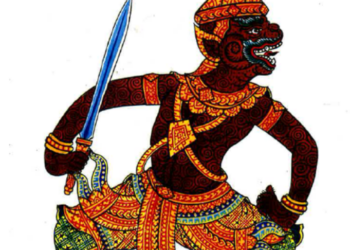
In the Khmer Reamker, Peali is the green king of the monkeys, ruling over Khahkhinn Borey, the monkey kingdom corresponding broadly to Kishkindha in the Sanskrit Ramayana tradition. Cambodian sources identify him as the son of Anchana and Indra, which explains his distinctive green complexion.
His younger half-brother Sugrib (សុគ្រិព) has a different divine parentage. Sugrib is associated with Preah Atitt, the Sun, and is traditionally represented with a red complexion. This difference in color is particularly useful in Cambodian performance and iconography, where audiences need to distinguish a large number of supernatural characters quickly.
Peali is therefore not simply “a monkey.” He is a king, a supernatural being, and a character whose appearance immediately identifies his position within the Reamker’s visual vocabulary.
Peali Thireach
Cambodian tradition also associates Peali with the name Peali Thireach, connected with his extraordinary strength. According to the Khmer account, Preah Eysaur gives him this name and presents him with a trident.
His strength is not ordinary royal muscle. Peali possesses supernatural power that makes him extraordinarily difficult to defeat. This matters enormously when his story reaches its inevitable family quarrel.
Because in epic literature, of course, being exceptionally powerful is often less a guarantee of happiness than an invitation to a complicated ending.
Peali and Sugrib: A Family Dispute Turns Into War
The heart of Peali’s story is his relationship with Sugrib.
The two brothers are initially connected through their royal family and the monkey kingdom. Their relationship, however, deteriorates after a dramatic episode involving an enemy and a cave. Sugrib believes that Peali has died and acts accordingly. When Peali survives and returns, he interprets Sugrib’s actions as betrayal.
The misunderstanding becomes a genuine political crisis.
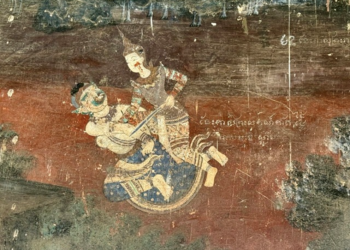
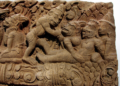
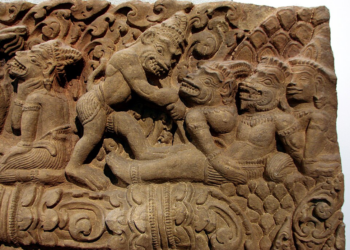
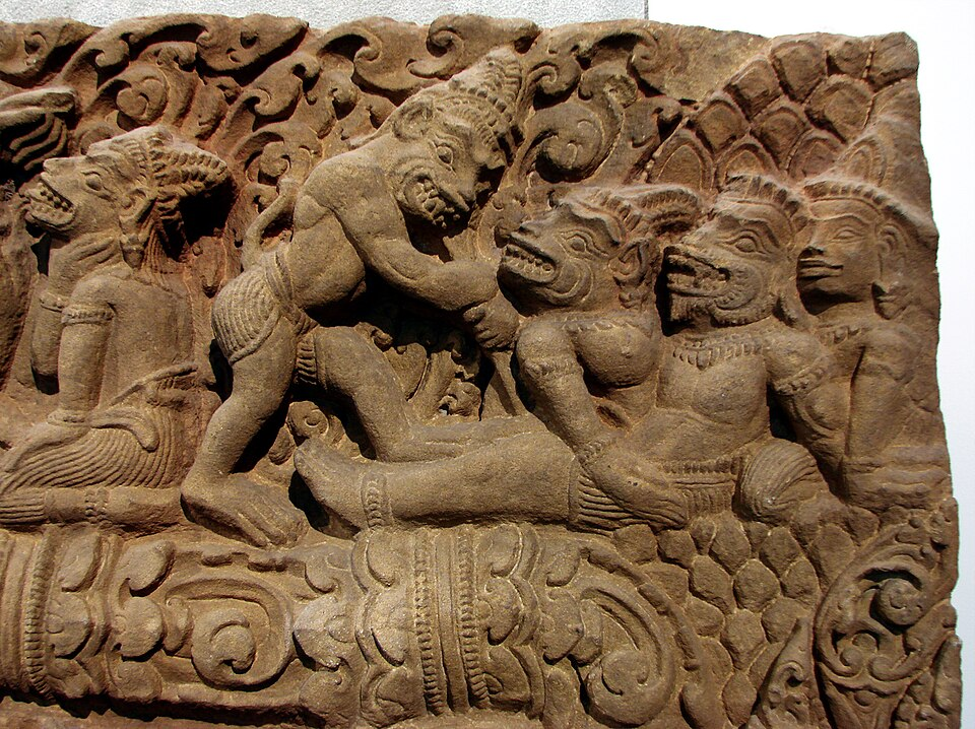
Peali takes control of the kingdom and forces Sugrib into exile. What begins as a dispute between brothers becomes a struggle over the throne. Cambodian depictions of the episode emphasize the physical violence of their confrontation, including the famous battle between the two monkey kings represented at Banteay Srei. The Authority for the Protection and Management of Angkor and the Region of Siem Reap has highlighted this battle as one of the temple’s narrative scenes.
The episode is important because neither brother exists in isolation. Their conflict eventually becomes entangled with the much larger struggle involving Preah Ream and Krong Reap.
Why Sugrib Needs Preah Ream
Sugrib’s exile eventually brings him into contact with Preah Ream, the hero of the Reamker.
Sugrib needs help recovering his kingdom. Preah Ream, meanwhile, needs allies in his search for Neang Seda, who has been abducted by Krong Reap.
A pact is therefore established.
Preah Ream will help Sugrib defeat Peali and regain his throne. In return, Sugrib will support Preah Ream’s campaign.
It is a perfectly practical political alliance, but it also changes the moral landscape of the story. Peali is not Preah Ream’s principal enemy. He has not abducted Neang Seda, invaded Preah Ream’s kingdom, or declared war on him.
He is, essentially, somebody else’s problem.
And yet Preah Ream agrees to solve it.
The Death of Peali
The confrontation between Peali and Sugrib is one of the most dramatic episodes of the Reamker.
Sugrib challenges his elder brother, but Peali’s supernatural strength makes the fight extremely difficult. Preah Ream therefore intervenes. According to Cambodian accounts of the episode, Preah Ream ultimately kills Peali with an arrow while Peali is fighting Sugrib, rather than facing him in a direct duel.
This detail is crucial.
Peali questions the morality of the act because he has not been engaged in combat with Preah Ream himself. The episode consequently becomes more than a story about a hero defeating a powerful antagonist. It becomes a question about justice and the means by which justice is achieved.
A particularly interesting Khmer interpretation emphasizes precisely this problem. Peali’s death is presented as a challenge to the moral authority of Preah Ream, who is otherwise associated with justice and humanity.
This is one reason Peali remains such a fascinating Reamker character. He loses the battle, but he does not simply disappear into the category of “bad guy defeated by good guy.” His death leaves a moral question hanging in the air.
A Powerful King, But Not a Simple Villain
It is tempting to reduce Peali to a villain because he takes his brother’s throne. That interpretation, however, misses much of the complexity of the character.
Peali is certainly proud and capable of violence. His treatment of Sugrib is central to the conflict and ultimately costs him his kingdom and his life. Yet his story is built around misunderstanding, competing claims, family loyalty, political authority, and revenge.
The Reamker itself is deeply concerned with morality, karma, loyalty, and justice. Its characters frequently find themselves caught between competing obligations rather than simply choosing between good and evil. Cambodian scholarship on Peali specifically notes the connection between the episode and ideas of morality, social justice, karmic law, and the conduct expected of rulers.
Peali therefore works particularly well as a tragic character.
He is powerful enough to frighten others, but not powerful enough to escape destiny. He is a king, but loses his kingdom. He is a warrior, but dies without receiving the conventional heroic confrontation one might expect. And he is a brother whose family dispute eventually becomes part of Preah Ream’s larger mission.
Peali in Cambodian Art and Performance
Peali’s importance is not confined to the written or oral story.
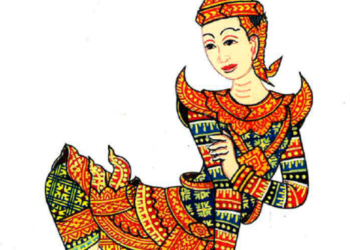
The Reamker has long been expressed through Khmer classical dance, masked theater, murals, sculpture, illustrated narratives, and other performing and visual arts. The battle between Peali and Sugrib is particularly well suited to performance because it combines action, recognizable characters, dramatic gestures, and a clear narrative conflict.
His green appearance also makes Peali particularly easy to identify.
For anyone watching a Cambodian Reamker performance, remembering a few basic visual clues can make the story much easier to follow:
Peali is green. Sugrib is red.
That little distinction is surprisingly useful when several monkey warriors are leaping around the stage with considerable enthusiasm.
Peali’s story also survives in the monumental narrative art of Cambodia. The battle between the two brothers at Banteay Srei is a good example of how episodes from the Ramayana tradition were transformed into Khmer artistic language.
Peali and Angkut
Peali’s story also continues through his son, Angkut (អង្គុត), corresponding to Angada in the broader Ramayana tradition.
After Peali’s death, Angkut becomes part of the monkey forces supporting Preah Ream. His presence gives the story another layer of irony. The son of the king killed by Preah Ream eventually becomes involved in the hero’s campaign.
This is one of the Reamker’s recurring strengths. Characters are connected by family, obligation and circumstance in ways that rarely allow a clean break between one episode and the next.
Peali may die, but his lineage and political legacy continue.
Peali Beyond the Reamker
There is another interesting reason the name Peali remains familiar in Cambodia.
The figure of Krong Peali has also acquired a life beyond the narrative of the Reamker. Cambodian traditions include ceremonies and offerings associated with Krong Peali, reflecting a broader cultural presence of the figure. AMS Khmer Civilization notes that Cambodians organize offerings connected with Krong Peali and that the character is strongly embedded in Cambodian belief and ritual practice.
This does not mean that every contemporary reference to Krong Peali should automatically be treated as identical to the dramatic character in every version of the Reamker. Rather, it demonstrates how figures originating in epic and religious traditions can develop wider cultural meanings over time.
That is one of the pleasures of studying Cambodian mythology. Characters do not always remain politely inside the pages of a single story.
Why Peali Matters
Peali is one of the best characters through whom to understand the complexity of the Cambodian Reamker.
His story introduces the reader to the monkey kingdom, the relationship between Peali and Sugrib, the alliance between Sugrib and Preah Ream, and the wider political world surrounding the search for Neang Seda. But it also introduces something more subtle: the possibility that a righteous hero can perform an act that deserves questioning.
That tension gives Peali unusual dramatic dignity.
He is defeated, but not entirely silenced. His challenge to Preah Ream forces the audience to think about justice rather than simply applaud victory. In this respect, Peali is not merely one of the Reamker’s colorful supporting characters. He is one of the characters who makes the epic morally interesting.
Conclusion
Peali ពាលី, the green monkey king of the Reamker, embodies the epic’s fascination with power, family conflict, justice and fate. His rivalry with Sugrib leads directly to his confrontation with Preah Ream, while his controversial death leaves one of the story’s most intriguing moral questions. For anyone exploring Cambodian mythology, Peali is a reminder that the Reamker is not simply an adventure story with gods, demons and spectacular monkeys. It is also a meditation on what happens when loyalty, justice and power collide.
About the author
Pascal Médeville is a writer and digital publisher based in Cambodia and the author of Wonders of Cambodia. His interests include Cambodian history, culture, literature, art, architecture and everyday life, which he explores through accessible articles that connect historical research with contemporary Cambodia.