In Cambodia’s version of the Ramayana, Dasharatha – the father of Rama – appears as more than a tragic old monarch. The Reamker gives him an emotional complexity and cultural flavor that feels distinctly Khmer, balancing divine duty with human frailty and royal heartbreak.

The father who sets everything in motion
Dasharatha (Khmer: ទសរថ, pronounced Tusarot) may not be the star of the Reamker, but without him, there would be no story to tell. He is the aged king whose decisions – driven by promises, fate, and paternal pain – send Rama into exile and set the wheels of cosmic justice in motion. Through him, the Cambodian epic mirrors both the grandeur of India’s Ramayana and the softer, more human tones of Khmer storytelling.
This article looks at Dasharatha’s role in the Reamker, the Cambodian adaptation of the Ramayana, exploring how he embodies the Khmer idea of moral kingship. It’s written for lovers of Southeast Asian mythology, history, and literature – especially those curious about how Indian epics took root and blossomed in Cambodia’s cultural soil.
By the end, you’ll see that Dasharatha’s sorrow isn’t just legendary; it’s profoundly relatable. His story is about promises that cannot be broken – and hearts that inevitably are.
Dasharatha’s Character in the Reamker
A king caught between love and duty
In the Reamker, Dasharatha is known as “Preah Dasaratha,” and he is portrayed not only as the father of Preah Ream (Rama) but as a ruler torn between righteousness and attachment. The story closely follows the Sanskrit original’s emotional core, but Cambodian narrations tend to emphasize his compassion and his sense of cosmic responsibility.
Unlike the rather austere image of the Indian Dasharatha, the Khmer version paints him as emotionally generous – so much so that he’s occasionally mocked by storytellers for being “too soft-hearted for a king.” He doesn’t just order Rama’s exile; he suffers visibly, lamenting that kingship without the son’s presence feels “like sunrise without color.” In traditional performances of the Reamker dance drama, when Dasharatha mourns, the music slows and becomes heavy with sorrow – a rhythm that Khmer audiences intuitively recognize.
The binding promise: Kaikeyi’s request
As in the Indian Ramayana, the pivotal moment is Kaikeyi’s fateful demand: that her son Bharata inherit the throne, and Rama be banished for fourteen years. But the Reamker adds local flavor – Kaikeyi (Preah Kaikey) is often portrayed with more sympathy, sometimes as a queen swayed by spirits or destiny rather than malice. This shift subtly changes our view of Dasharatha: he’s less the helpless husband, more the man caught in a web woven by karma.
In Khmer literature, a king’s baramey – his spiritual merit – is what sustains his kingdom. Dasharatha’s compliance, despite unbearable personal cost, reflects that ideal: a ruler must uphold promise and principle above all things. It’s a distinctly Buddhist interpretation grafted onto a Hindu tale, emphasizing impermanence and the inevitability of suffering in human life.
The Khmer Reinterpretation of Royal Suffering
From Ayodhya to Angkor: a story re-rooted
When the Ramayana reached mainland Southeast Asia, probably via trade and royal cultural exchanges around the first millennium CE, the story transformed in fascinating ways. In Cambodia, it became the Reamker (“Rama’s glory”), rendered in beautiful Khmer verse and later adapted into murals, dance dramas, and royal literature.
Dasharatha’s grief resonated deeply in the Khmer worldview, where kingship was seen as both sacred and sacrificial. The ideal monarch wasn’t triumphant but self-disciplined, ready to relinquish personal joy for universal balance. Seen through that lens, Dasharatha became not a weak old man, but a philosophical model – a king who recognizes the transient nature of power and affection.
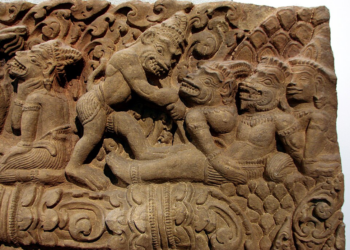
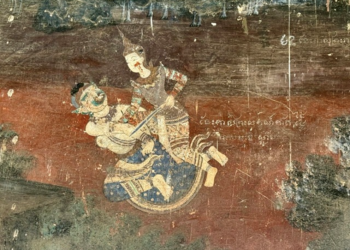
In sculpture and mural, his scenes are rare but poignant: Dasharatha, eyes downcast, surrounded by courtiers who dare not comfort him. It is a moment that humanizes divine law.
Court poets in pre-modern Cambodia loved invoking Dasharatha as an example of royal restraint. Some inscriptions even mention the name in ritual prayers to remind rulers that compassion must temper ambition. His decision to honor Kaikeyi’s request – even when it broke his heart – became a template for just governance: the notion that promises must be kept for the sake of moral continuity.
This principle parallels the Buddhist teaching of sacca (truthfulness) and khanti (patience) – qualities considered essential for kings seeking enlightenment through leadership.
The Emotional Language of Kingship
From epic to emotion: Dasharatha’s lament
In many Cambodian tellings, Dasharatha’s death scene is rendered with piercing emotional simplicity. He calls for Rama one last time, and in that breath, the audience feels both familial yearning and universal sorrow. It’s the human voice inside the cosmic narrative.
Traditional performers often describe Dasharatha as the king whose tears made Rama’s exile sacred. That phrasing might sound poetic, but it reflects a deep cultural truth: emotion validates duty. In Khmer dramaturgy, no heroism stands complete without compassion – and Dasharatha provides precisely that balance.
Lessons from a royal heartbreak
Why focus on Dasharatha today? Because his story bridges worlds. It shows how a tale from India could become timelessly Cambodian not by repetition, but by resonance. It also reminds us that leadership, both ancient and modern, often demands personal sacrifice – something Cambodia’s historical kings understood all too well.
If Rama is ideal virtue, Dasharatha embodies the virtue’s cost. He’s the man who proves that even divinely inspired rule comes with human pain. And that, perhaps, is the most Cambodian idea of all.
Scholars reading the Reamker often note how Dasharatha’s story sets the moral tone for the entire epic. Without his act of renunciation, Rama’s journey could not symbolize detachment or virtue. In the Buddhist-infused Khmer version, the entire chain of events – the exile, the war with Ravana (Krung Reap), the restoration of harmony – represents a cycle of moral purification that begins with the king’s self-renunciation.
Dasharatha’s pain is thus not a flaw, but the first step toward cosmic healing. Through his tears, the world learns its lesson.
One of the subtle yet enduring differences between the Indian and the Khmer portrayals lies here: the Reamker turns the drama of rule into a meditation on impermanence. Khmer art and literature consistently take royal imagery and fill it with Buddhist insight, showing that true power lies not in conquest, but in compassion. Dasharatha is the epitome of that ideal.
Dasharatha in the Reamker isn’t just an echo of India’s epic king – he’s an embodiment of Khmer values: compassion, duty, sacrifice, and the bittersweet wisdom that comes from renouncing attachment. His story gently reminds us that every great destiny begins with a choice that hurts.
Pascal Médeville is a writer and digital publisher based in Cambodia. He specializes in Southeast Asian culture, mythology, and culinary traditions. His articles blend research with storytelling, exploring how ancient tales – like the Reamker – still shape modern Cambodian identity and imagination.