(Estimated reading time: 10 minutes – just enough to finish a Khmer coffee before it gets cold.)
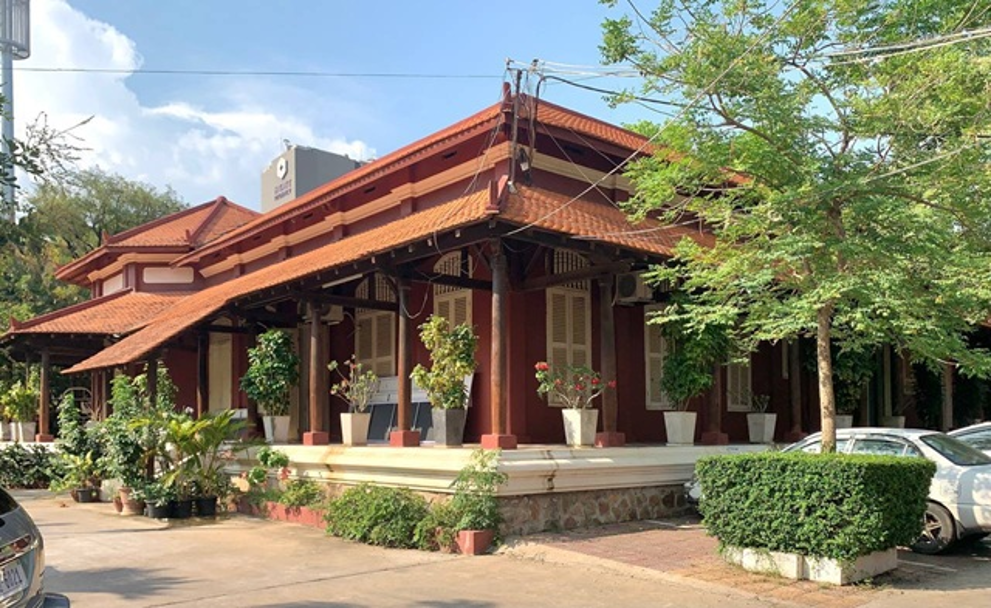
Behind the elegant red pavilions of Phnom Penh’s Royal University of Fine Arts lies a story of strategy, anxiety and aesthetics. This article explores how George Groslier, a French painter born in Cambodia, used the École des arts cambodgiens to “renovate” Khmer arts under the Protectorate. Between protection and control, patriotism and propaganda, we revisit the birth of modern art education in Cambodia.
Introduction: A School, a Museum, and a Mission
When you visit Phnom Penh’s Royal University of Fine Arts (RUFA), near National Museum of Cambodia and the Royal Palace, it is easy to be charmed by the graceful roofs and lotus ponds and forget that the whole ensemble was once a colonial project with a very precise agenda. The École des arts cambodgiens (Cambodian School of Arts), created between 1917 and 1920, did not appear out of nowhere, it answered French political concerns and a very personal vision of Khmer art promoted by George Groslier.
This article is for readers who love Cambodian culture but also enjoy peeking behind the façade to see how institutions are built, framed and used. We will look at the context before 1917, Groslier’s idea of “true” Khmer art, and how his program shaped the training of Cambodian artisans for decades. Along the way, we will see that “saving” art often came with conditions attached.
If you are a cultural traveler, a heritage professional or simply someone who has walked through the RUFA compound and want to know “who organized all this,” this story will give you a clearer picture of how colonial policy, royal initiatives and one determined art enthusiast twisted together to create the École des arts cambodgiens.
Before Groslier: Royal Workshops and Early Experiments
Court ateliers and the “royal manufacture”
Long before the French decided to reorganize Cambodian arts, the king already sustained a dense network of palace workshops. Painters, sculptors, goldsmiths and weavers worked in the royal ateliers, producing everything from dance costumes for the Ballet to ritual objects for the palace and pagodas.
In 1907, King Sisowath’s government tried to modernize this system by creating a “Manufacture royale” with two sections, one for jewelry and objects of art, the other for sewing, embroidery and weaving. The idea was to give traditional crafts new economic outlets, while still serving the needs of the palace. French observers liked to compare this initiative to the Manufacture de Sèvres in France, which had impressed the Cambodian delegation during their 1906 trip.
The short life of the École royale des Arts décoratifs
A second step came in 1912 with the creation of an École royale des Arts décoratifs, tasked with “developing and perfecting Cambodian arts.” The Manufacture was transformed into a “Magasin central,” and some workshops were even moved outside the palace, under the responsibility of princes, princesses or mandarins willing to invest their own resources.
On paper, it looked promising in practice, not so much. By 1917 the school had only around ten pupils, all under sixteen, and the results were judged disappointing for the royal treasury. For George Groslier, this “relative failure” was the proof that a more radical, independent art school was necessary one that would train artisans for a wider clientele beyond the court and fit into a reorganized colonial system.
The colonial administration joins the game
The Protectorate was not idle either. In 1913, the French set up an artistic section inside the professional school of Phnom Penh, with the right to sell works. But four years later they decided this small section was not enough and needed to be replaced by a fully-fledged art school separated from technical training.
All these experiments, royal and colonial, shared one concern: revive Khmer artistic practices by giving them economic value in a changing society. None of them, however, created the kind of centralized institution that Groslier would imagine in 1917 a Palais des Arts combining school, museum, administration and commercial outlet in one coherent machine.
Enter George Groslier: Painter, Planner, and Cultural Strategist
George Groslier (1887–1945) was not just any French official, he was a painter trained at the École des Beaux-Arts in Paris and, importantly, born in Phnom Penh. His father worked for the Protectorate administration, and although George returned to France as a child, he came back to Cambodia in 1910, spending months in Angkor studying ancient Khmer art.
By the time he was called in 1917, he had already written studies and lectures on Khmer art, including Danseuses cambodgiennes anciennes et modernes, published in 1913. His personal connections also helped: Governor General Albert Sarraut knew him through family ties and used a convenient “urgent aviation mission” to pull him away from the European front during the First World War and send him to Cambodia on a six‑month study mission.
A mission with very clear objectives
Groslier’s official task was to propose “the organization of a school of applied art” for Cambodia. He arrived in Phnom Penh in June 1917, was asked to study the situation on the ground, and to submit a rational plan, aligned with the orientations given by the Resident Superior and the Governor General.
His report of July 1917 did not limit itself to education it outlined a complete system for “the organization of the arts in Cambodia,” including a museum for Khmer art, an administrative “Direction des Arts,” and an art school tightly linked to both. The idea was ambitious, and the colonial authorities, who needed cultural legitimacy in the Protectorate and a good story for the French public, were delighted.
How Groslier Saw Khmer Art: Beauty, Anxiety and Stereotypes
Groslier liked to repeat that in Cambodia, the “work of art” in the European sense did not really exist: the sculptor decorated an ox‑cart yoke, a Buddha pedestal or a rice spoon, not a purely ornamental statue sitting uselessly on a console. Khmer art, for him, was fundamentally applied and present in everyday objects, which made it both omnipresent and fragile.
Because these artefacts were used, worn out and broken, he described Khmer artistic heritage as “by definition utilitarian and exposed to all the incidents of daily life.” Add to that political troubles, wars with neighbors and the new colonial situation, and Groslier painted a picture of an art on the brink of disappearance, unless France intervened decisively.
The “traditional” artisan and his limits
In a very early‑20th‑century colonial style, Groslier insisted that Cambodian artisans were trained to imitate, not to innovate. Arts were learned in pagodas and workshops by repeating what the master had himself learned, generation after generation, without written treatises or alternative references. This system, he argued, produced skilled hands but no individual creators in the European sense.
He also generalized rather confidently about the “psychology of the Cambodian artisan,” depicting the Khmer people as conservative, docile, respectful of hierarchy and tradition. These qualities, in his view, explained why artisans followed patterns faithfully but were also extremely vulnerable to outside influences, copying foreign models as easily as ancient Khmer ones.
From this diagnosis, Groslier developed a doctrine: Khmer art was both admirable and “moribund,” rigidified by its own traditionalism yet dangerously exposed to Siamese, Vietnamese and now European influences. The answer, in his view, was not to “Westernize” it but to renovate it from within, by reconnecting artisans with classical models and organizing their training and market in a modern way.
Behind this rhetoric lay a neat ideological bonus for the Protectorate: if Khmer art and even “Khmer culture” were supposedly threatened with extinction, France could present itself as the generous savior, justifying its presence in Indochina as a civilizing and protective mission.
The 1917 Program: A Palais des Arts for Cambodia
School, museum and Direction des Arts
In his 1917 report, Groslier proposed a three‑part structure: an École des arts cambodgiens, a new museum of Khmer art and a Direction des Arts in charge of sales, propaganda and technical supervision. All three would be grouped in a single “Palais des Arts,” for autonomy and maximum economy, with workshops, museum galleries, storage, offices and director’s housing on one site.
He insisted that one should not simply “teach an art” and hope it would survive. It was necessary to study ancient Khmer art in detail, to fix its principles, to document old techniques, to select current methods, and to organize a market that would support the artisans economically. It sounds very modern, except for the small detail that all of this would be tightly managed by a colonial administration.
A double leadership: director vs. “Director of Arts”
Groslier clearly separated the role of the school administrator and that of the “Director of Arts.” The former would manage daily life: accounts, materials, staff, student discipline. The latter would define artistic orientations, supervise Cambodian teachers, study old and foreign artistic principles, and decide how to combine them. In other words, one person to handle the paperwork, another to hold the aesthetic steering wheel.
At least on paper he suggested these should be two different individuals, although he accepted to cumulate both functions at the beginning while the school was being set up. His program was quickly accepted, and from January 1918 he was responsible for implementing it, while supervising the installation of the museum and the future “Bloc des Arts” building completed in 1919.
Corporations and existing artisans
One delicate question was how not to kill the existing artisan network by creating a powerful state school that would compete with them. Groslier insisted the school should work with contemporary artisans, not against them, and proposed the creation of “Corporations cambodgiennes” to organize them by trade and link them to the new system.
In practice, this meant that the school would train new artisans and give them access to museum models and modern tools, while the Direction des Arts would help sell their work alongside that of independent craft workers. This was both a way to protect a fragile ecosystem and a way to control it.
Inside the École des arts cambodgiens: Students, Workshops and Ideology
Admission to the school was restricted to young boys between 14 and 15 years old, who could read and write Khmer and preferably had already done a spell at the pagoda. Being presented by a “recommender” was also encouraged, a nice way to filter candidates through social networks. French language was optional, which sounds generous but also kept the students anchored primarily in a Khmer environment.
Groslier saw these conditions as a way to admit “only young people already saturated with tradition and whose Cambodian identity appears indisputable.” For students coming from the provinces, a boarding system for about thirty internal pupils was planned, with the expectation that they would return to their provinces to practice after their studies.
The École des arts cambodgiens was structured around six main workshops, each corresponding to an art practiced in Cambodia:
- Jewelry: goldsmithing, jewelry, damascening, enameling on metal
- Cabinetmaking: woodwork, gilding, lacquer
- Foundry
- Modeling in wax and clay: pottery, molding
- Weaving: especially for female students
- Drawing and architecture: plan drawing, estampage (rubbing and taking impressions)
All of this was placed under a paradoxical principle that Groslier summarized in one formula: “do only Cambodian art and do it in Cambodian fashion.” Teachers and students would be Cambodian, techniques would be Cambodian, but the overall direction, budget, and strategic choices remained firmly in French hands.
The school was officially under the control of the Cambodian Minister of Fine Arts (Oknha Veang Thiounn), and a Committee of Improvement presided over by the Resident‑Mayor of Phnom Penh. In 1922 it was attached to the Indochinese Department of Public Instruction, while still falling under the technical and artistic oversight of the Direction des Arts.
In everyday practice, that meant a dual system: Cambodian professors and workshop heads taught students in Khmer, using techniques and patterns drawn from Angkor, the palace and traditional crafts, while a European director (first Groslier, then André Silice) ensured conformity with the program and with colonial expectations. The dream of “Cambodian art made in Cambodian fashion” thus came with a carefully supervised frame.
Conclusion: Heritage, Power and the Legacy of a School
The École des arts cambodgiens was born from an encounter between royal experiments, colonial strategy and George Groslier’s very personal vision of Khmer art. It contributed to preserving techniques and motifs that might otherwise have been weakened by rapid social change, but it did so while centralizing control of artistic production and defining what counted as “authentic” Cambodian art.
When we admire the refined silverwork, lacquered boxes or silk textiles from that period, we are looking not only at “traditional” Khmer arts, but at creations shaped by a school designed to renovate, discipline and market them. Understanding this layered history allows us to appreciate the beauty of the objects while keeping a clear eye on the politics that accompanied their “protection.”
For a more in-depth exploration of the École des arts cambodgiens, see Gabrielle Abbe’s article “Le Développement des Arts au Cambodge à l’Époque Coloniale : George Groslier et l’École des Arts Cambodgiens (1917–1945)” (in French), published in Udaya, Journal of Khmer Studies, no. 12, 2014. An online version is available here.
About the author
Pascal Médeville is a writer and digital publisher based in Cambodia. He runs the Wonders of Cambodia website, where he explores Khmer history, arts and everyday culture for an international audience. He writes regularly about heritage, colonial archives and the living traditions that still shape Cambodia today.