Introduction
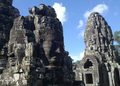
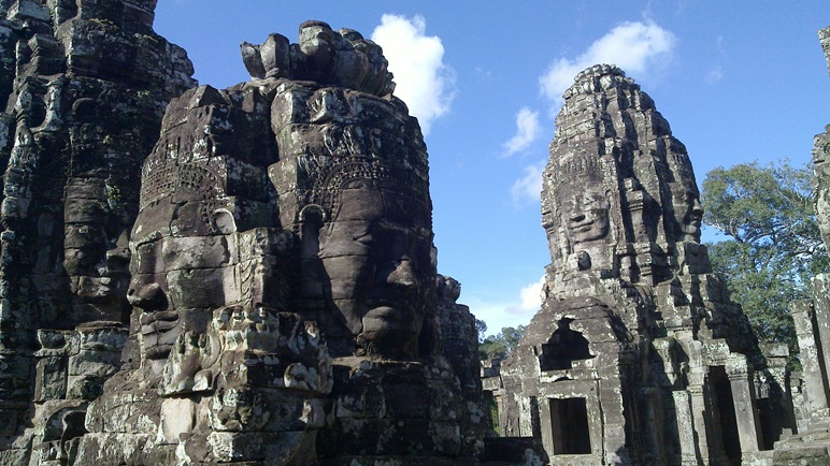
You enter Bayon expecting a temple. Instead, you discover that the temple appears to be looking back at you. Huge stone faces emerge from the towers of Bayon, their eyes lowered, their lips curved into an expression that is neither quite a smile nor quite a secret. They appear everywhere, facing the cardinal directions, so that wherever you stand, one of them seems to be watching.
But who are they?
For more than a century, scholars have debated the answer. The most familiar explanation is that the faces represent Avalokiteshvara, the Mahayana Buddhist bodhisattva of compassion. Yet many scholars have also seen the features of King Jayavarman VII in them. The interesting possibility is that the two interpretations may not have been mutually exclusive.
A temple full of faces
Bayon was built during the reign of Jayavarman VII, at the end of the 12th and beginning of the 13th century, in the center of his royal city, Angkor Thom. It became the great religious monument of his Mahayana Buddhist kingdom.
The faces are the temple’s most unforgettable feature. Towers rise like a strange stone forest, many carrying three or four enormous faces. They look remarkably similar to one another, with broad foreheads, long earlobes, elaborate ornaments and a calm, almost meditative expression.
And then there is that smile. It is remarkably restrained. These are not faces laughing at a particularly good joke. They seem peaceful, composed and faintly amused by the difficulties of being human. The National Museum of Cambodia describes the characteristic Bayon-style expression as conveying knowledge, compassion and peacefulness.
So, are they Buddhist or royal?
This is where things become interesting.
The traditional scholarly interpretation identifies the faces with Avalokiteshvara, known in Khmer contexts as Lokesvara, the bodhisattva associated with compassion. The multiple faces facing in different directions fit such an interpretation particularly well.
But the faces also bear a striking resemblance to surviving portraits of Jayavarman VII. His sculptures show a mature man with a rounded face, lowered eyes and the same remarkably serene smile. The Musée Guimet notes that this naturalistic style was characteristic of the Bayon period.
So perhaps the faces were intended to evoke both the king and the bodhisattva. That would make considerable sense in the religious and political world of Jayavarman VII. The king presented himself as an exemplary Buddhist ruler, while the imagery of his reign repeatedly connected kingship, compassion and Buddhist devotion. Scholars therefore increasingly treat the identity of the faces as deliberately ambiguous rather than a problem requiring one tidy answer.
Why are they smiling?
There is another small mystery here.
The expression is not simply decorative. The Bayon faces were part of a larger religious idea. The temple was conceived as a representation of Mount Meru, the cosmic mountain at the center of the Buddhist and Hindu universe. The towers rise around the central sanctuary like a mountainous landscape, with the faces extending their presence in every direction.
In other words, the smiling faces were not placed there merely because ancient Khmer sculptors had an unusually cheerful day at work. Their serenity communicates something. They suggest compassion, calm and an ordered universe. At the same time, their resemblance to the king creates a powerful political image: the ruler’s benevolent presence extends throughout the kingdom.
A face looking in every direction is a rather effective way of saying, I am here.
The smile is the real clue
Perhaps the most revealing thing about Bayon is that the faces do not look triumphant.
Angkorian kings built enormous monuments to demonstrate power, but Jayavarman VII’s artistic image is unusually human. His portraits do not present him as a young, flawless warrior. They show a mature man, inward-looking and composed. The giant faces repeat that expression on an almost absurd scale. You can stand beside one and feel that you are being watched by a king, a bodhisattva, or perhaps both. The uncertainty is part of the experience.
Conclusion
The smiling faces of Bayon remain mysterious because we want ancient images to behave like labels. King or deity? Buddhist or Hindu? Portrait or divine symbol? Bayon refuses to make things quite so easy.
Perhaps that is precisely why the faces still work so well. They do not shout their meaning. They simply look down with extraordinary calm, their faint smiles surviving centuries of political change, religious transformation and modern tourism. And after a few minutes among them, you may find yourself smiling back. That seems like a perfectly reasonable response to a temple that has been smiling at Cambodia for eight centuries.