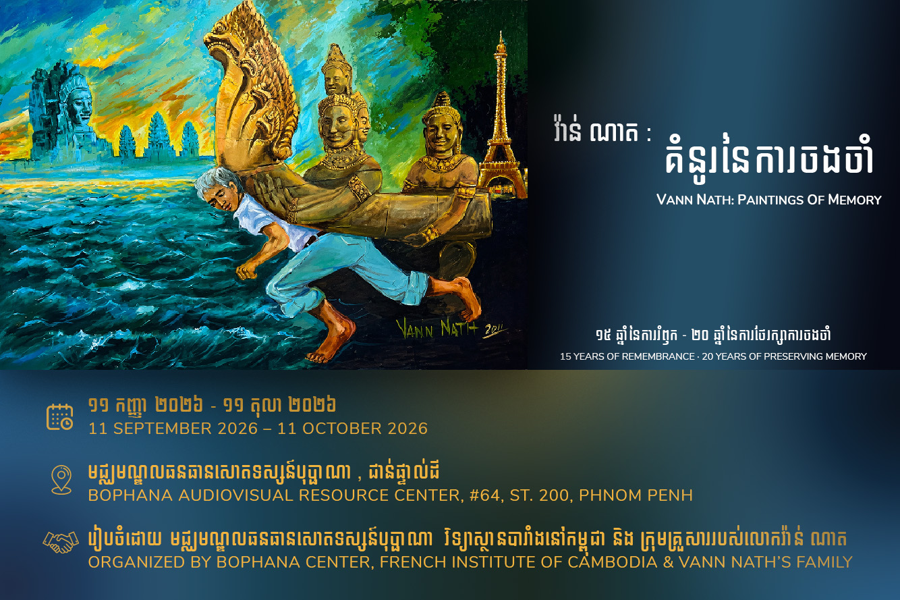
An exhibition at Bophana Center brings the paintings, voice, and memories of one of Cambodia’s most important artists back into focus.
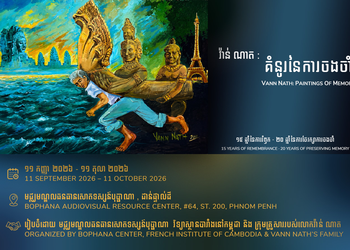
Fifteen years after the death of Cambodian painter Vann Nath, his art returns to public view in a poignant exhibition at the Bophana Audiovisual Resource Center in Phnom Penh.
“Vann Nath: Paintings of Memory,” running from September 11 to October 11, 2026, brings together paintings preserved in Cambodia, including works from the artist’s family as well as pieces lent by friends and collectors. The paintings are presented alongside audiovisual material from the Bophana archives, allowing visitors to encounter not only Vann Nath’s images, but also his voice, testimony, and reflections on art and memory.
Vann Nath is perhaps best known internationally as one of the few survivors of S-21, the Khmer Rouge security prison in Phnom Penh, now known as the Tuol Sleng Genocide Museum. His artistic skills helped him survive the prison, where he was assigned to work in its artists’ workshop.
After the fall of the Khmer Rouge regime, he transformed his memories into paintings. His powerful depictions of imprisonment, torture, starvation, and executions at S-21 became some of the most recognizable artistic testimonies of the Cambodian genocide. His paintings did something that photographs and written records could not quite do: they conveyed not only what had happened, but something of what it felt like to have witnessed it.
Yet Paintings of Memory deliberately looks beyond Vann Nath solely as a survivor and witness.
The exhibition also presents works depicting portraits, landscapes, everyday scenes, and other subjects, reminding visitors that Vann Nath was an artist with a broader creative life. His experience of history was profound, but it did not entirely define his artistic imagination.
That distinction matters. Vann Nath did not spend his life painting only darkness. His work also shows an enduring sensitivity to people, nature, beauty, and ordinary Cambodian life.
Another important dimension of the exhibition is the presence of Vann Nath’s recorded voice. Bophana’s audiovisual archives contain recordings in which he discussed his paintings, his experiences, memory, and the responsibilities of an artist. Placing these recordings beside the paintings creates an unusual encounter across time: the visitor sees the work while hearing the man who created it reflect upon its meaning.
In this sense, Vann Nath: Paintings of Memory is not simply an art exhibition. It is also an exhibition about how Cambodia remembers.
As the generation that directly experienced the Khmer Rouge period gradually disappears, paintings, photographs, films, recordings, documents, and personal testimonies become increasingly important carriers of memory. Bophana Center’s work is particularly significant in this respect, preserving Cambodia’s audiovisual heritage and making it accessible to new generations.
For visitors interested in Cambodian history, contemporary art, or the ways in which societies preserve difficult memories, this exhibition offers an opportunity to encounter Vann Nath beyond the familiar images of S-21.
His paintings remain witnesses. But they are also paintings. And that is perhaps one of the most important things this exhibition asks us to remember.
Exhibition details
Vann Nath: Paintings of Memory
September 11 to October 11, 2026
Bophana Audiovisual Resource Center
#64, Street 200, Phnom Penh
Admission: Free
Bophana Center is open Monday to Friday from 8am to 12pm and 2pm to 6pm, and Saturday from 2pm to 6pm.
Official exhibition page:
https://memory.bophana.com/events/vann-nath-paintings-of-memory?lang=en