Wonders of Cambodia
  • Home
  • Culture
  • Cuisine
  • Tourism
  • Business
  • Life in Cambodia
  • 中文
  • ខ្មែរ
  • Français
  • Tiếng Việt
  • e-Books
No Result
View All Result
  • Home
  • Culture
  • Cuisine
  • Tourism
  • Business
  • Life in Cambodia
  • 中文
  • ខ្មែរ
  • Français
  • Tiếng Việt
  • e-Books
No Result
View All Result
Wonders of Cambodia
No Result
View All Result
Home Books

Reference: Stolen Gods of Angkor – Cambodia’s Lost Statues

Pascal Medeville by Pascal Medeville
June 21, 2026
in Books, Reference
Reading Time: 4 mins read
0

Matthew Campbell’s The Man Who Stole the Gods follows the journey of looted Khmer statues from remote Cambodian temples to the world’s most powerful museums.
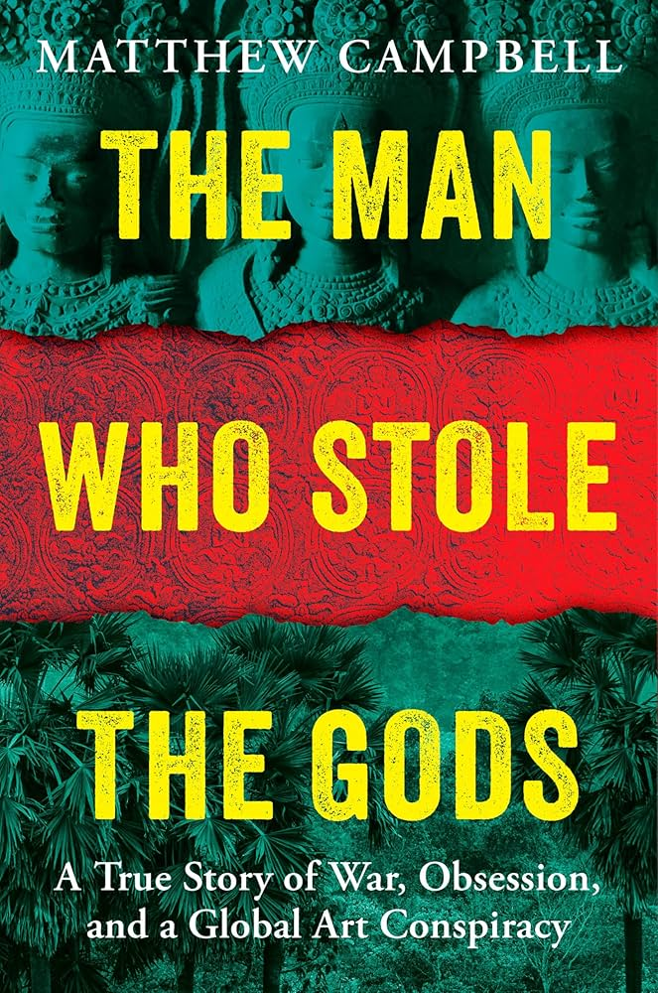
Cambodia’s temples are not only spectacular monuments for travel photos; they are the heart of Khmer culture and a living record of centuries of faith and power. For much of the late twentieth century, however, some of the most sacred statues from these sites stood far away from Cambodia, displayed in quiet museum galleries in Europe and North America. In The Man Who Stole the Gods, Matthew Campbell reconstructs how these sculptures were taken, sold, and eventually traced back to the soil of Angkor and beyond.

The book opens in a Cambodia shattered by war and revolution. In the 1970s and 1980s, when the country was torn apart by conflict, looters moved through temple sites that had stood for centuries. Stone guardians of Hindu and Buddhist deities were wrenched from their pedestals in places like Koh Ker, Angkor, and remote provincial shrines. What might look to a visitor like timeless ruins were, in reality, being stripped of their most important figures. The story that Campbell tells is not abstract art history; it is a very concrete account of how statues left jungle sanctuaries in trucks and oxcarts, crossed borders, and entered a global trade that thrived on secrecy.

At the center of this narrative is Douglas Latchford, a British‑Thai dealer who presented himself as a connoisseur and protector of Khmer art. He co‑authored lavish books on Cambodian sculpture and worked closely with collectors, auction houses, and major museums. At the same time, he was quietly handling pieces that had been hacked out of temple walls, often only a few years earlier. The contrast is striking: on one side, the language of preservation and scholarship; on the other, the physical violence done to Cambodia’s cultural heritage. For readers interested in Cambodia, Southeast Asian history, or the ethics of travel and collecting, this double life makes the book particularly compelling.

Khmer culture, sacred art, and historical memory

One of the strengths of The Man Who Stole the Gods is the way it explains why these statues matter so much inside Cambodia. In many Khmer communities, temple sculptures are not just decorative art or archaeological “objects.” They are embodiments of deities, royal power, and collective protection. When a statue leaves its shrine, something more than stone is lost. By setting the story within the broader history of the Angkorian empire, French colonial archaeology, and the upheavals of the Khmer Rouge era, the book gives readers the context they need to understand this loss.

Campbell also shows how Cambodian historians, museum staff, lawyers, and village elders work together to identify and document looted pieces. Old photographs taken before the war become vital evidence. So do memories of local guardians, monks, and residents who remember exactly which statue stood where. This research, combined with growing international pressure around looted art, has led to the return of important Khmer sculptures from prominent collections. For anyone who loves Khmer culture, this part of the story carries a sense of cautious hope.

Why this book matters for today’s visitors to Cambodia

For modern travelers, The Man Who Stole the Gods offers a different way to see famous sites such as Angkor Wat, the National Museum in Phnom Penh, or smaller regional museums. It invites visitors to think not only about architectural beauty, but also about the journeys these statues have taken: from creation in the Angkorian period, through centuries of worship, to recent decades of theft and repatriation. The book encourages a more responsible approach to cultural tourism in Cambodia, where curiosity about history goes hand in hand with respect for local communities.

In the end, this is a story about more than crime. It is about how a nation damaged by war is fighting to reclaim its past, piece by piece. The Man Who Stole the Gods does not romanticize that struggle, but it does show how determined Cambodians are to ensure that their statues, and the stories they carry, remain part of Cambodia’s future as well as its history. For readers interested in Cambodian culture, global museum debates, or the darker side of the art market, it is an important and timely book.


Buy this book on Amazon.

Don’t miss our upcoming articles!

We don’t spam!

Check your INBOX or SPAM folder to confirm your subscription.

Tags: Angkor temple heritage travelCambodia looted art historyCambodian history and museumsDouglas Latchford Khmer antiquitiesethical travel in Cambodia templesKhmer culture stolen statuesKhmer sculpture cultural contextMatthew Campbell The Man Who Stole the Godsrepatriation of Cambodian artifactstrue crime book about art theft
ShareTweet
Previous Post

Loanwords in Khmer, or How Foreign Words Found a Home in Cambodia’s Language

Pascal Medeville

Pascal Medeville

Author of the blog Wonders of Cambodia, I share my passion for Cambodia through stories, cultural insights, and personal reflections on the country. I'm also the founder of Simili Consulting, where we provide high-quality, professional translation services to international clients.

Related Posts

Cover of Pauline Dy Phon’s trilingual Dictionary of Plants Used in Cambodia in Khmer, French, and English
Books

Reference: Bringing Pauline Dy Phon’s “Plants Used in Cambodia” Online – A New Life for a Botanical Classic

May 26, 2026
Cozy corner of the Angkor Database Documentation Center with floor‑to‑ceiling wooden bookshelves, a striped chair, and a reading desk filled with books and maps.
Books

Video: Angkor Database Documentation Center

May 21, 2026
Books: A History of Cambodia by David Chandler: A Cornerstone Guide to the Khmer Past
Books

Books: A History of Cambodia by David Chandler: A Cornerstone Guide to the Khmer Past

March 17, 2026
Books: “Quelques textes chinois concernant l’Indochine hindouisée” by Paul Pelliot(1925 original; Hachette Livre – BnF reprint)
Books

Books: “Quelques textes chinois concernant l’Indochine hindouisée” by Paul Pelliot(1925 original; Hachette Livre – BnF reprint)

March 1, 2026
Announcement: The Smile of the Cambodian People: New Bilingual Book to Welcome Francophonie Leaders in 2026
Books

Announcement: The Smile of the Cambodian People: New Bilingual Book to Welcome Francophonie Leaders in 2026

February 7, 2026
Reference: Thailand’s Response to the Cambodian Genocide: How Politics Trumped Justice
Reference

Reference: Thailand’s Response to the Cambodian Genocide: How Politics Trumped Justice

February 9, 2026

Leave a Reply Cancel reply

Your email address will not be published. Required fields are marked *

  • Trending
  • Comments
  • Latest
The French Protectorate of Cambodia (1863–1953): An Overview

The French Protectorate of Cambodia (1863–1953): An Overview

July 13, 2025
The Franco-Siamese Treaty of 23 March 1907: Borders, Politics, and the Return of Angkor

The Franco-Siamese Treaty of 23 March 1907: Borders, Politics, and the Return of Angkor

February 11, 2026
Cambodian-Vietnamese War (1978-1989)

Cambodian-Vietnamese War (1978-1989)

July 13, 2025
Working in Cambodia in 2026: Visas, Work Permits and Everyday Reality for Foreigners

Working in Cambodia in 2026: Visas, Work Permits and Everyday Reality for Foreigners

February 9, 2026
Kampot Province

Takeo Province: A Cradle of Cambodian History and Culture

3
Kratié Town on the Mekong: Colonial Echoes, River Life, and Irrawaddy Dolphins

Kratié Town on the Mekong: Colonial Echoes, River Life, and Irrawaddy Dolphins

3
Banteay Meanchey Province: A Gateway to Cambodia’s Rich Heritage

Banteay Meanchey Province: A Gateway to Cambodia’s Rich Heritage

2
Stung Treng Province: The Gateway to Cambodia’s Northern Wilderness

Stung Treng Province: The Gateway to Cambodia’s Northern Wilderness

2
Reference: Stolen Gods of Angkor – Cambodia’s Lost Statues

Reference: Stolen Gods of Angkor – Cambodia’s Lost Statues

June 21, 2026
Loanwords in Khmer, or How Foreign Words Found a Home in Cambodia’s Language

Loanwords in Khmer, or How Foreign Words Found a Home in Cambodia’s Language

June 21, 2026
Illustration of Sugrib, the Khmer monkey king, shown in dynamic profile with dark red skin, ornate gold and green costume, pointed crown and a raised sword against a white background

Characters of the Reamker: Sugrib, The Monkey King of the Reamker

June 21, 2026
Close-up of Cambodian Nom Sleuk Chak from Kampot, a sticky rice flour cake with coconut, palm sugar, and black sesame seeds, unwrapped from nypa palm leaves on a green table.

Picture of the day: Nom Sleuk Chak, Kampot’s Sticky Rice Sesame Delight

June 21, 2026

Recent News

Reference: Stolen Gods of Angkor – Cambodia’s Lost Statues

Reference: Stolen Gods of Angkor – Cambodia’s Lost Statues

June 21, 2026
Loanwords in Khmer, or How Foreign Words Found a Home in Cambodia’s Language

Loanwords in Khmer, or How Foreign Words Found a Home in Cambodia’s Language

June 21, 2026
Illustration of Sugrib, the Khmer monkey king, shown in dynamic profile with dark red skin, ornate gold and green costume, pointed crown and a raised sword against a white background

Characters of the Reamker: Sugrib, The Monkey King of the Reamker

June 21, 2026
Close-up of Cambodian Nom Sleuk Chak from Kampot, a sticky rice flour cake with coconut, palm sugar, and black sesame seeds, unwrapped from nypa palm leaves on a green table.

Picture of the day: Nom Sleuk Chak, Kampot’s Sticky Rice Sesame Delight

June 21, 2026
Wonders of Cambodia

Exploring Culture, Nature, and Spirit in the Land of Wonder.

Follow Us

Browse by Category

  • Architecture
  • Architecture
  • Art
  • Books
  • Business
  • Business
  • Cinema
  • Costume
  • Costume
  • Cuisine
  • Culture
  • Defense
  • Du lịch
  • e-Books
  • Education
  • Expat life
  • Fauna
  • Festival
  • Flora
  • Food providers
  • Français
  • Geography
  • Handicraft
  • Health
  • Histoire
  • History
  • Hotels
  • Khmer Stories
  • Khmer stories
  • Knowledge
  • Language
  • Last posts
  • Lịch sử
  • Life in Cambodia
  • Literature
  • Music
  • Pictures
  • Politics
  • Population
  • Press review
  • Professional services
  • Proverbs
  • Reference
  • Reference
  • Religion
  • Restaurants
  • Textile
  • Tiếng Việt
  • Tourism
  • Tourisme
  • Transport
  • Uncategorized
  • Video
  • Vidéo
  • Vie quotidienne
  • Who's who
  • ខ្មែរ
  • ទេសចរណ៍៖
  • បគ្គលល្បី
  • ប្រវត្តិសាស្ត្រោ
  • 中文
  • 书籍
  • 历史
  • 旅游
  • 生活

Recent News

Reference: Stolen Gods of Angkor – Cambodia’s Lost Statues

Reference: Stolen Gods of Angkor – Cambodia’s Lost Statues

June 21, 2026
Loanwords in Khmer, or How Foreign Words Found a Home in Cambodia’s Language

Loanwords in Khmer, or How Foreign Words Found a Home in Cambodia’s Language

June 21, 2026
  • About Us
  • Advertise
  • Privacy & Policy
  • Contact Us

© 2025 - Made with 💫 by TechFlow.

No Result
View All Result
  • Home
  • Culture
  • Cuisine
  • Tourism
  • Business
  • Life in Cambodia
  • 中文
  • ខ្មែរ
  • Français
  • Tiếng Việt
  • e-Books

© 2025 - Made with 💫 by TechFlow.