Khmer temples are not just piles of poetic stones slowly losing arguments to the jungle. They are highly structured, symbol-packed worlds in sandstone or bricks, meant to be read as much as admired. In this guide, we walk through a temple the way a Cambodian elder, monk or art student might: from naga balustrades to bas‑reliefs, from Mount Meru to market scenes.

Introduction: From “Pretty Ruins” to Legible Temples
If your first reaction to Angkor or a village pagoda is “Wow, old stones!”, you are in excellent company – but you are also missing about 80% of the story. A Khmer temple is a visual library where theology, cosmology and gossip about 12th‑century markets coexist on the same wall.
This article is for curious travelers, long‑term residents, and even Cambodians who never quite got past “this is a naga, that is an apsara.” You’ll learn how to read a Khmer temple like a local: how Cambodians move through the space, what they notice first, and how they connect carvings to stories, virtues and everyday life.
By the end, you won’t see “just another ruin.” You’ll see Mount Meru in the towers, cosmic oceans in the moats, protective serpents in the balustrades, and historical footnotes hidden in the bas‑reliefs. With a bit of practice, any Khmer temple becomes legible – and delightfully talkative.
Start at the Outside: Gates, Moats and Nagas
Moats and Causeways: You Are Crossing a World
To a local, the outer moat is not just a pretty water feature; it represents the cosmic ocean surrounding the world‑mountain Meru. When you cross a causeway over that water, you symbolically leave the messy human world and head toward the divine center.
If there are multiple enclosures, think of them as concentric zones of increasing sacredness, a horizontal version of the vertical climb up Meru. Moving inward – through gopura (gates), cloisters and courtyards – is already a ritual, even if your only offering is a bottle of warm water and the promise of good behavior.

The Naga Balustrades: Guardians and Bridges
Those long serpents lining the causeway are nagas, often with five or seven heads flaring at each end. In Khmer culture, the naga is much more than a decorative snake: it is a protector, a symbol of origins, and a kind of living boundary between worlds.
Locals often understand these naga balustrades as both guards and bridges – the “rainbow” or serpent bridge between the human realm and the divine temple space. When you rest your hand on the naga’s body to steady yourself, you are literally using a mythological being as a handrail. That is very Khmer.
Orientation and Towers: Finding Mount Meru
Khmer temples are not thrown at the landscape at random. Their axes usually follow cardinal directions and often encode religious meaning. Many Hindu‑era temples orient to the east, toward the rising sun and ideas of rebirth and illumination. Angkor Wat famously faces west, a direction linked in Indian tradition to Varuna and sometimes to death or funerary aspects – fitting for a royal temple‑tomb.
Cambodians who grew up with these spaces may not recite astronomical reports, but they pay attention to direction: where the main gate is, where the sun hits during festivals, which side feels “proper” for entering. Watching how people move – where they prostrate, which doors they avoid – gives you clues to the invisible map of auspiciousness.
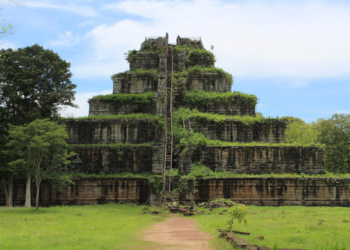
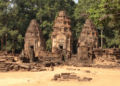
Those iconic central towers are not just architectural bravado; they are Meru rendered in sandstone. In Hindu and Buddhist cosmology, Meru (or Sumeru) is the world‑axis, the sacred mountain at the center of all universes. Khmer architects translated this idea into a cluster of soaring prasat (towers), often five, echoing Meru’s mythic peaks.
Locals may describe a famous temple simply as “the mountain” or “the center,” especially during festivals when circumambulation and climbing become acts of merit. Every step up a steep stair, every gallery passed, is a small ascent toward the divine summit. You are walking a cosmology, not just a monument.
Lintels, Pediments and the Drama Above Your Head
Meet the Lintel: Myth in a Single Line
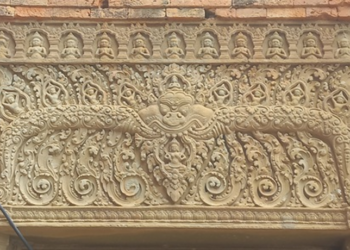
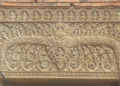
Above almost every doorway, you’ll see an elaborately carved lintel: a horizontal band filled with vegetal scrolls, monsters and very busy deities. Common motifs include kalas (grinning, toothy faces), nagas, makaras (mythical aquatic beasts) and, in the center, a god or important scene framed by foliage.
A classic example: Vishnu riding his mount Garuda, wings spread energetically, while flanked by symmetrical naga‑vine scrolls. To the trained eye, the pattern of symmetry and the presence of these creatures is not random decoration; it reflects Khmer theories of balance and cosmic order. Locals educated in classical art will read the lintel like you read a book cover.

Pediments – the triangular or lobed fields above lintels – are where the narrative really unfolds. Here you encounter full scenes from epics like the Ramayana (Reamker), Mahabharata, or Buddhist Jataka tales: battles, coronations, forest exiles, celestial dances.
A Khmer viewer looks for a few things: central figure (is that Rama? Shiva? the Buddha?), supporting characters, and spatial clues like palaces, chariots or forests. Over time, you learn to identify recurring compositions: a multi‑armed deity on a lotus, a king on a platform, apsaras swirling above. Khmer scholars have traced how these pediments evolved, but even a short visit allows you to spot patterns and “read” the drama.
Bas‑Reliefs: Epics, Battles and Everyday Life
Walk along the inner galleries of major Angkorian temples and you’ll find long narrative friezes. These bas‑reliefs are at once religious text, historical chronicle and political manifesto carved in stone. They show mythological battles, royal processions, and cosmic events, often arranged in registers like a graphic novel without speech bubbles.
Guides and learned locals may point out famous scenes: churning of the ocean of milk, divine battles, and royal victories. They are not just “nice stories” – they articulate ideals of kingship, dharma and cosmic order. For a Cambodian, recognizing a scene from the Reamker on a temple wall is a bit like spotting a beloved chapter from a family epic in public.
The Small Stories: Markets, Fishermen and Flirting
Then there are the delightful “side notes”: market stalls, soldiers cooking rice, fishermen casting nets, women carrying jars, lovers embracing in discreet corners of the wall. These appear already at Angkor (famously at Bayon and Ta Prohm) and continue in later monastic murals like those at Wat Bo in Siem Reap.
Locals often gravitate to these scenes because they look strangely familiar. The hat styles change, but the gestures – negotiating at a stall, hauling water, mildly misbehaving in the background – feel contemporary. Cambodian writers have noted how rare and precious these glimpses of “ordinary life” are: most ancient art focused on gods and kings, not someone getting stoned behind a market stall.

Knowing Who’s Who: Nagas, Garuda, Apsaras and Friends
The Sacred Naga and His Rivals
We met the naga as balustrade, but you will also see naga motifs on lintels, pediments and stairways. A multi‑headed naga often signals protection and sacred thresholds; seven heads are particularly common, tied in Khmer lore to both cosmic protection and ancestral origins.
Opposite the naga in the mythological food chain stands Garuda, the eagle‑man mount of Vishnu. On some lintels and standalone sculptures, Garuda clutches nagas in his claws or beak, their bodies transforming into vegetal scrolls. This dynamic tension between serpent and bird – water and sky, earth and heavens – is a recurring Khmer visual theme, one that locals familiar with classical stories recognize instantly.
Apsaras and Devatas: Not Just “Dancers”
Tourists tend to call every female figure an “apsara,” but art historians and some Cambodian guides make a distinction: devatas as standing deities or guardians, apsaras as more explicitly celestial dancers. Either way, these figures communicate grace, auspiciousness and the idealized body.
Their hairstyles, jewelry and gestures change with period and region; local experts will sometimes date a temple just by the way a devata’s hair curls. For everyday visitors, the key is to notice their placement: flanking doorways, lining galleries, turning a passage into a kind of celestial catwalk you cross with appropriate humility.

Reading a Working Pagoda: Living Temples Today
From Angkor to the Village Wat
Outside the Angkor Archaeological Park, most Cambodians today interact with living Buddhist temples (wats), where monks chant, loudspeakers crackle and freshly painted murals sit beside centuries‑old fragments. The same narrative logic applies: epics, Jataka tales, scenes of heaven and hell, and occasional slices of contemporary life.
At places like Wat Bo, you can see 19th‑ and early 20th‑century murals that mix Reamker scenes with colonial‑era market life, foreigners in hats, and people engaged in recognizably modern vices. Locals may point at these paintings with laughter and commentary: the temple becomes a moral mirror as much as a sacred space.

How Locals Actually “Read” a Temple
A Cambodian visit to a temple might start pragmatically – lighting incense, making a small donation, tying a thread around the wrist – before drifting into a kind of informal art tour. Someone will point out their favorite story, a particularly fierce hell scene, or a Buddha image known for answering specific kinds of prayers.
The reading is rarely linear or academic. It is conversational, anecdotal, and deeply situational: this pediment is good for exams, that statue for health, this gallery for reminding children what happens if they misbehave. To read a Khmer temple like a local, you don’t need a PhD; you need curiosity, time, and a willingness to let stories accumulate visit after visit.
To read a Khmer temple like a local is to move from “ruins and statues” to a layered world where architecture, orientation, myth, politics and daily life all speak at once. With each naga, lintel, bas‑relief and tower you decode, Cambodia’s sacred landscapes become less like outdoor museums and more like complex, living texts that invite you back for another chapter.
Sources & further reading / To know more
- Khmer architecture overviews – Clear introductions to Khmer temple plans, common decorative motifs and historical periods, useful before or after an Angkor visit.
- National Museum lintel descriptions – Detailed object notes that help you understand how to read lintels, vegetal scrolls, nagas and Garuda in Khmer stone carving.
- Cosmology and Mount Meru – Articles explaining how Hindu‑Buddhist cosmology shaped Angkor’s orientation, towers and moats as a three‑dimensional model of the universe.
- Visual storytelling in Khmer reliefs – Specialist studies and essays on how narratives from the Reamker and daily life scenes are organized on walls at Angkor and later pagodas.
- Symbolism of the naga and Garuda – Analyses of serpents and bird‑men in Khmer religion and art, from protective balustrades to dramatic lintels and freestanding sculptures.
Pascal Médeville is a writer and digital publisher based in Cambodia, where he spends an inordinate amount of time loitering in temple galleries and village wats. He writes mainly about Khmer history, language and religious culture, with a particular interest in how everyday visitors can learn to “read” sacred spaces without losing their sense of wonder. When he is not decoding bas‑reliefs, he curates the online publication Wonders of Cambodia.
Related articles you might like
Garuda: The Winged Guardian of Cambodia