On the banks of the Bassac River in Koh Thom district, Kandal province, Wat Preah Sisowath Ratanaram (also known as Wat Chrouy Takeo) quietly preserves a 118‑year‑old vihara and rare traditional murals. If you enjoy Buddhist art, countryside pagodas and a touch of royal history without city crowds, this temple is a rewarding day trip from Phnom Penh.

Not every important Cambodian temple sits in the middle of Phnom Penh. Wat Preah Sisowath Ratanaram (Khmer: វត្តព្រះស៊ីសុវត្ថិរតនារាម), in Koh Thom district, Kandal, is a good reminder that some of the country’s most interesting Buddhist sites live along rural rivers, down quiet roads, and behind tamarind trees.
This royal monastery combines several things at once: a historical vihara, an old cycle of murals, a living monastic community and a classic Bassac River landscape. This article is for travelers, heritage lovers and students of Khmer art who want to understand why this provincial pagoda matters and how to visit it with respect and curiosity.
A Royal Monastery in the Countryside
Wat Preah Sisowath Ratanaram is a royal monastery named in honor of King Sisowath, one of Cambodia’s early modern monarchs. The royal connection is not just decorative: it reflects a long tradition in which Cambodian kings supported major monasteries as part of their religious and political role.

Locally, the temple is often called Wat Chrouy Takeo, after the commune where it stands in Koh Thom district, Kandal province. The double name is typical: the royal title signals prestige, while the village name anchors the pagoda in everyday community life.
The Oldest Monastery in Koh Thom
This temple is regarded as the oldest Buddhist monastery in Koh Thom district, which already gives it a special place in the local religious landscape. The core of the complex is its 118‑year‑old vihara (ordination hall), a building that has seen colonial rule, war and the reconstruction period that followed.
The vihara’s age is visible in its proportions and materials. This is not a shiny new hall with mirror tiles and bright neon lights, but a structure from another era: weathered walls, traditional woodwork and an interior that feels more like a historical document than a fresh coat of paint.

Architecture and Layout of the Pagoda
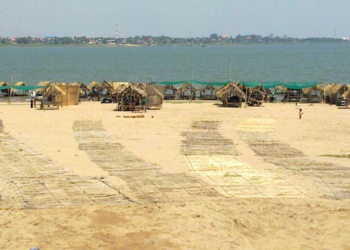
Wat Preah Sisowath Ratanaram stands near the Bassac River, in a typical Cambodian riverine landscape: water, fields, scattered houses and one unmistakable main pagoda rising above it all. The river setting is not only picturesque; it also reflects the traditional connection between monasteries, transport routes and fertile land.
Arriving at the pagoda, you enter a compound that feels unmistakably rural: a main gate, sandy paths, stupas, trees, children playing, monks moving quietly between buildings, and sometimes a rooster who considers himself in charge of security. The atmosphere is calm but very much alive.
Main Structures in the Compound
Within the grounds, you are likely to find:
- The main vihara, the historical heart of the complex.
- Several stupas, probably dedicated to respected monks or donors.
- Monks’ living quarters and service buildings.
Architecturally, the vihara follows a classical early 20th‑century Cambodian style: a rectangular plan, tiered roof, and traditional Khmer ornament around doors and windows. Time has softened some of the details, but that patina is precisely what gives the building its character.
Inside the Vihara: Murals and Meaning
The main reason many people come to Wat Preah Sisowath Ratanaram is its interior murals. These paintings, spread along the walls of the vihara, form one of the more interesting surviving mural cycles in Kandal province. They belong to the same broad period sometimes described as a “Khmer painting renaissance” at the turn of the 20th century.
These murals are not museum pieces removed to a controlled environment; they are still in situ, where they were meant to be seen – around a central Buddha image, in a space used daily for chanting, ceremonies and community rituals. That context matters as much as the paint itself.
Although each wall would deserve its own study, the general themes are classic for a Cambodian vihara:
- Scenes from the life of the Buddha.
- Jataka stories, illustrating the Buddha’s previous lives and virtues.
- Cosmological scenes showing heavens, hells and moral lessons.
The style is recognizably Khmer: clear narrative sequences, flat but expressive space, and color used to guide the eye and emphasize moral contrasts. The murals are worn in places, yet still readable. They feel like an elderly storyteller: the voice is softer, but the story remains sharp.

For visitors, these paintings provide:
- A visual introduction to Buddhist teaching, even if you do not read Khmer or Pali.
- A chance to see a provincial royal monastery where art, devotion and local history meet.
- A living example of Khmer mural painting outside the more famous sites in Phnom Penh.
If you are familiar with the murals around the Silver Pagoda in the capital, visiting Koh Thom offers a useful contrast: smaller scale, less restoration, and a more intimate relationship with the surrounding village.
Religious Life and Local Community
A Working Monastery, Not a Museum
Despite its age and its art, Wat Preah Sisowath Ratanaram remains a functioning Theravada monastery. Monks reside here, villagers visit for blessings and ceremonies, and the pagoda plays its usual Cambodian role as a social as well as religious center.
You may see preparations for funerals, offerings for the dead, or children learning simple prayers. The sacred and the everyday coexist comfortably: a loudspeaker testing before a ceremony, a monk checking a smartphone, a grandmother patiently counting her beads in front of the main Buddha image.
Major Buddhist festivals such as Pchum Ben (Festival of the Ancestors) and Khmer New Year give the pagoda a different energy: more people, more food, more offerings, more dust and noise, and a deeper sense of community.
During such times, the old murals seem almost like extra participants, watching new generations continue the same patterns of merit‑making, chanting and communal life that have filled the hall for more than a century. For visitors who are respectful and patient, it is an excellent way to see how heritage is lived, not just preserved.
How to Visit Wat Preah Sisowath Ratanaram
Wat Preah Sisowath Ratanaram is located in Chrouy Takeo commune, Koh Thom district, Kandal province, south of Phnom Penh along the Bassac corridor. For most visitors, it works best as a day trip from the capital by car or motorbike, possibly combined with other stops in Kandal.
Road conditions vary by season, but the trip is straightforward enough if you are used to Cambodian countryside driving. As always, allow extra time: not just for the road, but for the inevitable temptations to stop for sugarcane juice or grilled snacks along the way.
- Best time of day: Morning or late afternoon offer softer light and cooler temperatures, which are kinder both to visitors and to photography.
- Dress code: Wear modest clothing (shoulders and knees covered), remove shoes and hats before entering the vihara, and avoid loud behavior in the compound.
- Donations: There is no entrance fee, but small donations are welcome and can support maintenance, monk life and, ideally, the conservation of the murals.
- Photography: Be discreet inside the vihara. Avoid flash, keep your time with the camera reasonable, and if a monk or layperson is present, a polite request or smile before shooting is always a good idea.
If you are interested in art or history, bring a notebook and take time to sit and look carefully at one or two walls instead of trying to “collect” every image. The longer you look, the more narrative details you will notice.
Wat Preah Sisowath Ratanaram is not a blockbuster attraction, and that is precisely its charm. It offers a riverside setting, a venerable vihara, rare murals and a living Buddhist community, all wrapped in the quiet rhythm of Koh Thom district. For travelers who like their history slightly off the main road, it is a place where royal memory, village life and painted walls still speak to each other.
Pascal Médeville is a writer and digital publisher based in Cambodia. He focuses on Khmer temples, Buddhist art, local histories and everyday life across the country’s provinces. On Wonders of Cambodia, he enjoys writing about sites like Wat Preah Sisowath Ratanaram that combine beauty, history and a very human sense of place.