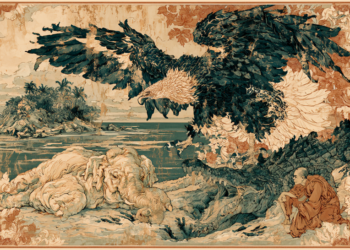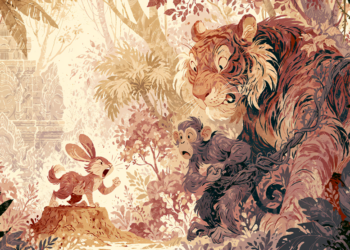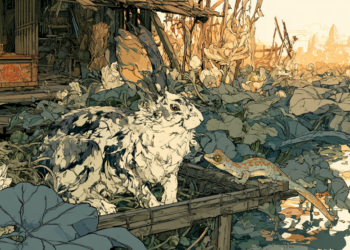
A wounded crocodile is rescued by a compassionate father and son, only to repay their kindness by trying to eat them. This classic Khmer tale has a lesson sharper than the crocodile’s teeth.
A Khmer Folktale About Gratitude and Trust
Khmer folklore is full of stories in which animals behave remarkably like people. They argue, deceive, repay kindness, forget favors, and occasionally make the sort of terrible decisions that would make even a village elder sigh.
This traditional Cambodian story, “The Father and Son Who Met a Crocodile,” revolves around a simple question: is kindness always rewarded with kindness?
The answer, according to the crocodile, is apparently no.
The story begins with a father and his son travelling by ox cart to trade. Along the road, they encounter a crocodile badly injured by a forest fire. Its four legs have been scorched, leaving it unable to walk or hunt. Weak from hunger, the crocodile has become thin and miserable.
Taking pity on the suffering animal, the father decides to help. He cuts pieces of wood and uses them to bind the crocodile securely. He then lifts the helpless animal onto the cart and continues his journey.
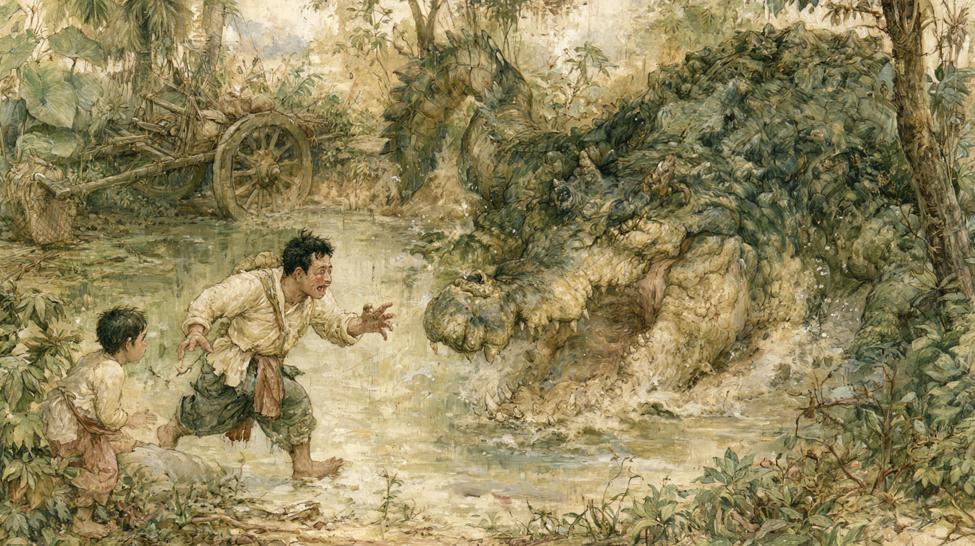
Eventually, father and son reach a large pond, a place where the crocodile can once again live comfortably. The father removes the crocodile from the cart and releases it into the water.
The crocodile drinks deeply, swallowing muddy water until it is satisfied. Strength begins to return to its body. Then, instead of thanking its rescuers, the crocodile decides to eat the man.
The father protests: “Do not bite me. I have done you a kindness.”
The crocodile disagrees. From its point of view, being tied up and transported on a cart was hardly a favor. It argues that the man had caused it great suffering and therefore deserved to become lunch.
The father pleads for time. Rather than fight the crocodile, he suggests that they seek the judgment of a wise ruler. The crocodile agrees. The two therefore go before the king and each presents his version of events.
The crocodile speaks first. It explains that it had been quietly minding its own business when the man came along, tied it up with wooden poles, placed it on a cart, and carried it away. Unable to escape, the crocodile claims that the man had caused it considerable distress. It therefore considers its intention to eat him entirely justified.
The father then gives his account. He explains that the crocodile had been badly burned by a forest fire. All four legs were injured, and it could no longer walk or find food. Feeling sorry for the creature, he had bound it with wooden supports, placed it on his cart, and transported it to a large pond. There, he released it. After drinking the muddy water and recovering its strength, the crocodile had turned against its rescuer. The father concludes by asking the king to judge the matter fairly. If the king doubts his story, he asks him to look at the crocodile’s four injured legs.
The king considers the case. He reflects that the crocodile appears to have forgotten the kindness shown to it. Rather than allowing the animal to attack its rescuer, the king proposes a practical test: “If what you say is true,” the king tells the crocodile, “let yourself be tied in the same manner as before. Then I shall consider the matter further.”
The man therefore binds the crocodile exactly as he had done previously. Once the crocodile is securely restrained, the king gives his judgment. The man is told to take the crocodile away. The king then gives him a warning: in the future, he should be careful about doing favors for wild animals, especially creatures that possess sharp teeth or poisonous fangs.
The man is satisfied with the king’s judgment and returns home.
The Meaning Behind the Crocodile
Like many traditional Khmer folktales, the story works on several levels. On the surface, it is an entertaining tale about a man, his son, an enormous reptile, and a surprisingly sensible king.
At a deeper level, it explores gratitude, justice, trust, compassion, and human judgment.
The father represents compassion. He sees suffering and responds by helping, without initially asking what he will receive in return. The crocodile represents the opposite principle: an individual who remembers only his own suffering and conveniently forgets the help he received.
The king represents reason. Instead of deciding the case simply by listening to competing claims, he reconstructs the original circumstances through a practical demonstration.
There is also a characteristic element of Khmer moral storytelling here: wisdom is often expressed through a concrete action rather than an abstract philosophical argument. The king does not deliver a long lecture on ethics. He simply puts the crocodile back into the situation that caused the dispute.
And suddenly, the legal problem becomes remarkably easy to solve.
A Warning About Kindness
The final lesson is deliberately cautious. Cambodian traditional wisdom does not necessarily suggest that compassion is foolish. Rather, it warns that kindness without judgment can become dangerous.
The crocodile is not condemned merely because it is an animal. It is condemned because it fails to recognize a debt of gratitude and attempts to turn the person who saved it into prey.
The final warning about animals with fangs and venom also reflects a familiar feature of Southeast Asian storytelling. Nature is beautiful, useful, and deserving of respect, but it is not necessarily tame.
A crocodile may accept your rescue today and still regard you as dinner tomorrow.
That is perhaps why this old Khmer tale remains memorable. Its moral is simple, its humor is dark, and its advice is surprisingly practical: help others when you can, but do not confuse compassion with blindness.
Closing Reflection
This traditional Cambodian story ultimately asks a timeless question: what happens when gratitude disappears?
The answer is presented with Khmer storytelling’s characteristic mixture of wisdom and humor. Sometimes justice requires compassion. Sometimes it requires common sense. And sometimes, before helping a crocodile, it is worth remembering that crocodiles have very different ideas about friendship.