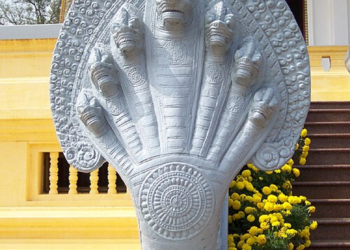
You can walk through Cambodia for only a short time before meeting a naga. It may be carved along a temple staircase, stretched across a bridge, curled around a shrine, painted on a Buddhist banner, or quietly present in a wedding ceremony.
After a while, you may begin to wonder whether Cambodia simply has an unusually strong attachment to giant snakes.
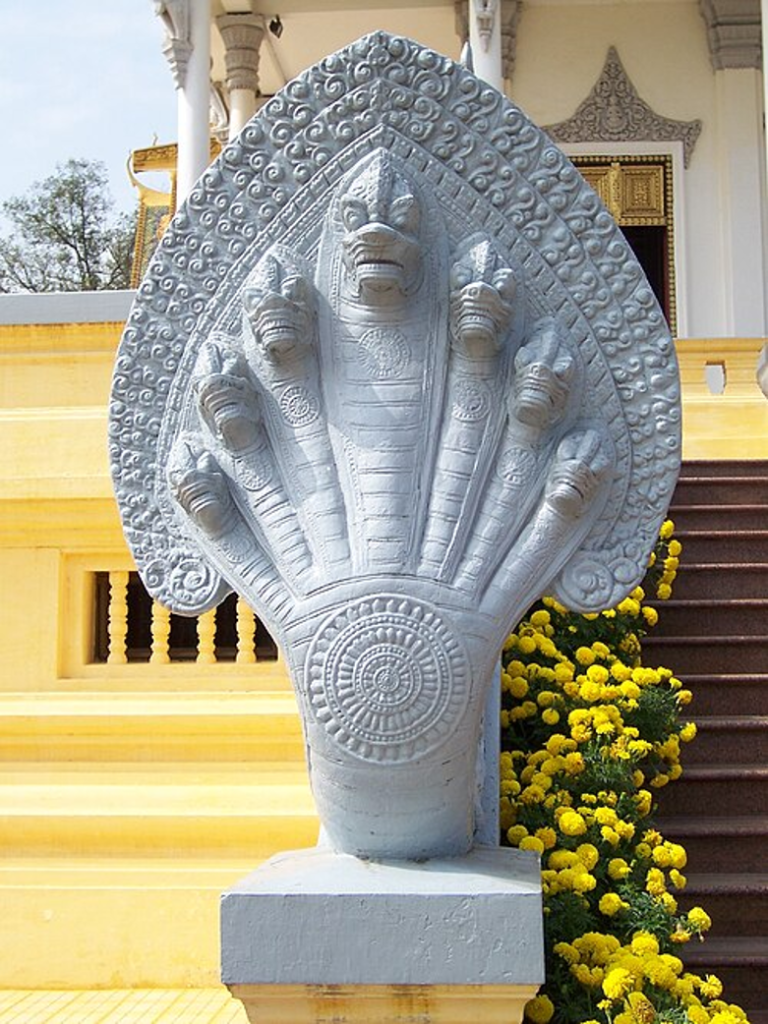
The answer is more interesting. The naga, or neak (នាគ), belongs to several layers of Khmer culture at once: ancient beliefs about water and the land, Hindu traditions, Buddhism, architecture, royal mythology, and popular folklore. That is why the creature keeps turning up in places where, at first glance, a snake seems like a rather surprising decoration.
The serpent that helped create Cambodia
One reason the naga has such deep roots is the Khmer story of Preah Thong (Kaundinya) and Neang Neak (Soma).
In the legend, Preah Thong, a foreign prince, encounters Neang Neak, the daughter of the Naga King. Their marriage becomes a foundational story about the origins of the Khmer people and their land.
Different versions of the story vary considerably, and historians have debated how the legend developed. What matters culturally is its extraordinary persistence. The naga is not simply a supernatural animal in this tradition. It is connected with ancestry, territory, fertility, and the legitimacy of a Khmer kingdom.
The story also helps explain why the naga feels unusually local in Cambodia. It is not merely something borrowed from Indian mythology and placed on Khmer temples. Cambodian ideas about nagas developed through a mixture of indigenous beliefs, Hindu traditions, and Buddhism.
Look down the temple staircase
The easiest place to notice this tradition is architecture.
At Angkor and other Khmer temples, nagas frequently line causeways and stairways. At Angkor Wat, enormous serpent balustrades accompany the famous rows of devas and asuras. These scenes refer to the Hindu story of the Churning of the Ocean of Milk, in which the naga Vasuki serves as the cosmic rope.
But the naga has an even broader architectural role.
It appears at thresholds, beside roads, on bridges, and around sacred spaces. At Neak Poan, for example, the modern name itself means “coiled serpents,” referring to the nagas encircling the central sanctuary.
And the association with water is hardly accidental. Angkorian Cambodia depended on an elaborate landscape of reservoirs, canals, rivers, and rice fields. The naga, traditionally associated with water, fertility, protection, and the connection between different realms, was an unusually appropriate creature to guard a bridge or sacred water landscape.
From ancient temples to modern weddings
Perhaps the most surprising thing is that the naga did not stay behind in the ruins of Angkor.
The story of Preah Thong and Neang Neak remains connected with Khmer wedding traditions. In one well-known symbolic gesture, the groom holds the bride’s sash, recalling the legend in which Preah Thong follows Neang Neak into the naga realm. Scholars have identified naga symbolism in Cambodian wedding customs as part of a much wider cultural tradition involving ancestry, fertility, and the union of two families.
So when you see a naga at a Cambodian wedding, you are not looking at a random decorative serpent imported from an ancient temple. The old story has simply changed clothes.
Why there are so many of them
There is therefore no single meaning of the Cambodian naga.
Sometimes it is a guardian. Sometimes it represents water and fertility. Sometimes it belongs to Hindu mythology. In Buddhist contexts, the naga can also appear as a protector of the Buddha and Buddhist teachings. And in Khmer origin traditions, it is tied to ancestry and the land itself.
This mixture explains something important about Cambodian culture. Religious and cultural ideas did not necessarily replace one another as new traditions arrived. Older beliefs could survive, acquire new meanings, and become part of Hindu and Buddhist traditions.
The result is a creature capable of appearing simultaneously ancient, Hindu, Buddhist, royal, folkloric, architectural, and thoroughly Khmer.
Conclusion
Once you start noticing nagas in Cambodia, they become almost impossible to ignore.
They are on bridges, stairways, temple walls, Buddhist objects, public monuments, and wedding rituals. Yet their persistence is not simply a matter of artistic taste. The naga carries several layers of Cambodian memory: water, fertility, protection, ancestry, sacred space, and the enduring story of how people came to belong to this land.
So the next time a stone serpent appears beside a Cambodian staircase, take a second look. It may be guarding more than the steps.