In Cambodia’s temples, the Navagraha – the nine planetary deities of Indian astrology – are not just cosmic abstractions but carved, seated, and sometimes slightly grumpy-looking stone characters. This article explores how the Navagraha reached Khmer lands, where to find them in Cambodia’s temples, and what these celestial panels tell us about Angkorian religion, politics and the art of managing fate.

Introduction: When Astrology Meets Laterite
If you have ever stared at a Khmer lintel wondering “Who are these nine oddly seated gentlemen above the doorway?”, chances are you have met the Navagraha (Khmer: ទេពនព្វគ្រោះ or ទេវតានព្វគ្រោះ) – the nine celestial deities of Indian astral lore, imported, adapted and thoroughly Khmer-ized in Cambodia. This article is for curious travelers, temple nerds, and anyone who secretly suspects that their destiny might be hidden in a 10th‑century sandstone panel.
We will look at what the Navagraha are, how they appear in Cambodian art, and where you can actually see them on your next trip to Angkor and beyond. Along the way, we will meet learned Brahmins, ambitious kings, and a few eclipses personified as hungry demons. No horoscope required, only a decent hat and some patience with uneven staircases.
What Are the Navagraha, Exactly?
In Indian and Khmer tradition, the Navagraha are nine celestial bodies that influence human life and cosmic order: the Sun, the Moon, five visible planets, plus two shadowy eclipse points (Rahu and Ketu). In their “classical” form, the list runs:
- Surya (Kh: ព្រះសូរិយា) – the Sun
- Chandra (Kh: ព្រះចន្ទ្រា) – the Moon
- Mangala (Kh: ព្រះអង្គារ) – Mars
- Budha (Kh: ព្រះពុធ) – Mercury
- Bṛhaspati (Kh: ព្រះព្រហស្បតិ៍) (Guru) – Jupiter
- Shukra (Kh: ព្រះសុក្រ) – Venus
- Shani (Kh: ព្រះសៅរ៍) – Saturn
- Rahu (Kh: ព្រះរាហុ) – the ascending lunar node
- Ketu (Kh: ព្រះកេតុ) – the descending lunar node
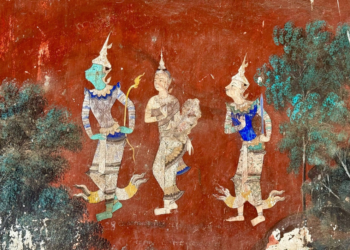
In Cambodia, these nine appear together as “nine deities” panels, a format that developed strongly in Angkorian art and is now recognized as a distinct Khmer contribution to the visual history of Navagraha worship. They are usually shown in a row, each deity with their own vahana (mount), posture and attributes – not unlike a celestial group photo taken in sandstone.
From India to the Mekong: Navagraha in Khmer Religion
Brahmanism, Astrology and Statecraft
The Navagraha reached Cambodia through the broader transmission of Brahmanical religion, ritual and astronomy from the Indian world into mainland Southeast Asia. By the pre‑Angkorian and early Angkorian periods, Khmer elites had fully integrated astrology into royal rituals, temple consecrations and everyday decisions of the court.
The nine deities were not mere decoration: they embodied the idea that cosmic forces could be propitiated and aligned with royal power. When you consecrate a temple exactly when Aquarius rises and several planets cluster in a favorable house, you are not just being poetic – you are turning the sky itself into a political ally.
Panels of nine deities functioned as protective and auspicious images, linked to rituals meant to avert misfortune and stabilize the realm. Their presence in temples signaled that the sanctuary – and by extension, the king – stood in harmonious relationship with the shifting heavens.
In that sense, Navagraha in Cambodia are a stone‑carved insurance policy: a way of saying “we have consulted the planets, performed the rituals, and the kingdom is cosmically compliant—for now.”
Nine Deities Panels in Ancient Cambodia
Research on nine‑deity panels in Cambodia shows that the oldest known example dates back to the pre‑Angkorian period, with the Navagraha depicted standing. This early form is important: it proves that planetary cults were present in Cambodia before the great Angkorian building boom, and that Khmer artists were already experimenting with how to show the nine celestial powers together.
Later, during the Angkorian period, the iconography changes: the nine deities now appear seated on their individual mounts, a more elaborate and fully developed visual system. This evolution suggests not only growing sophistication but also a deepening ritual and theological investment in the Navagraha.
Typology and Iconographic Details
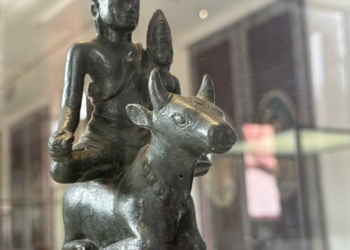
Specialist studies classify these panels by posture, order and attributes of the deities, reflecting different local traditions and textual sources. In Angkorian versions, the vahanas – ranging from horses and birds to more exotic creatures – help identify each celestial body, while specific hand gestures and emblems echo Indian models with a Khmer twist.
For the non‑specialist visitor, one practical takeaway is: do not just glance past the “row of nine little gods” above a doorway. If you look closely, you will see that each figure is distinct, forming a tightly choreographed cosmological line‑up rather than generic decoration.
Where to See Navagraha in Cambodia
Angkor and the Western Baray: Ak Yum
One key site for Navagraha at Angkor is Ak Yum, a smaller temple associated with the Western Baray. A notable bas‑relief there presents a Navagraha panel, which has been studied as a prime example of 10th~11th‑century Khmer planetary imagery.
Ak Yum’s Navagraha is especially interesting because it allows researchers to trace how astral iconography was integrated into a temple linked to one of Angkor’s major hydraulic projects, hinting at the connection between water management, kingship and cosmic order.

Banteay Srei and the Planetary Alignment of 967 CE
Few stories capture the imagination as nicely as Banteay Srei’s consecration. An inscription (K842) indicates that the Saivite deity was installed when Aquarius was rising, with Mars, Jupiter and Venus in the fifth house and the Moon at the end of the tenth. Astronomical reconstruction shows that the consecration culminated in a rare planetary clustering visible at dawn on 23 April 967 CE.
This celestial choreography has been explicitly linked to the Navagraha, since the alignment involves the five visible planets plus the Sun, Moon, Rahu and Ketu as a conceptual set. Banteay Srei thus offers not only exquisite carvings but also one of the clearest cases where the timing of a Khmer temple’s inauguration was synchronized with a specific planetary configuration.
East Mebon and Other Angkorian Sanctuaries
Studies of planetary clustering at Banteay Srei mention that the Navagraha were venerated at many sanctuaries, explicitly citing the contemporary East Mebon as an example. Panels or imagery relating to the nine celestial deities appear in several Angkorian temples, sometimes fragmentary, sometimes in museum collections rather than in situ.
For the traveler, this means that Navagraha hunting in Cambodia is part fieldwork, part detective game. Guides may not always point them out, so knowing to ask for “nine‑deity panels” or “Navagraha” can open up an extra layer of meaning in otherwise familiar monuments.
Why the Navagraha Matter for Understanding Angkor
Cosmology, Kingship and Architecture
Navagraha panels are a compact entry point into the larger question: how did the Khmer see their place in the cosmos? Angkor’s temples famously mirror mountain ranges and celestial diagrams, but the Navagraha give this an almost personal touch by turning planets into individually worshipped beings.
When planetary cycles dictated auspicious dates for foundation and consecration, architecture became a material expression of a specific cosmic moment. The alignment at Banteay Srei illustrates how astronomy, ritual and politics could converge into a single, precisely timed ceremony.
Material Traces of Astral Piety
From a historical perspective, the proliferation of nine deities panels during the Angkorian period shows how deeply astral cults had penetrated Khmer religious life. Their presence across Cambodia and into neighboring regions of Thailand indicates that this fusion of Brahmanical astral lore and local kingship was part of a broader mainland Southeast Asian pattern.
For us, they are also extremely practical: stone survives where manuscripts perish. Without these carved Navagraha, much of the everyday interaction between priests, planets and palace would remain purely hypothetical.
Practical Tips for Spotting Navagraha in Cambodia
Reading Lintels and Doorframes
When exploring Cambodian temples, pay special attention to:
- Lintels above main doorways, especially at smaller or less restored shrines.
- Panels in museum displays labeled “nine deities” or “Navagraha”.
- Rows of nine seated or standing figures, often small but highly individualized.
Combining Navagraha with Your Itinerary
For a compact “Navagraha‑flavored” temple day around Siem Reap, you might:
- Visit Banteay Srei, keeping in mind its 967 CE planetary alignment as you walk through the sanctuary.
- Explore East Mebon and nearby sites, looking for astral imagery and asking about nine‑deity panels known from the area.
- Add a museum stop (e.g. Angkor National Museum in Siem Reap) to see detached panels in better lighting and at eye level.
You will not leave with your personal horoscope carved in stone, but you will see how ancient Cambodians inscribed their cosmic anxieties and hopes into the very fabric of their architecture.
The Navagraha in Cambodia show that Angkorian temples were not only grand monuments to gods and kings but also sophisticated instruments for negotiating with the sky. From early pre‑Angkorian standing figures to elaborate seated panels and carefully timed consecrations like Banteay Srei, the nine planetary deities offer a rare, tangible link between Khmer art, astronomy and the very human desire to keep fate on one’s side.
Sources & further reading / To know more
- Nine Deities Panel in Ancient Cambodia – Menghong Chhum
Scholarly study of the history, typology and meaning of nine‑deity panels (including Navagraha) in pre‑Angkorian and Angkorian Cambodia. - Navagraha, by Ang Choulean – Angkor Database
Overview of Navagraha imagery in Khmer sculpture, with examples such as the Ak Yum bas‑relief and related iconographic notes. - Planetary Clustering and Navagraha at Banteay Srei – Asger Mollerup – Angkor Database
Detailed analysis of the 967 CE planetary alignment and its connection with the consecration of Banteay Srei and Navagraha worship. - Angkor Wat and Astral Connections (various studies)
Articles exploring how Angkorian temples encode celestial symbolism and planetary concepts in their layout and decoration. - Regional Studies on Brahmanism and Planetary Cults in Southeast Asia
Broader academic works tracing how Brahmanical astronomy and Navagraha worship spread into Cambodia, Thailand and neighboring regions.
Pascal Médeville is a writer and digital publisher based in Cambodia, where he spends an inordinate amount of time staring at lintels and inscriptions. He writes mainly about Cambodian history, Southeast Asian cultures and the small details in temples that most visitors walk past. When not chasing Navagraha across the Angkorian landscape, he works on his online projects such as Wonders of Cambodia.