(Estimated reading time: 8-10 minutes – just enough for a coffee, not enough to reach enlightenment.)
Venerable Khieu Chum was one of the most influential Khmer monks of the twentieth century, a preacher and political thinker who helped justify the fall of the Cambodian monarchy in 1970. In this article, we explore who he was, what he believed, and why he still matters for anyone interested in Cambodian Buddhism and modern history.
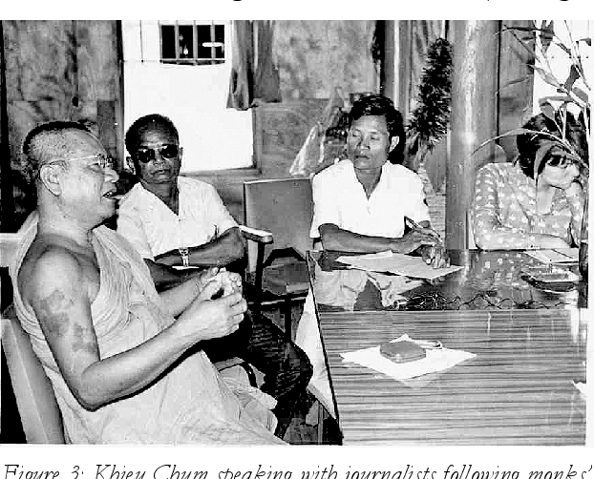
Introduction
If you follow Cambodian history, you usually hear three names when the conversation turns to 1970: Sihanouk, Lon Nol and the Khmer Republic. The name Khieu Chum tends to appear much later, often in footnotes, which is a shame because without this monk the story of regime change in Cambodia looks strangely incomplete.
This article is for readers who want to go beyond the usual political narrative and look at the Buddhist mind behind a republican revolution. We will see how Venerable Khieu Chum rose from scholar monk to star preacher, how he became one of the most powerful religious voices of his time, and how he used Buddhist reasoning to argue against monarchy and in favor of a Khmer Republic.
By the end, you will know who Khieu Chum was, what exactly he did in 1970, and how his ideas complicated the relationship between Buddhism and politics in Cambodia. Along the way, we will meet a few kings, generals and republican manifestos, plus the occasional doctrinal argument, because monks also do politics, just in saffron.
Early life and monastic background
Khieu Chum (ខៀវ ជុំ) was born in 1907 and entered the monkhood young, as many Khmer boys did, but he quickly distinguished himself as a scholar and preacher within the Buddhist monastic network. He became one of the most celebrated students of the famous monk Louis Em, a key figure in modernist Khmer Buddhism who combined scriptural erudition with concern for national reform.
Within this context, Khieu Chum emerged not just as a local abbot but as a national religious personality, conducting popular sermons and publishing works that addressed both spiritual and political questions in a modern idiom. By the time Cambodia gained independence from France in 1953, he was already recognized as one of the country’s most influential monks and a rising public intellectual in saffron robes.
A monk with political interests
Unlike the idealized image of the monk who spends his life quietly meditating under a Bodhi tree, Khieu Chum took a strong interest in the shape of the Cambodian state and its laws. After independence, he became an active participant in internal politics and is now regarded as one of the key political thinkers of that era, particularly for how he framed issues in Buddhist terms.
His sermons and writings often explored the relationship between Dhamma, good government and the moral obligations of rulers, going beyond generic moral advice to suggest that certain political arrangements were more consistent with Buddhist ethics than others. This prepared the ground for his later role in justifying regime change against Prince Norodom Sihanouk’s monarchy.
Khieu Chum and Buddhist Republicanism
From royalism to republican thought
Modern Cambodian history is full of royal imagery, and yet Khieu Chum helped articulate a distinctly Buddhist republicanism that challenged the traditional link between throne and religion. As a monk close to reformist circles and sympathetic to figures such as Samdech Sisowath Monireth, he gradually came to see monarchy as neither the only nor the best political expression of Buddhist principles in contemporary Cambodia.
Scholars who studied his writings describe works in which he provided a Buddhist justification for overthrowing the monarchy, arguing that sovereignty ultimately belonged to the nation and that rulers had to be accountable to ethical norms rooted in the Dhamma, not in royal blood. In this sense, his republicanism was less about Western ideology and more about re-reading Buddhist concepts such as righteousness, non-attachment and compassion in a modern political framework.
Justifying regime change in 1970
When the coup of March 1970 removed Prince Sihanouk and opened the way to General Lon Nol’s Khmer Republic, Khieu Chum was not an accidental bystander. He was part of a small group involved in planning the overthrow of the monarchy and in providing its ideological justification through Buddhist discourse.
Accounts of the period note that he authored texts which explained why the monarchy could legitimately be replaced and how a republic could better embody Buddhist ideals of justice and moral government. This made him a crucial link between the political project of regime change and the religious sensibilities of the Buddhist majority, who might otherwise have perceived the fall of the king as a sacrilegious act.
The Monk and the Khmer Republic
Writing for Lon Nol and the republic
In the early years of the Khmer Republic, Khieu Chum did not retreat into the monastery, he went further into politics behind the scenes. Research on Cambodian constitutional politics reports that he helped write speeches for President Lon Nol and even chaired a committee that drafted the Khmer Republic’s political manifesto.
The idea of a monk drafting a president’s speeches sounds like the opening of a political satire, yet in Cambodia’s context it reflected the deep entanglement between Buddhism and state power. By lending his authority as a respected preacher and thinker, Khieu Chum tried to give the new regime a moral and religious legitimacy in the eyes of the public.
As one of Louis Em’s most brilliant disciples and a monk naturally in sympathy with modernist republican elites, Khieu Chum became arguably the most powerful religious figure aligned with the Khmer Republic. His voice carried weight not only because of his learning but because he embodied a new type of activist monk who considered political engagement part of his religious duty.
At the same time, the republican experiment was short-lived, and the ability of any monk, however eloquent, to stabilize a deeply divided country was limited. The Khmer Republic faced war, internal conflict and the growing threat of the Khmer Rouge, challenges that no amount of Buddhist rhetoric could resolve. Khieu Chum’s influence on policy was real but could not protect Cambodia from the storms that were coming.
Khieu Chum’s story ends tragically, like so many Cambodian lives in the 1970s. He died around 1975, the year the Khmer Rouge seized Phnom Penh and emptied the cities, although the precise circumstances of his death are not fully documented. Given the regime’s violent hostility to monks, intellectuals and anyone associated with previous governments, his disappearance fits into the broader pattern of persecution that nearly destroyed the Cambodian sangha.
While other figures, such as Khieu Samphan, would later stand trial as leaders of Democratic Kampuchea, Khieu Chum’s name is absent from tribunals and courtrooms. Instead, he remains a monk of the previous era, silenced before he could witness the full extent of the catastrophe unleashed after 1975.
Legacy in Khmer Buddhism and politics
Despite his disappearance, Khieu Chum is remembered in contemporary scholarship as one of the most influential preachers and modernist thinkers in Khmer Buddhism during the mid twentieth century. His life illustrates how monks did not simply bless kings or chant at ceremonies, but actively debated what kind of state Cambodia should be and sometimes helped design it.
For historians and students of Cambodian Buddhism, Khieu Chum offers a case study of Buddhist republicanism in action, where religious authority was used to support the removal of a king and the creation of a republic. His work invites modern readers to think seriously about how Dhamma can be invoked both to support traditional structures and to justify radical change.
Why Khieu Chum Still Matters Today
A key figure for understanding 1970
Anyone trying to understand the 1970 coup only through military and diplomatic lenses misses a crucial dimension the role of Buddhist monks in legitimizing the move against Sihanouk. Khieu Chum is central to this dimension, because his sermons and writings provided a moral vocabulary through which regime change could be presented as ethically justified and even religiously desirable.
For students, researchers or curious readers, following Khieu Chum’s story helps link abstract political events to the daily religious life of Cambodian society. It shows how debates about karma, merit and righteous rule could suddenly become arguments about constitutions, presidents and the legitimacy of a coup.
A monk between tradition and modernity
Khieu Chum also stands at the crossroads between traditional Khmer Buddhist education and modern political thought. He was deeply rooted in scriptural learning, yet he was willing to re-interpret core ideas in light of nationalism, republicanism and constitutional politics.
This makes him particularly interesting today, as Cambodia continues to negotiate the relationship between Buddhist institutions and a state that has seen monarchy, republic and revolutionary dictatorship within one century. In that sense, studying Khieu Chum helps us see continuity and change together, rather like a monk holding a smartphone in one hand and a palm-leaf manuscript in the other.
Venerable Khieu Chum was more than a Buddhist monk in the margins of Cambodian politics he was a central architect of Buddhist republicanism who helped justify the fall of the monarchy and shape the moral language of the Khmer Republic. For anyone who wants to understand modern Cambodian history, his life offers a vivid example of how religious thought can both challenge and sustain political power.
PS: To know more about Khieu Chum and its role, you can read Ian Harris’ “The Monk And The King: Khieu Chum And Regime Change In Cambodia”, in Udaya, 2008, available online here.
Pascal Médeville is a writer and digital publisher based in Cambodia, where he explores the intersections of history, religion and politics in Southeast Asia. He writes regularly about Khmer culture, Cambodian Buddhism and the lesser-known figures who shaped the country’s modern trajectory. On Wonders of Cambodia, he enjoys turning archival footnotes into readable stories for curious readers around the world.