(Estimated reading time: 7 minutes – just enough to follow the moon and learn something meaningful along the way.)
Each year, Cambodia pauses under the full moon of Visak to honor one of Buddhism’s most sacred days. Visak Bochea commemorates the birth, enlightenment, and passing of the Buddha. For visitors and residents alike, it offers a rare glimpse into Khmer spirituality, temple rituals, and living traditions that shape daily life across the Kingdom.

Visak Bochea (Khmer: វិសាខបូជា) is one of the most important religious holidays in Cambodia, observed on the full moon of the Visak month in the Khmer lunar calendar. If you happen to be in Phnom Penh, Siem Reap, or even a quiet provincial town during this time, you will notice a shift in atmosphere: calmer streets, glowing pagodas, and an almost meditative rhythm to the day.
This article is for curious travelers, expats, and culture enthusiasts who want to understand what Visak Bochea truly represents beyond its surface. You will learn its historical roots, how it is celebrated in Cambodia today, and how you can respectfully experience this deeply spiritual event.
Visak Bochea marks three pivotal events in the life of Siddhartha Gautama, the Buddha: his birth, his enlightenment, and his passing into Nirvana. According to Theravada Buddhist tradition, all three occurred on the same full moon day – a detail that gives the holiday its profound symbolic weight.
Unlike many religious observances that focus on a single event, Visak Bochea compresses an entire spiritual journey into one day:
- The birth of Prince Siddhartha in Lumbini.
- His enlightenment under the Bodhi tree in Bodh Gaya.
- His passing (Parinirvana) in Kushinagar.
This convergence makes Visak Bochea not only a celebration but also a reflection on the full cycle of existence – birth, awakening, and release.
In Cambodia, Visak Bochea is an official public holiday. Government offices close, and many businesses operate on reduced hours. More importantly, it is a day devoted to merit-making, reflection, and temple activities.
The Full Moon of Visak: Timing and Meaning
The date of Visak Bochea changes each year because it follows the lunar calendar. It falls on the 15th day of the waxing moon of the Visak month – typically in May. This year (2026) it fell on May 1st.
The full moon is not just a poetic backdrop. In Buddhist symbolism, it represents clarity, completeness, and enlightenment. It is, in a way, the perfect celestial companion for a day dedicated to spiritual awakening.
How Cambodians Celebrate Visak Bochea
While the meaning of Visak Bochea is universal in the Buddhist world, its expression in Cambodia carries distinct cultural nuances.
Morning Offerings and Merit-Making
Early in the morning, many Cambodians visit pagodas to offer food to monks. This act, known as dana (generosity), is believed to accumulate merit for oneself and one’s family.
You will often see:
- Families dressed in white or modest attire.
- Offerings of rice, fruits, and traditional dishes.
- Quiet conversations and respectful gestures.
It is not a festive atmosphere in the Western sense – more contemplative than celebratory.

Dharma Talks and Chanting
Throughout the day, monks deliver teachings (Dharma talks) that recount the life of the Buddha and emphasize key principles such as compassion, impermanence, and mindfulness.
Chanting sessions fill the pagodas with a steady, almost hypnotic rhythm. Even if you do not understand Khmer or Pali, the experience is strikingly immersive.
Evening Candlelight Processions
The highlight of Visak Bochea often comes after sunset.
Devotees gather in pagodas for candlelight processions, walking slowly around the main shrine three times – each circuit representing one of the three jewels of Buddhism:
- The Buddha
- The Dharma (his teachings)
- The Sangha (the monastic community)
Candles flicker, incense curls into the night air, and the full moon quietly oversees it all. It is, without exaggeration, one of the most serene sights you can witness in Cambodia.
Where to Experience Visak Bochea
You do not need to travel far to experience Visak Bochea authentically, but some locations offer particularly memorable settings.
At Wat Phnom or Wat Ounalom, you will find large gatherings and well-organized ceremonies. These are ideal if you want a structured experience with visible rituals.
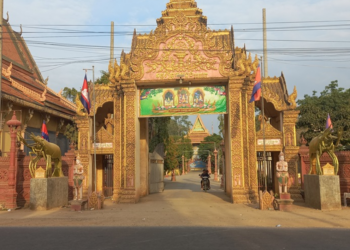
Near Angkor, the atmosphere takes on an added historical dimension. Pagodas around the temples host ceremonies that feel timeless – almost as if the ancient stones are participating.
If you prefer something more intimate, head to a local pagoda in smaller towns or rural areas. The experience tends to be quieter and more personal, though less explained.
Experiencing Visak Bochea respectfully requires only a bit of awareness.
- Wear modest clothing (shoulders and knees covered).
- Remove shoes before entering temple buildings.
- Keep your voice low and movements calm.
You are welcome to observe and even participate, but do so gently:
- Follow the crowd during processions.
- Accept guidance from locals if unsure.
- Avoid intrusive photography, especially during prayers.
- Some restaurants and shops may close early.
- Alcohol consumption is generally discouraged on this day.
- Traffic near major pagodas can be busier than usual.
Why Visak Bochea Matters Today
In a rapidly modernizing Cambodia, Visak Bochea remains a powerful anchor to tradition. It is a day when technology slows, commerce pauses, and spiritual reflection takes center stage.
For Cambodians, it is not just about honoring the Buddha – it is about reconnecting with values that still shape everyday life: patience, generosity, and awareness.
For visitors, it offers something rarer: a moment to witness a living tradition that has not been staged for tourism but continues to exist on its own terms.
Visak Bochea in Cambodia is more than a religious holiday – it is a quiet, luminous reminder of the country’s spiritual roots. Whether you join a candlelit procession or simply observe from a respectful distance, the full moon of Visak offers a meaningful pause in time, one that stays with you long after the candles burn out.
Pascal Médeville is a writer and digital publisher based in Cambodia, specializing in cultural heritage, travel insights, and technical storytelling. Through his platform, he explores the intersections of history, spirituality, and everyday life in Southeast Asia, with a particular focus on Cambodia’s living traditions.