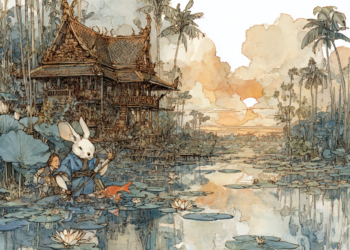
A tired rabbit, a basket of bananas, and a very gullible grandmother – this classic Khmer folktale delivers wit, humor, and a lesson in survival.
Cambodian folklore is filled with clever animals, moral lessons, and playful storytelling, and few characters embody this better than the cunning rabbit. Known in Khmer tales for its quick thinking and mischievous nature, the rabbit often outsmarts humans and larger animals alike – not through strength, but through wit.
This particular story begins with a weary rabbit, exhausted after fleeing from danger. As it stumbles near a village, it spots an elderly woman carrying a basket of bananas on her head, heading to sell them. For the rabbit, this is both temptation and opportunity.
Too tired to hunt or forage, the rabbit devises a plan – simple, risky, but brilliant. It lies down in the middle of the road, pretending to be dead.
When the old woman approaches, she notices the motionless rabbit. Assuming it is indeed dead, she exclaims with delight at her unexpected fortune. In rural Cambodian life, nothing goes to waste – finding a dead animal could mean an extra meal. She happily places the rabbit on top of her basket of bananas, imagining a delicious stew to come.
But the rabbit is far from dead.
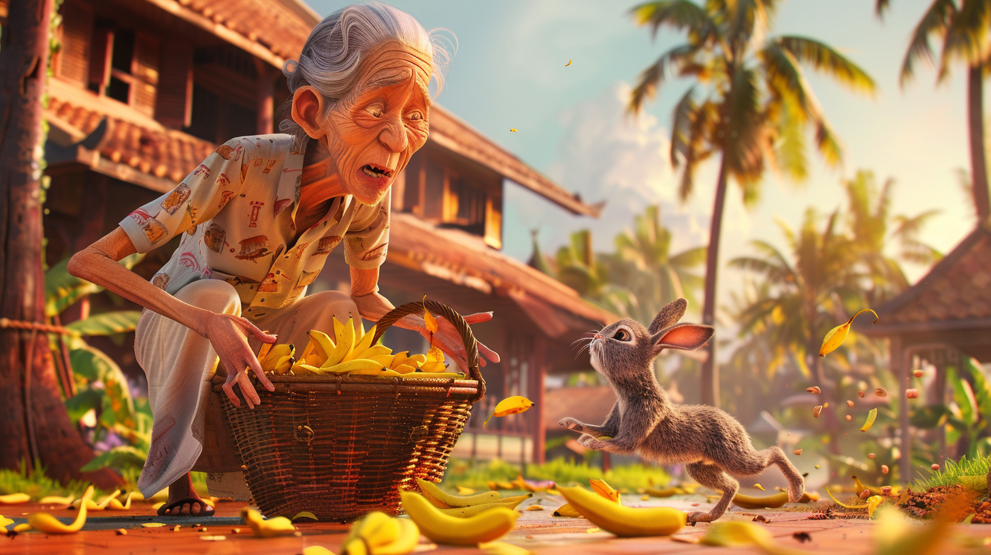
As the woman continues her journey, the “lifeless” rabbit begins quietly eating the bananas one by one. It nibbles away, peeling and devouring them, leaving only empty skins behind. The scene is almost cinematic – an oblivious grandmother walking proudly, while her cargo disappears beneath her nose.
By the time she reaches the village and lowers her basket to sell the bananas, the damage is done. The rabbit seizes the moment, springs to life, and leaps away to freedom. All that remains are banana peels and a very confused seller.
Realizing what has happened, the old woman exclaims in shock: the rabbit was never dead at all. Her bananas are gone, her plans ruined, and the trickster has escaped.
(This is an adaptation of a story published by the Buddhist Institute in Phnom Penh. The original Khmer version is available here.)
The rabbit holds a special place in Cambodian storytelling. Much like the trickster figures found in other cultures – such as Anansi in West Africa or the fox in European tales – the Khmer rabbit represents intelligence over strength.
These stories were traditionally passed down orally, often told by elders in rural villages. They served not only as entertainment but also as subtle lessons about survival, adaptability, and human nature. In a landscape shaped by agriculture and seasonal hardship, cleverness was often more valuable than physical power.
The presence of bananas in the story is no coincidence. Bananas are a staple in Cambodian cuisine and rural livelihoods. Easily grown and widely consumed, they appear in everything from snacks and desserts to ceremonial offerings.
In this tale, bananas symbolize both sustenance and economic activity. The old woman represents small-scale vendors commonly seen in Cambodian villages and markets – individuals whose daily income depends on modest goods like fruit.
The humor of the story lies partly in this familiar setting. For Cambodian audiences, the image of a banana seller is instantly recognizable, making the rabbit’s trick both amusing and relatable.
At first glance, the story is simply funny – a rabbit pretending to be dead and secretly eating bananas. But like many folktales, it carries deeper meaning.
- Appearances can be deceiving.
- Quick thinking can overcome difficult situations.
- Overconfidence or assumption can lead to loss.
The old woman’s mistake is not greed, but certainty. She assumes the rabbit is dead without checking, and that small oversight costs her everything.
Meanwhile, the rabbit’s success is not luck – it is strategy. Even in exhaustion, it uses its mind to survive.
Stories like this continue to resonate in modern Cambodia. They are still told to children, shared in classrooms, and increasingly adapted into digital content, animation, and educational materials.
For travelers and cultural enthusiasts, these tales offer a window into Khmer values and humor. They reveal a worldview shaped by resilience, practicality, and a deep appreciation for cleverness.
And perhaps most importantly, they remind us that sometimes, survival depends not on strength – but on knowing when to play dead.
Follow us to discover more tales from the quick‑witted Cambodian hare!