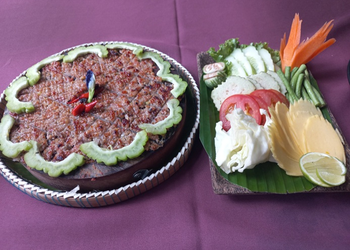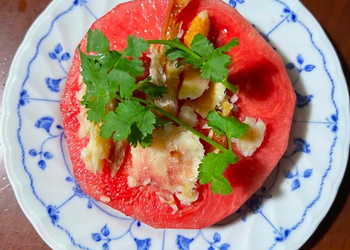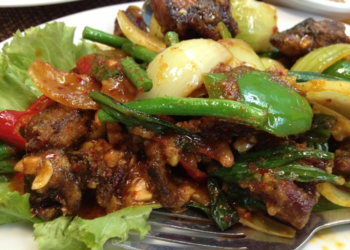
Saraman beef curry is often called Cambodia’s richest curry – a slow-simmered, coconut-laced celebration of beef, peanuts and warm spices. But where does saraman come from, and what does the name actually mean? In this article, we unpack the tangled origins, cultural layers and possible meanings behind saraman beef curry, from Cham Muslims to royal cookbooks.

What This Article Is About (and For Whom)
Saraman beef curry (Khmer: សារ៉ាម៉ាន់សាច់គោ saraman sach ko, or ការីសារ៉ាមម៉ាន់ kari saraman) sits at the crossroads of Cambodia’s royal cuisine, Cham Muslim heritage and regional spice routes, yet it remains oddly under-discussed outside the Kingdom. This article looks at where saraman beef curry comes from, what it tells us about Cambodian history, and what the name saraman might mean.
If you are a food traveler, home cook, culinary historian or simply someone who has heard of saraman and thought “Massaman’s Cambodian cousin?”, this is for you. You will come away with a clearer sense of origin, context and vocabulary, and perhaps a renewed respect for what a patient stew of beef and coconut can do.
We will not give a full recipe here, but we will use ingredients and techniques as evidence – like a delicious, edible footnote – to understand how this curry evolved and what its name may encode about trade, religion and identity.
A royal curry with Muslim roots
Saraman curry (kari saraman) is a coconut-based beef curry that holds a special place in Cambodian royal cuisine. It is notably associated with the Muslim communities of Cambodia, especially the Cham, who have long considered it one of their signature festive dishes.
The curry is rich and relatively mild, built on slow-cooked beef, coconut milk, roasted peanuts and a complex paste of dry and fresh spices such as cardamom, cinnamon, star anise, cloves, lemongrass and galangal. In a country where cattle traditionally pulled ploughs rather than voluntarily jumped into pots, a lavish beef curry like this has historically been reserved for important occasions.
Rich, complex, and time‑consuming
Writers and cooks regularly describe saraman as the “richest” and most complex of Cambodian curries, both in flavor and in the amount of work involved. Compared with everyday Khmer curries, saraman typically involves more slow roasting of spices, longer simmering, and a more generous hand with coconut cream and peanuts.
The result is a thick, almost velvety curry in which the beef is braised until it is yielding and the sauce clings in a glossy coat, closer in spirit to a wet rendang than to a brothy soup. It is, in short, not a Tuesday-night affair.
Cham, Malay, Javanese… or all of the above?
Most scholarly and culinary sources broadly agree that saraman curry has roots in the culinary customs of Cambodia’s Cham Muslim minority. However, in Khmer, the word “Cham” has often been used loosely to refer to various Muslim communities – Cham, Malay, Javanese – making a precise origin difficult to pin down.
A royal Cambodian cookbook by Princess Rasmi Sobhana Norodom, republished in 2022 by Angkor Database, famously includes the dish under the name Somlor Saraman Chvea, literally “Javanese Saraman”, which suggests a perceived Javanese connection. At the same time, modern writers emphasize Malaysian and Indonesian influences more generally, seeing saraman as part of a broader Malay-Indonesian Muslim curry family that adapted itself to local Khmer tastes and ingredients.
A product of spice routes and royal kitchens
Historically, Cambodia has sat along maritime and overland trade routes linking South Asia, the Malay world and China, and these routes brought not only textiles and ceramics but also spices. The presence of “foreign” spices such as cinnamon, cloves, cardamom and star anise in saraman reflects these long-distance connections, since such spices are not typical of older, purely local Khmer flavor profiles.
This curry’s association with royal cuisine suggests that it may have been polished, codified and elevated at court, where cooks had access to imported spices and to the culinary habits of elite Muslim or foreign visitors. In that sense, saraman behaves like Thailand’s massaman: a “cosmopolitan” curry that records centuries of contact and negotiation in a pot.
Relationship to Massaman curry and rendang
Comparisons with Thai massaman curry and Malay/Indonesian beef rendang come up with suspicious regularity, and not without reason. Saraman, massaman and certain styles of rendang all rely on a hybrid technique: dry, “Persian–Indian” spices such as cardamom and cinnamon combined with “Southeast Asian” aromatics like lemongrass, galangal and kaffir lime leaves, all simmered with coconut milk and meat.
Some authors describe saraman as a cousin of both Thai massaman and Malay rendang – richer and darker than standard Khmer curries, yet perhaps wetter and milder than classic dry rendang. The family resemblance points again to shared Muslim trade networks rather than a single neat point of invention.
Unlike “curry” (from South Indian words like kari) or “rendang” (from Malay/Indonesian roots), the label saraman does not immediately reveal its origin. Khmer script records it as សារ៉ាម៉ាន់, transliterated saraman or saramann, but the word does not have an obvious meaning in modern Khmer.
To complicate matters, the dish is sometimes spelled “Saramann”, “Saraman”, or “Cari Saramann”, while Thai massaman has generated its own etymological debates, with theories linking it to “Musliman” (Muslim) or to various local terms. We are clearly in the murky territory where trade languages, exonyms and cook’s shorthand happily collide.
Possible links to “Muslim” and regional terms
Although there is no definitive scholarly consensus, several strands are plausible when thinking about the meaning of saraman:
- In Thailand, one influential theory sees massaman as deriving from “Musliman”, an older form of “Muslim”. Given that saraman is likewise a Muslim-associated curry rich in non-local spices, some food historians see it as part of the same naming family, perhaps evolving from a similarly pronounced ethnonym along Khmer or Malay lines.
- Khmer sources explicitly link the dish to Muslim communities in Cambodia, and some writers use “Cham Muslim curry” as a descriptive gloss, reinforcing the idea that the name refers to a people or religious group rather than to, say, a cooking method.
None of this proves that saraman etymologically “means” Muslim, but it does show that both the dish and the word live in a semantic field populated by religious and ethnic labels rather than by descriptive culinary terms.
The safest conclusion, frustrating as it may be for tidy etymologists, is that saraman is a loan or adaptation whose original meaning has been partly obscured by centuries of use across different languages and communities. It may encode an old ethnonym, a regional label, or a term for a style of curry that no longer survives in ordinary speech.
What matters for contemporary Cambodian cooks and diners is less the literal meaning than the associations the word carries: Muslim hospitality, festive occasions, royal kitchens and a sense that this is not just another curry, but a ceremonial, almost aristocratic presence on the table.
Ingredients as Clues to Origin
Beef is central to saraman’s identity and is no trivial choice in a largely Buddhist country where cattle have historically been more valuable as draft animals than as dinner. In Muslim communities, by contrast, beef is religiously permissible and culturally significant, making a rich beef curry an appropriate centerpiece for major occasions.
Coconut milk, meanwhile, places the curry firmly within the broader Malay-Indonesian-Southern Thai belt of coconut-based curries rather than in the drier, non-coconut stews more characteristic of some inland traditions. The combination of beef and coconut already whispers “Muslim maritime Southeast Asia” before a single spice is added.
Dry spices, peanuts, and local aromatics
Saraman’s spice list reads like a travelogue: cardamom, cloves, star anise, cinnamon, sometimes nutmeg – most associated historically with Indian and Indonesian trade and with Muslim merchants. These are roasted and ground, then combined with lemongrass, galangal, garlic, shallots and sometimes turmeric in a paste that feels very Khmer in its texture and technique.
Peanuts add thickness, richness and a subtle nuttiness, again recalling massaman and certain Malay curries. Tamarind or another souring agent often appears to balance the sweetness of coconut and palm sugar, which is a very Southeast Asian way of orchestrating flavors: sweet, salty, sour, fatty, gently warming rather than aggressively hot.
Saraman is not simply “flavorful”; it is flavor that has been given time to think about what it wants to be. Recipes typically call for extended simmering – often an hour or two – so that beef softens, peanuts break down, and coconut milk reduces to a glossy, clingy sauce.
This slow approach mirrors festive dishes across Southeast Asia and reinforces saraman’s status as a special-occasion curry: the sort of dish a family might make for weddings, religious holidays or communal gatherings, when time and fuel can be spent with more abandon.
Why Saraman Beef Curry Matters Today
In contemporary Cambodia, saraman beef curry functions as a delicious reminder that “Khmer food” has never been a monolith. From Cham Muslims to royal cooks and spice traders, a whole cast of historical actors has left its mark on this single dish.
For travelers, learning to recognize saraman is a way of noticing Muslim neighborhoods, wedding tents, and royal recipes that might otherwise blur into the general curry landscape. For cooks, attempting saraman at home can be an introduction to Cambodian ingredients and techniques that go beyond the better-known amok and lok lak.
Practical notes for curious cooks
If you are tempted to cook saraman beef curry, most reliable recipes recommend: slow-cooking tougher cuts like beef chuck or brisket, making the spice paste from scratch, and not rushing the simmering stage. Many home cooks also advise roasting whole spices and peanuts separately before grinding, as this deepens the aroma and body of the curry.
While shortcuts are possible (pre-made paste, pressure cookers, etc.), they tend to produce something that is “curry-flavored” rather than fully saraman in spirit – slightly like reading the summary of a novel instead of the book itself.
Where to eat saraman in Phnom Penh?
Kraya Angkor Restaurant (Mao Tse Toung Blvd, opposite Chinese Embassy): Primarily a Khmer restaurant with a focus on homestyle dishes like fish amok, sausages, and salads; saraman is on the menu. Prices are moderate, atmosphere is casual, and they do both lunch and dinner daily.

Banteay Srey Restaurant (St. 13 / St. 178 corner): Cambodian family restaurant with a wide curry selection (chicken curry, fish amok) and a reputation for careful, “home‑cooked” flavors; they sometimes rotate specials, so you can ask specifically whether they have saraman or a similar rich Muslim curry on the menu that week.
Conclusion
Saraman beef curry is more than “Cambodia’s richest curry”; it is a layered culinary text that records Muslim influence, royal patronage and centuries of spice trade in every slow-simmered spoonful. Its name, saraman, remains etymologically enigmatic, but everything around it – ingredients, techniques, social uses – speaks volumes about how Cambodian cuisine has absorbed and reinterpreted outside influences while retaining its own character. For the curious eater, understanding saraman’s origin and meaning is one of the most rewarding ways to taste Cambodian history.
Pascal Médeville is a writer and digital publisher based in Cambodia, focusing on Southeast Asian history, foodways and cultural crossovers. He writes extensively about Cambodian cuisine, language and heritage for online audiences. When he is not chasing curries like saraman through archives and markets, he curates content for his websites, including Wonders of Cambodia.