
Kampong Cham province (ខេត្តកំពង់ចាម), located in the heart of Cambodia along the central lowlands of the Mekong River, was the country’s largest province by area and one of its most populous and culturally significant regions. It covers approximately 4,549 square kilometers and is situated about 124 kilometers northeast of Phnom Penh, the national capital, accessible via National Roads 6 and 7.
Geography and Location
Kampong Cham is bordered by several provinces: Kampong Chhnang to the west, Kampong Thom and Kratié to the north, Tboung Khmum to the east, and Prey Veng and Kandal to the south. The province’s terrain is characterized by fertile lowlands along the Mekong River, which supports extensive agriculture and sustains the local population. The Mekong River itself is a vital artery for transportation, trade, and fishing, contributing to the province’s historical and economic importance.
Historical Significance
Kampong Cham has a rich history dating back to the Angkorian era. Historically, it served as a crucial center of trade and commerce due to its strategic position on the Mekong River. Merchants from across Southeast Asia frequented this area, making it a bustling hub for economic and cultural exchange. The province’s name, which means “Cham Port,” reflects the historical presence of the Cham people, an ethnic group with a distinct culture and language, who once inhabited the region in significant numbers.
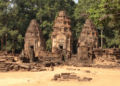
The province also retains remnants of its prosperous past, including ancient temples and colonial-era architecture that provide insight into its historical development and cultural heritage. Kampong Cham was officially established as a provincial entity on January 1, 1885, and has evolved through various administrative changes, including the 2013 division that created Tboung Khmum province from its eastern part.
Demographics and Culture
As of 2023, Kampong Cham has a population of approximately 988,800 people, ranking it seventh in population among Cambodia’s provinces. The population density is about 198 people per square kilometer, making it one of the more densely populated areas in the country. The demographic composition includes a majority of ethnic Khmer, with smaller communities of Cham and other ethnic groups.
The Cham people, who historically gave the province its name, are mostly Muslim and maintain distinct cultural and religious traditions. Although their numbers in Kampong Cham have diminished over time, their influence remains evident in local culture and place names.
The province is known for its vibrant cultural life, including traditional festivals, religious ceremonies, and a rich culinary heritage. The Mekong River plays a central role in community life, influencing local customs and livelihoods.
Economy and Agriculture
Kampong Cham is often described as one of the most fertile provinces in Cambodia, with agriculture being the backbone of its economy. The fertile floodplains of the Mekong support the cultivation of rice, the staple food of Cambodia, along with other crops such as rubber, cassava, and various fruits and vegetables.
Fishing is also a significant economic activity due to the province’s extensive river systems. The Mekong River provides a rich source of fish, which supports both local consumption and trade.
In recent years, Kampong Cham has seen increased investment in infrastructure and development projects aimed at improving transportation, education, and healthcare, which in turn support economic growth and improve living standards.
Administrative and Political Structure
The provincial capital is Kampong Cham city, which is also the 12th largest city in Cambodia with a population of around 61,750 (2021). The city is located on the Mekong River and serves as the administrative, economic, and cultural center of the province. Kampong Cham city is connected to the district of Tboung Khmum by the Kizuna Bridge, Cambodia’s first bridge spanning the Mekong, symbolizing the province’s connectivity and development.
Administratively, Kampong Cham is divided into one municipality and nine districts. The local government is headed by a governor, and the province is represented by 10 seats in Cambodia’s National Assembly. Politically, the Cambodian People’s Party (CPP) has been dominant in the region, controlling most local government positions.
Climate and Environment
Kampong Cham experiences a tropical climate with distinct wet and dry seasons. The average annual temperature is around 27.7°C, with the hottest months reaching up to 39°C. Rainfall is abundant during the rainy season, averaging about 1,721 mm annually, which supports the province’s agricultural productivity.
The province’s natural environment includes riverine ecosystems along the Mekong, which are crucial for biodiversity and local livelihoods. Efforts to balance development with environmental conservation are ongoing, particularly in managing the impacts of agriculture and urbanization.
Tourism and Attractions
Kampong Cham offers a variety of attractions for visitors interested in history, culture, and nature. Key sites include ancient temples such as Wat Nokor, which blend Khmer and Buddhist architectural styles, and colonial-era buildings that tell the story of the province’s past.
The Mekong River itself is a major draw, offering scenic views, river cruises, and opportunities for fishing and boating. The province’s cultural festivals and traditional markets provide immersive experiences of local life.
Challenges and Development
Despite its advantages, Kampong Cham faces challenges common to many Cambodian provinces, including infrastructure needs, rural poverty, and balancing modernization with cultural preservation. The 2013 administrative split, which created Tboung Khmum province from the eastern part of Kampong Cham, was seen by some as politically motivated but has also allowed for more focused governance in both provinces.
Ongoing development projects aim to improve roads, healthcare, education, and economic opportunities, helping Kampong Cham to maintain its role as a vital region within Cambodia.
In summary, Kampong Cham province is a vital and dynamic part of Cambodia with a rich historical legacy, fertile lands, and a diverse cultural tapestry. Its strategic location along the Mekong River has shaped its development as a center of trade, agriculture, and culture. With a growing population and ongoing investments in infrastructure and services, Kampong Cham continues to be a key player in Cambodia’s national landscape.