(Estimated reading time: 8 minutes – about the time it takes to sip a strong Cambodian coffee and reconsider what “ruins” really means.)
Angkor is more than postcard temples and sunset photos. It is also a century of quiet, sometimes heroic work carried out behind walls filled with statues, blueprints and dusty field journals: the story of the Conservation d’Angkor.
This article walks you through the history of that institution created in the colonial era, shaped by French archaeologists and Cambodian craftsmen, interrupted by war, and reborn in the framework of UNESCO and APSARA. It is written for curious visitors, heritage lovers and history-minded readers who want to understand why Angkor still stands, despite monsoon rains, creeping jungle and a turbulent twentieth century.
Along the way, you will meet names like Bernard‑Philippe Groslier, Jacques Dumarçay and the École française d’Extrême‑Orient, and see how their Conservation d’Angkor evolved from a technical office into a symbolic guardian of Khmer art.
What Was the Conservation d’Angkor, Exactly?
A Colonial Creation with a Very Specific Mission
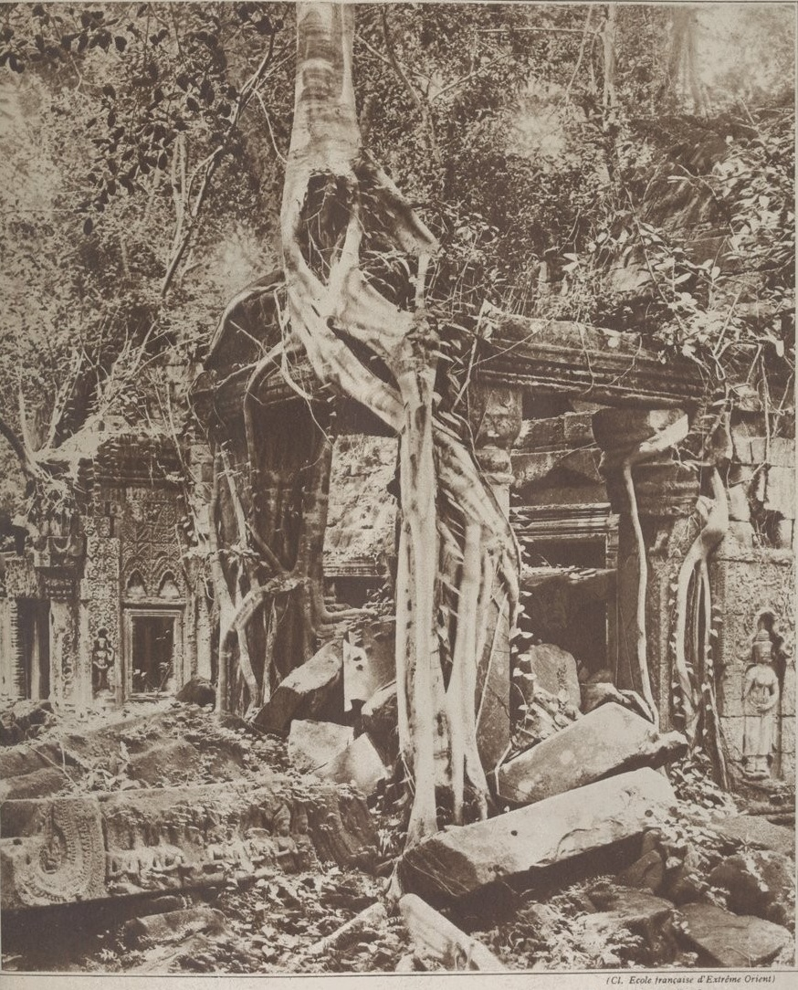
The Conservation d’Angkor was officially created by the École française d’Extrême‑Orient (EFEO) in 1908, a few years after Angkor had captured the imagination of scholars, photographers and colonial administrators. Its mission was very down to earth: clear vegetation, consolidate masonry, document the temples and organize restorations of key monuments in the Angkor region.
Based in Siem Reap, the Conservation functioned as a technical service housed in modest premises along the river, with workshops, storage rooms and an archive that slowly grew into one of the richest sources on Angkorian archaeology. Architects and archaeologists recorded their daily work in journals and reports, producing thousands of pages of drawings, plans and photographs that today form the backbone of our historical knowledge of the site.
For visitors who imagine Angkor as eternal stone, it is good to remember that without this early intervention many temples would have simply collapsed under tree roots, rain and gravity.
Between Field Lab and Museum in the Making
By the 1960s, the Conservation had become much more than a repair office. Its walled compound sheltered large numbers of sculpted statues and bas‑reliefs taken from vulnerable or heavily looted sites, effectively turning the place into a hidden museum of Khmer art. It also hosted specialized workshops for stone, iron, bronze and ceramic restoration, where Cambodian technicians and French experts experimented with conservation techniques adapted to tropical conditions and laterite, sandstone and brick monuments.
A design office brought together up to thirty‑eight draftsmen under supervisors like Guy Nafilyan and Jacques Dumarçay, producing meticulous architectural drawings and site plans that documented almost every monument in the Angkor Archaeological Park. At its peak, just before the civil war, the institution was preparing to open a Museum of Ancient Khmer Art in Siem Reap, an idea that would only fully materialize decades later in other forms.
Key Figures and Milestones in the Conservation d’Angkor
From its birth in 1908 to the 1950s, the Conservation was closely tied to EFEO scholars who alternated between patient excavation work and grand restoration projects. These teams organized the famous clearings of temples such as Angkor Wat, Bayon and Ta Prohm, tested techniques of “anastylosis” (careful dismantling and rebuilding of monuments) and produced comparative studies on Khmer architecture that still guide modern specialists.
The archives created during this period are today digitized and accessible through EFEO platforms, allowing researchers to trace day‑to‑day operations and see how archaeological reasoning evolved in the first half of the twentieth century. If you enjoy reading field notes where “discovered a new lintel” appears next to “the truck broke down again,” these documents are a delight.
Bernard‑Philippe Groslier and the Ambitious 1960s
A major turning point came in 1963, when Bernard‑Philippe Groslier took the lead in what would become the most dynamic phase of the Conservation d’Angkor. He managed to secure strong support from both French and Cambodian authorities, enabling ambitious programs of prospection, preservation and archaeological excavation at numerous sites, from Baphuon to the Elephant and Leper King terraces and from Pre Rup to small temples like Palilay.
Under Groslier’s direction, the Conservation expanded its role in investigative archaeology. One striking example is the excavation of Srah Srang, the “Royal Basin,” between 1963 and 1965, which revealed complex funerary rites from the tenth to fourteenth centuries and underground storage pits where statues had been carefully hidden in clay jars. These finds not only enriched the historical narrative of Angkor but also showed that medieval Khmer people had their own ideas of art conservation, discreetly protecting sculptures for reasons we are still discussing today.
This era combined meticulous documentation, wide‑ranging excavations and proactive rescue of sculptures threatened by illicit art dealers, creating a model that continues to inspire heritage work in Southeast Asia.
War, Rupture and Institutional Transformation
The Cambodian civil war abruptly disrupted this promising trajectory. On 20 January 1972, Bernard‑Philippe Groslier had to leave the Conservation premises as fighting approached Angkor and security deteriorated. By 1973, EFEO’s Conservation d’Angkor ceased its direct role in clearing, studying and restoring temples, closing a chapter that had lasted roughly from 1908 to the early 1970s.
Many documents, blueprints and photographic collections produced over those decades survived and are now carefully preserved in EFEO archives, but some masterful designs and records disappeared during the chaos of the 1970s and 1980s. For heritage historians, the absence of certain plans is like missing pages in an otherwise engrossing novel.
From EFEO Conservation to National Authorities and UNESCO
After the turmoil of the late twentieth century, the guardianship of Angkor shifted decisively toward Cambodian institutions and international frameworks. In 1992, Angkor was inscribed on the UNESCO World Heritage List, and at the same time on the List of World Heritage in Danger, reflecting both its universal value and serious threats. In 1993, the Tokyo Conference created an International Coordinating Committee for the Safeguarding and Development of Angkor, co‑chaired by France and Japan, to organize technical and financial support for its protection.
The APSARA National Authority, established by the Cambodian government, became the main body overseeing the site’s management, conservation and sustainable development, working with many international teams such as the Japanese Government Team for Safeguarding Angkor. UNESCO monitoring reports now provide one of the most comprehensive documentation systems on conservation issues worldwide, echoing but also extending the detailed record keeping once carried out by the old Conservation d’Angkor.
In other words, what began as a relatively small EFEO office focused on temple repair evolved into a vast network of national and international partners managing a complex archaeological landscape of more than 400 square kilometers.
Why the Conservation d’Angkor Still Matters Today
A Treasure‑House of Archives and Statues
Even though the original EFEO‑run Conservation d’Angkor no longer operates in its historic form, its legacy lives on in several ways. The archival collection, now digitized and publicly accessible, offers scholars and conservators a detailed day‑to‑day account of excavations, restorations and discoveries made over roughly seventy years. These records assist current teams in understanding earlier interventions, evaluating structural risks and reconstructing damaged or collapsed elements with historical accuracy.
The Conservation compound in Siem Reap, which once guarded impressive Khmer statues and reliefs in relative secrecy, continues to be seen as a discreet but important repository of Angkorian art, even as museums and more public spaces have taken on a larger display role. When you stroll through Angkor today and admire serene stone faces or narrative reliefs, remember that many pieces have been studied, moved, repaired and protected thanks to decisions taken inside those walls.
Lessons for Future Heritage Work
The story of the Conservation d’Angkor offers several practical lessons for heritage professionals and, more modestly, for visitors trying to make sense of what they see. First, the combination of solid documentation, multidisciplinary teams and long‑term vision is crucial for resilience, especially in regions exposed to political instability and environmental stress. Second, conservation is never a finished task. The EFEO phase, the Groslier era, the war years, the UNESCO and APSARA frameworks are all chapters in an ongoing process of safeguarding Angkor.
For the reader planning a trip or writing about Angkor, understanding the history of the Conservation d’Angkor deepens your appreciation of every restored causeway and re‑erected tower. Instead of seeing only picturesque ruins, you start to see traces of past decisions, debates and sometimes improvisations, all quietly inscribed in the stones.
The Conservation d’Angkor began as an EFEO technical service in 1908, grew into a powerful center of research and restoration under figures like Bernard‑Philippe Groslier, suffered a brutal interruption in the 1970s, and finally gave way to a broader system led by APSARA and UNESCO. Its archives and legacy remain essential for anyone who cares about Angkor as a living, evolving heritage landscape rather than a frozen ruin.
Pascal Médeville is a writer and digital publisher based in Cambodia, founder of Wonders of Cambodia and long‑time observer of the Angkor region. He focuses on Cambodian history, heritage and everyday culture, and regularly writes in several languages about temples, food, literature and the many ways past and present meet in Southeast Asia.