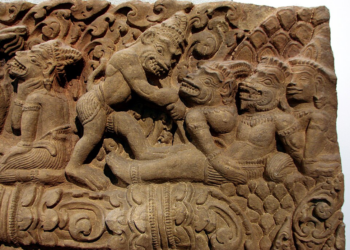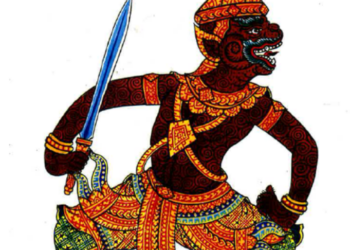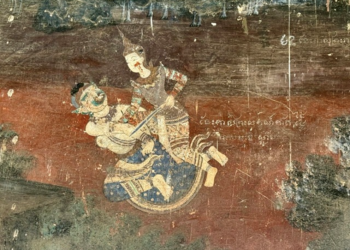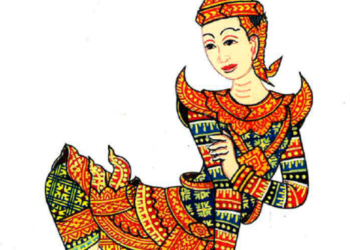
More than a book, Gatilok (also spelled Gatiloke or Kotelok) is a universe of Khmer wit, wonder, and moral imagination. Compiled in the early 20th century by the brilliant scholar Suttantaprija Ind, this collection of 112 tales and poems preserves the soul of Cambodian storytelling – mixing humor, poetry, and Buddhist wisdom with irresistible charm.

Every culture has its own literary treasure chest where wisdom and imagination mingle freely. For Cambodia, one such masterpiece is Gatilok (គតិលោក), a compilation of 112 folktales, fables, and narrative poems written and assembled by Suttantaprija Ind (សុត្តន្តប្រីជាឥន្ទ, 1859-1924), a.k.a. Achar Ind, in the first decades of the twentieth century.
The work stands as both a monument and a mirror. It reflects the daily life of Cambodian people – peasants, monks, lovers, mischief-makers – while preserving the voice of a nation built on rhythm, laughter, and reflection. Gatilok is not a single story but a living anthology of Khmer thinking, moral teaching, and poetic invention.
Achar Ind: The Sage Who Wrote in Smiles
Poet, scholar, collector of voices
Achar Ind, known in print as Suttantaprija Ind, was one of Cambodia’s truly versatile minds. Equally at home in Khmer and Pali, he wrote about ethics, folklore, and the delicate art of making virtue entertaining. At a time when storytelling traditions risked fading under colonial influence, he turned his pen into a bridge between temple chants and modern literature.
He saw wisdom in laughter, grace in language, and teaching in story. Ind’s words dance with rhythm and insight, proving that moral lessons need not be solemn – they can sparkle with humor and kindness.
Preserving oral beauty in writing
When Ind began compiling Gatilok, the shift from oral storytelling to print was just beginning. Around the markets and village fires, tales that had passed from voice to voice were losing their audience. Ind became their archivist, weaving them gently into written form while keeping their tone intact.
He did what poets rarely admit doing: he listened deeply before writing. And because of that, Gatilok still sounds like someone speaking – not preaching – from the heart of Cambodian life.
Inside Gatilok: One Hundred and Twelve Glimpses of the World
Tales that teach with a wink
The stories in Gatilok are full of clever animals, wise monks, foolish kings, loyal lovers, and sharp-witted peasants who defeat fortune with words more than swords. They laugh at vanity, reward humility, and remind readers that goodness is rarely loud; it often arrives disguised as common sense.
Each tale ends not with a moral sermon but with a quiet smile. Pride meets its teacher, wit trumps strength, and love discovers its limits without losing dignity. Reading Gatilok feels like listening to an old storyteller under a tree – a mix of mischief, compassion, and deep truth.
Poetry alive in everyday speech
Ind wrote in both verse and prose, reshaping traditional Khmer meters. His rhythm gives even the humblest tale a kind of musical grace. The language flows with idioms and ironies still heard today, showing how written Khmer retains its oral roots.
There is wit in his narration – a light teasing tone never far from sympathy. His humor isn’t cutting; it is the laughter of someone who has seen the world clearly and found forgiveness for it.
Why Gatilok Still Matters
A mirror of Khmer sensibility
To modern readers and scholars alike, Gatilok is a miniature encyclopedia of Cambodian life in the early twentieth century. Within its pages we find everything from rural wisdom and market philosophy to subtle metaphors about justice, generosity, and social harmony.
Ind’s writing freezes time in the most humane way possible: not by describing history, but by capturing how people felt, spoke, and imagined before mass communication reshaped memory.
The storyteller’s inheritance
Though decades have passed, Gatilok continues to breathe through Cambodian art and speech. Many archetypes – the clever servant, the honest monk, the chatty neighbor – live on in today’s dramas and songs. The same gentle irony resurfaces in popular humor and moral tales shared among families.
Ind knew that stories never truly end; they only change voice. His genius was to record them before time grew silent.
Beyond Gatilok: The Writer’s Broader Legacy
Achar Ind’s repertoire extended far beyond this single work. He wrote philosophical essays, collections of proverbs, and religious treatises, all infused with human warmth. His pen proved that classical Cambodian language could express modern emotion without losing its elegance.
Through Gatilok, he inspired generations of writers and monks who saw moral writing not as preaching but as dialogue – a way to speak gently and memorably about life’s complexities.
Rediscovering Gatilok
Today, Gatilok may be found in print, in archives, and through digital preservation efforts. Reading it now yields both pleasure and perspective.
It offers three gifts:
- Cultural rediscovery – insight into a Cambodia balancing faith and humor.
- Linguistic delight – the taste of vivid Khmer phrasing at its finest.
- Moral reflection – reminders that kindness, wit, and self-awareness endure beyond centuries.
For readers, it feels less like studying literature and more like entering a conversation that started long ago and still continues.
Conclusion
Gatilok remains one of Cambodia’s most beautiful literary legacies, a gathering of voices shaped by compassion and intelligence. Through 112 tales and poems, Suttantaprija Ind captured the soul of Khmer storytelling and preserved it for future generations. His work is not only literature – it is heritage, breathing wisdom through laughter and rhyme.
To read Gatilok is to listen again to Cambodia telling its own story.
About the author
Pascal Médeville, based in Cambodia, writes about Southeast Asian literature, philosophy, and living traditions. His work explores how words preserve identity and how stories reveal the moral pulse of societies. On Wonders of Cambodia, he shares essays on Khmer culture, language, and history.