Prasat Tao is one of the main temple groups of Sambor Prei Kuk, famous for its lion guardians and elegant brick sanctuary, but sitting slightly off-axis in the forest rather than at the ceremonial center of the site. It grew out of a 7th‑century royal project linked to King Isanavarman I and was later expanded under other Chenla rulers, with its iconic lions only arriving in the early 9th century.
On the wooded edges of ancient Isanapura, Prasat Tao stands as a lion-guarded sanctuary built in the 7th century under King Isanavarman I’s Chenla capital project and reworked by later rulers. This guide explains who built Prasat Tao, when its different parts were added, how to read its architecture, and why it’s worth the walk beyond Sambor Prei Kuk’s central focus.
Prasat Tao (ប្រាសាទតោ), often nicknamed the “Lion Temple,” belongs to the Sambor Prei Kuk complex in Kampong Thom Province, identified with the ancient Chenla capital of Isanapura. It is not the central group of the site, but one of its key walled clusters, with its own tower, enclosure, and sculptural program.

This article is for travelers who enjoy temples as historical arguments in brick: people who want more than “old” and “beautiful” and are curious about kings, dates, and building phases. You’ll get a clear sense of which rulers are associated with Prasat Tao, what the 7th–9th century timeline looks like, and how to explore the group on foot without losing the thread of the story.
Who built Prasat Tao, and when?
To understand Prasat Tao, you have to zoom out to Sambor Prei Kuk as a whole. The complex corresponds to Isanapura, the 7th‑century Chenla capital founded and monumentalized under King Isanavarman I, who reigned roughly from 616 to 637 CE and took Isanapura as his capital. Multiple sources note that the early main temples at the site, especially the northern and southern groups, belong to this period.
Beyond Angkor, which treats individual temple groups in detail, states that Prasat Tao was founded in the 7th century and lists its builders as Isanavarman I and Jayavarman I. According to that entry, brick analysis suggests the central tower is the earliest structure, with some outer shrines corresponding to the Bhavavarman II period and additional shrines, particularly to the east, added under Jayavarman I.
In simple terms, the construction timeline looks like this:
- Late 6th–early 7th century: Site of Isanapura emerges as a political and religious center in the Chenla kingdom.
- Reign of Isanavarman I (616–637 CE): Major building phase at Sambor Prei Kuk; foundation of the capital Isanapura and construction of core temple groups, including structures in the Prasat Tao group.
- Later 7th century: Bhavavarman II and Jayavarman I add or complete outer shrines and elements at Prasat Tao, extending the group’s footprint.
- 8th century: Decorative features such as colonnettes and lintels show stylistic traits of Prei Khmeng and Kampong Preah styles.
- Early 9th century: The famous lion statues are added, giving Prasat Tao its modern nickname and visual identity.

Some modern “lightweight” documentation attributes Sambor Prei Kuk more broadly to Jayavarman II, who is associated with early Angkor and the devarāja cult in the early 9th century. But specialist references and the Isanapura entry emphasize that the main construction at Sambor Prei Kuk, including the core of Prasat Tao, belongs to the 7th century under Isanavarman I and his immediate successors, not to Jayavarman II.
A layered monument, not a single date
Prasat Tao is therefore not “built in year X by king Y” but a layered monument:
- its skeleton (central brick sanctuary and early walls) emerges under Isanavarman I’s capital;
- its flesh (outer shrines and expansions) comes from Bhavavarman II and Jayavarman I;
- its expressive face (the lions and stylistically later details) belongs to the 8th–early 9th centuries.
When you walk into the enclosure today, you are effectively crossing a century and a half of political and religious history without leaving the site.
Where Prasat Tao sits in the Sambor Prei Kuk landscape
Sambor Prei Kuk lies about 20–30 km north of Kampong Thom town and is recognized as one of mainland Southeast Asia’s earliest “temple towns,” a religious and urban complex rather than a single standalone sanctuary. It was inscribed as a UNESCO World Heritage Site in 2017 as the “Temple Zone of Sambor Prei Kuk, Archaeological Site of Ancient Ishanapura.”
Within this forested cityscape, most guides highlight three large walled groups — usually described as north, central, and south — plus additional clusters and scattered shrines. Prasat Tao is one of these groups, often associated with the lion imagery and a substantial double enclosure system with moat and laterite walls, but it is not the symbolic “main temple” of the whole site (that role belongs to Prasat Sambor in the north group).
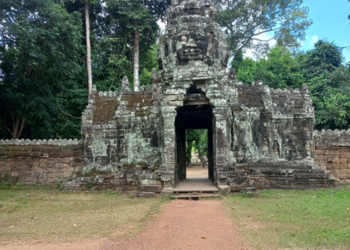
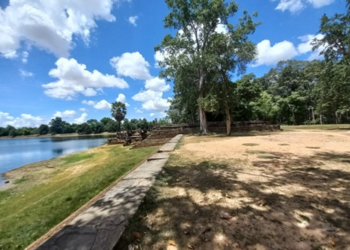
Voyagecambodge’s description notes that the “temple of lions” group is made up of 18 temples, enclosed by two sets of walls and associated with a rectangular pond between them. The outer laterite wall has a perimeter over 300 meters per side and features gopuras (gate towers) at the east and west entrances, linked by laterite walls, with small mounds marking shrine locations along the processional way.
This gives Prasat Tao a clear internal logic:
- an outer sacred boundary (laterite wall and pond),
- a processional path towards the main eastern gate,
- an inner enclosure with the central brick sanctuary as its focal point,
all slightly off the main axis of the wider site but perfectly coherent in itself.
What to look for: architecture and lions
At the heart of Prasat Tao stands the central brick shrine, a substantial tower opening to the east and fitted with sandstone doorframes, colonnettes, and lintels. Hello Angkor describes this central shrine as a monumental brick tower, likely dating to the 7th–8th century, and notes the presence of decorative sandstone elements typical of pre-Angkorian temple architecture.

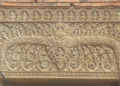
The art-historical analysis in Beyond Angkor refines this further: the central shrine’s initial construction likely dates to Isanavarman I’s era, while its decoration (colonnettes, lintels) fits 8th‑century Prei Khmeng and Kampong Preah styles. This is a good reminder that “built” and “decorated” are often different chronological stories.
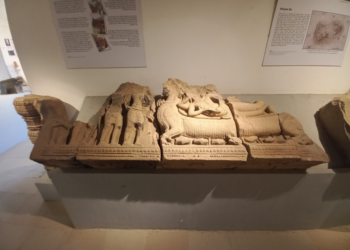
The lions at Prasat Tao are the reason many visitors remember the group’s name. They flank the entrance steps of the central tower, sitting upright with raised heads and open mouths that face the approach. According to Beyond Angkor, these lion statues are considered early‑9th‑century works, slightly later than most of the brick construction.
From an iconographic point of view, they are part of a wider Khmer tradition of guardian lions that persists well into the Angkor period. From a traveler’s point of view, they provide scale, character, and a focal point for both photography and contemplation. One might call them the temple’s public-relations department, working centuries overtime.
The material palette at Prasat Tao — brick for the main masses, laterite for walls and certain structural elements, sandstone for doors and sculpture — is classic pre-Angkor. The forest setting, with tall trees and encroaching roots, only amplifies the color contrasts between red brick, dark laterite, and pale sandstone, especially in early morning or late afternoon.

Because the group sits a bit away from the busiest nodes, the atmosphere is often quieter. Expect more birds than people on many days, especially if you time your visit outside of weekends and holiday peaks.
Visiting Prasat Tao: practical tips
Sambor Prei Kuk is about 25–30 km from Kampong Thom, accessible by moto, tuk-tuk, or car from town; once inside the site, visitors explore the various groups on foot along sandy or laterite paths through the forest. The standard visit takes two to three hours, but including Prasat Tao in a more deliberate loop can easily fill half a day.
Because Prasat Tao is not the central group, you may have to insist (gently) that your driver or guide includes it, especially if they are used to short, main-group-only itineraries. Having a clear idea of the group’s name and its lion feature helps avoid misunderstandings.
The site is generally open during daylight hours (7:00–17:00 is common practice for Sambor Prei Kuk), so aim for early morning or late afternoon for the best combination of light and temperature. Paths between groups can be hot, dusty, or muddy depending on season; good footwear and water are not optional.
Once you reach Prasat Tao, start by walking the outer enclosure line to understand the scale of the group (and spot the pond depression), then move inwards towards the central shrine and its lions. This outside‑in approach mirrors the way historical processions may have used the space and helps you read it as an ordered ensemble rather than a single “ruin photo-stop.”
For photos, try three basic compositions:
- lions plus tower from a low angle;
- brick tower framed by tree trunks or branches;
- details of brick joints, sandstone colonnettes, and lion surfaces.
If you can, give yourself ten minutes simply to sit near the lions and watch how light shifts across brick and foliage. In that small pause, the 7th‑century capital project, the 8th‑century decoration, and the early‑9th‑century lions all quietly line up in your field of vision.
Prasat Tao is not the central group of Sambor Prei Kuk, but a lion-guarded sanctuary born from Isanavarman I’s 7th‑century capital at Isanapura and expanded by later Chenla kings, then given its most famous sculptures in the early 9th century. Visiting it is a way of walking through that layered timeline in a single, forest-framed space — less crowded than Angkor, but every bit as eloquent in brick and stone.
About the author
Pascal Médeville is a Cambodia-based writer and digital publisher who enjoys following Khmer history where it actually happened: in the dust, shade, and brick of sites like Sambor Prei Kuk. He writes research-based yet accessible pieces that help readers link kings, dates, and temple plans to what they see under their own feet in Cambodia today.