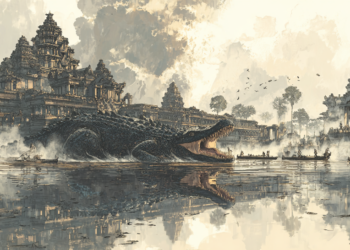
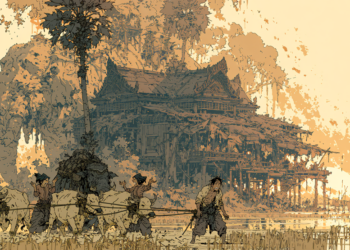
Suryavarman I is one of the Khmer kings who quietly changed everything: borders, temples, administration and even the balance between Hinduism and Buddhism at Angkor. Often overshadowed by Suryavarman II and Jayavarman VII, he nonetheless laid the foundations for a stronger, more cohesive empire. This article introduces who he was, what he did, and why he still matters today.
Suryavarman I (Khmer: សូរ្យវរ្ម័នទី១) ruled the Khmer Empire in the early 11th century, roughly from the first years of the 1000s until his death around 1050. His reign came after a period of instability marked by rival claimants to the throne and competing power bases inside the kingdom. By imposing his authority over Angkor, he helped end this phase of fragmentation and ushered in several decades of relative cohesion.
He is often remembered as both a conqueror and an administrator, a king who extended the empire’s boundaries while also tightening its internal organization. His posthumous name was “Nirvanapada,” the king who has gone to nirvana, which reflects his attachment to Buddhism even while he maintained a Hindu royal cult. For travelers, students and history enthusiasts trying to understand Angkor’s long story, Suryavarman I is a key figure linking the early foundations of the empire with its later classical apogee.

Suryavarman I did not inherit the throne smoothly; he fought for it. Around 1002 he challenged and defeated King Udayadityavarman I, seizing the royal title amid open conflict. At the same time another king, Jayaviravarman, controlled part of Cambodia, meaning that for almost a decade the realm was effectively divided between rival courts.
The struggle between Suryavarman I and Jayaviravarman appears to have lasted until around 1010 or 1011, when Suryavarman I finally secured sole control over Angkor. In this sense he was both a usurper and a unifier, depending on which faction’s perspective one adopts. Modern scholarship tends to see him as a legitimate heir of one important branch of the royal family, participating in a broader pattern of rotating kingship among related lineages rather than a simple outsider seizure of power.
A long-standing historical puzzle is Suryavarman I’s origin. Some researchers have argued that he may have had ancestral links to the Malay Peninsula, particularly to the kingdom of Tambralinga. Inscriptions and later analyses suggest he may have used these connections to build alliances beyond the Khmer heartland, though the exact details remain debated. Whatever his background, by the early 11th century he was firmly established as the ruler of Angkor and recognized as “King of the Khmer.”
Ruling Angkor: The “King of Just Laws”
Consolidating power at the center
Once king, Suryavarman I had to secure loyalty across a politically fractured elite. One famous account describes him inviting around 4,000 local officials to the palace to swear an oath of allegiance, an extraordinary display of mass elite incorporation into royal service. This gathering symbolized a new political order in which regional notables were bound more tightly to the central court.
He also moved to strengthen the royal residence itself. His palace, located near the site of what would later become Angkor Thom, is said to have been the first in Khmer history to be surrounded by a defensive wall. This architectural choice reflected both real threats — internal and external — and an ideological assertion of a well‑protected, ordered royal center.
Law, religion and daily governance
Suryavarman I earned the epithet “King of the Just Laws,” implying an interest in orderly governance and the codification or enforcement of norms. Inscriptions depict him as an energetic promoter of public works, especially irrigation systems, which were crucial for rice cultivation and therefore state revenues. By maintaining canals and reservoirs, he supported the agricultural surplus that fueled Angkor’s growth.
Religiously, he appears as a Buddhist king ruling an empire in which Hinduism remained very influential. He favored Buddhism personally, as reflected in his posthumous title “Nirvanapada,” yet he allowed his subjects to continue their Shaivite and Vaishnavite practices. This pragmatic tolerance helped maintain stability in a multi‑religious elite culture where temple foundations, land grants and religious endowments were deeply intertwined with politics.
Under Suryavarman I, the Khmer Empire pushed outward in several directions. In the north and northeast, his campaigns brought territories in what is now southern Laos under more direct Angkorian control. These gains were not short‑lived: some remained within the Khmer sphere for centuries, shaping the historical geography of mainland Southeast Asia.
Inscriptional and later narrative evidence collectively portray his reign as one of external consolidation, with no major revolts recorded against him once his rule was fully established. For a kingdom that had just emerged from intense internal factionalism, this relative calm underpinned prosperity and ambitious building projects.
Alliance with the Chola Empire
Suryavarman I also looked across the sea. Early in his reign he established diplomatic relations with the powerful Chola dynasty of southern India, ruled at the time by Rajendra Chola I. This connection was not merely ceremonial; it became part of a regional power struggle in the Malay Peninsula and maritime Southeast Asia.
When the kingdom of Tambralinga sought help from the Srivijaya ruler against Khmer‑Chola pressure, it contributed to a larger conflict between the Chola and Srivijaya empires. The war ended in a clear Chola victory and significant losses for Srivijaya and Tambralinga, leaving the Khmer Empire on the side of the winning coalition. For Angkor, this meant prestige, safer maritime routes for trade and a stronger diplomatic profile in the wider region.
Builder King: Temples and Public Works
From Angkor’s plain to sacred mountain tops
Though Suryavarman II and Jayavarman VII often receive more attention as “builder kings,” Suryavarman I also left a substantial architectural legacy. Many of his known projects lie not only around Angkor but also in provincial areas, particularly on prominent hills and mountain ridges. This positioning emphasized royal presence across the landscape and linked political authority with sacred geography.
One of the most notable sites associated with him is Preah Vihear, the spectacular cliff‑top temple straddling the modern Thai – Cambodian border. Although elements of the sanctuary predate him, much of what visitors see today — including the long processional axis and several gopuras (gate‑towers) — was constructed or significantly developed during his reign. Inscriptions at Preah Vihear mention Suryavarman I together with his Brahmin adviser Divakarapandita and describe donations such as a golden statue of Nataraja.

Beyond temples, Suryavarman I is credited in inscriptions and later summaries with extensive work on water management. By building and repairing reservoirs, channels and other hydraulic infrastructure, he reinforced the agricultural base that supported Angkor’s population and monumental building program. This kind of investment often receives less attention than sandstone towers, but it was essential to the empire’s endurance.
For today’s visitor to Cambodia, sites like Preah Vihear, Phnom Chisor or Phnom Ek can be read partly as the material trace of this king’s policy: temples that double as political statements, anchored in landscapes irrigated and organized under his authority. Seeing them this way helps connect the art and architecture of Angkor to the political choices of specific rulers, including Suryavarman I.
Suryavarman I died around 1050 after a long reign of nearly four decades, an impressive tenure in such a turbulent political environment. After his death he was venerated under the posthumous name Nirvanapada, underscoring again the Buddhist tone of his royal image. He was succeeded by Udayadityavarman II and then Harshavarman III, who continued to face internal tensions and external threats, particularly from Champa.
Yet the institutional and territorial framework he created endured. By stabilizing the throne after years of conflict, consolidating lands from the Mekong regions to the Dangrek ranges and engaging with major powers like the Cholas, he prepared the ground for the spectacular 12th‑century achievements of Suryavarman II and later kings. In many respects, understanding Suryavarman I is essential to understanding how Angkor became capable of building Angkor Wat and projecting power across mainland Southeast Asia.
Suryavarman I may not be the most famous Angkorian king, but he was one of the most decisive. By winning a brutal succession struggle, binding regional elites to the court, expanding the empire’s frontiers, cultivating powerful overseas allies and sponsoring temples such as Preah Vihear, he transformed a divided kingdom into a more cohesive imperial state. For anyone exploring Angkor’s history—or standing on the cliffs of Preah Vihear today—Suryavarman I offers a compelling “who’s who” entry in the long story of the Khmer Empire.
Sources & further reading / To know more
- Suryavarman I (Wikipedia) – Concise overview of his reign, including chronology, titles, religious policy and foreign relations within the Khmer Empire.
- Suryavarman I (Encyclopaedia Britannica) – Short scholarly article emphasizing his role as a conqueror and builder who expanded and unified the empire.
- Khmer Empire (Wikipedia) – Broader context on Angkor’s political history, where Suryavarman I appears as a key unifier after decades of instability. See also “The Rise and Legacy of the Khmer Empire: Southeast Asia’s Ancient Powerhouse” on Wonders of Cambodia.
- The Reign of Suryavarman I and Royal Factionalism at Angkor (Michael Vickery) – Academic study examining his legitimacy, family background and the dynamics of royal factions.
- The Trace of King Suryavarman I (Academia.edu paper) – Research paper that explores his conquests, territorial expansion and possible Malay connections.
- Preah Vihear temple resources – Site‑focused pages and inscriptions highlighting Suryavarman I’s architectural legacy on the sacred mountain of Preah Vihear. See the article about Preah Vihear Temple on Wonders of Cambodia.
Pascal Médeville is a writer and digital publisher fascinated by Cambodian history, the Khmer Empire and the living heritage of Angkor. He regularly produces accessible, well‑researched articles for online readers interested in Southeast Asian culture, archaeology and royal biographies. Through his platforms, he aims to connect historical scholarship with curious travelers and lifelong learners.