Introduction: Why Prasat Sambor Matters
Prasat Sambor (ប្រាសាទសំបូរ) is the principal sanctuary of the northern group of temples at Sambor Prei Kuk, one of Cambodia’s most evocative pre-Angkorian sites. Located in Kampong Thom province, this complex once formed the sacred core of Ishanapura, capital of the Chenla kingdom in the 7th century. For travelers who want to go beyond Angkor Wat and discover the roots of Khmer temple architecture, Prasat Sambor offers a rare, atmospheric glimpse into an earlier era. Surrounded by shaded forest paths, lichen-covered brick towers, and scattered inscriptions, the site feels both intimate and monumental at the same time.

Historical Background: From Chenla to Angkor
Sambor Prei Kuk has been identified with Ishanapura, the capital of the Chenla kingdom that succeeded Funan and laid the foundations of classical Khmer civilization. The city flourished under a line of powerful rulers, especially King Isanavarman I, who reigned in the early 7th century and is closely associated with the building of Prasat Sambor. An inscription dated 627 CE, found within the group, confirms the temple’s early date and links it directly to his reign. Dedicated to a form of Shiva known as Gambhireshvara, the sanctuary expressed royal devotion to Hinduism, already infused with local artistic traditions. Although Sambor Prei Kuk predates Angkor by several centuries, later kings continued to modify and honor the site, with evidence of additions in the 10th century and occupation into the Angkorian period.
In 2017, the “Temple Zone of Sambor Prei Kuk, Archaeological Site of Ancient Ishanapura” was inscribed as a UNESCO World Heritage Site, recognizing its outstanding testimony to early Khmer art and city planning. The wider archaeological landscape contains more than a hundred temples and an urban footprint of around 13 square kilometers, with ancient waterworks and habitation mounds still being studied. For visitors today, Prasat Sambor represents the spiritual and architectural heart of this lost city in the forest.
Layout and Architecture of Prasat Sambor
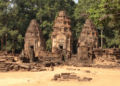
Prasat Sambor forms the northernmost of three main groups at Sambor Prei Kuk, the others being Prasat Tao (central) and Prasat Yeai/Yeah Puon (southern). The complex is enclosed by three successive square walls, which once structured the sacred space and emphasize the importance of this group within the ancient city. A causeway leads east from the sanctuary towards the site of an enormous, now-dry baray (reservoir), underlining the close relationship between water, kingship, and sacred architecture in early Cambodia. Inside the enclosures, you will find multiple brick towers arranged around a central sanctuary, with traces of laterite and sandstone elements that once framed doorways and pedestals.

Several individual structures stand out. Temple N11 is the best-preserved tower, a square brick sanctuary opening to the east with false doors on the other three sides and bands of carved brick “flying palaces” decorating its exterior. Nearby, N14 preserves an important inscription, while N14-2 is known for its ornate sandstone pedestal, hinting at the ritual statuary that once stood here. Other towers such as N12 and N13 survive only partially, yet their footprints help reconstruct the complex’s original composition. Taken together, the group shows early experiments with forms and motifs that would later evolve into the more elaborate towers and galleries of Angkor.

Artistic Details and Inscriptions
Even in their damaged state, the decorative details of Prasat Sambor’s brickwork are a major reason to visit. The characteristic “flying palaces” – miniature palatial facades populated by tiny figures – appear in relief on the tower walls and foreshadow similar motifs that would re-emerge centuries later in Angkorian bas-reliefs. Delicate pilasters, colonettes, and false doors in brick demonstrate a technical mastery that makes Sambor Prei Kuk one of the earliest and most sophisticated brick-temple traditions in mainland Southeast Asia. Some towers once carried stucco and sandstone embellishments, but time, vegetation, and war have stripped much of this surface, leaving a softer, almost organic texture.

Inscriptions scattered through the group provide rare glimpses into the social and religious life of Ishanapura. At Prasat Sambor, texts record royal dedications and, in one famous case from the nearby complex, even mention the marriage of a Brahmin priest from the Deccan to the king’s daughter, underlining long-distance links with India. Within the northern group, inscriptions K.436 and K.437, associated with the gopura and tower N14, preserve Sanskrit and Old Khmer texts that epigraphers continue to mine for information on Chenla’s political and ritual landscape. For the casual visitor, simply noticing the incised stone blocks, often tucked into doorframes or pedestals, adds another layer of depth to the experience of walking through the ruins.
Prasat Sambor lies about 30 kilometers north of Kampong Thom town, making Sambor Prei Kuk an easy half-day or full-day excursion from the provincial capital. The site is reached via rural roads that thread through rice fields and small villages, heightening the feeling that you are entering a forgotten city reclaimed by the forest. Once inside the archaeological park, a network of sandy paths leads to the three main temple groups; the northern group containing Prasat Sambor is usually quieter than Angkor’s major monuments, allowing for slow exploration and photography without crowds. Local guides are available at the entrance and can enrich your visit with explanations of iconography, inscriptions, and lesser-known shrines scattered beyond the main clusters. Foreign visitors need to buy an entrance ticket to visit the site (USD10).
For an optimal visit, aim to arrive in the early morning or late afternoon, when the light is gentle and the forest shade keeps temperatures manageable. Wear comfortable walking shoes, carry water, and be prepared for uneven ground, tree roots, and the occasional tangle of vines around temple bases. As a UNESCO site, Sambor Prei Kuk is under active conservation, so you may see ongoing stabilization work on some towers or restricted access around fragile structures; respecting these barriers helps protect the delicate brickwork for future generations. If you have more time, combine Prasat Sambor with visits to the central Prasat Tao (with its iconic lion guardians) and the southern group, to appreciate the diversity of early Khmer architecture in one compact, magical landscape.