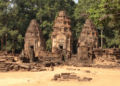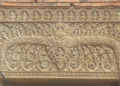

Standing as a monumental testament to the grandeur of the Khmer Empire, Angkor Thom (អង្គរធំ, meaning “Great City”) was the last and most enduring capital of the kingdom. Rebuilt in the late 12th century by King Jayavarman VII, this vast walled city covers an area of 9 square kilometers and represents the zenith of Khmer power, art, and architecture. Located just north of Angkor Wat, in Siem Reap Province, Angkor Thom is one of the most significant archaeological sites in Cambodia, renowned for its iconic face towers, grand gates, and intricate bas-reliefs.
Historical Background
Angkor Thom was established after Jayavarman VII reclaimed the Khmer capital from the Cham invaders in 1181. Unlike earlier Hindu temples, Angkor Thom was designed as a Buddhist city, reflecting the king’s devotion to Mahayana Buddhism. However, it also incorporated elements of Hinduism and ancestral worship, showcasing the empire’s religious syncretism.
The city remained the political and religious heart of the Khmer Empire for centuries, even as the kingdom declined in the 15th century. By the time European explorers rediscovered it in the 19th century, Angkor Thom had been reclaimed by the jungle, its stone structures entwined with towering roots—a sight that continues to captivate visitors today.
Architectural Highlights
1. The Bayon: The Temple of Faces
The Bayon, the spiritual center of Angkor Thom, is one of the most enigmatic temples in Cambodia. Known for its 216 gigantic stone faces smiling serenely from 54 towers, the Bayon remains a subject of debate among historians. Some believe the faces depict Avalokiteshvara, the Bodhisattva of compassion, while others argue they represent Jayavarman VII himself, symbolizing the king’s divine omnipresence.
The temple’s two levels of bas-reliefs depict both mythological scenes and historical events, including naval battles against the Cham and daily life in the Khmer Empire. The intricate carvings make the Bayon a masterpiece of Khmer narrative art.
2. The South Gate & the Giant Faces
The most famous entrance to Angkor Thom is the South Gate, approached by a causeway lined with 54 stone gods (Devas) and demons (Asuras) holding a giant naga (serpent). This scene mirrors the Churning of the Ocean of Milk from Hindu mythology, symbolizing the cosmic struggle between order and chaos.
The gate itself is crowned by four colossal faces, similar to those at the Bayon, gazing in the cardinal directions. These faces, along with the towering prasat (towers), create an awe-inspiring first impression of the ancient city.
3. Baphuon: The “Mountain Temple”
Just northwest of the Bayon stands the Baphuon, an 11th-century temple-mountain built before Angkor Thom’s construction. Originally dedicated to Hinduism, it was later converted into a Buddhist temple with a massive reclining Buddha added to its western side. The temple underwent a painstaking 50-year restoration, finally reopening in 2011.
4. The Terrace of the Elephants & the Terrace of the Leper King
These two grand platforms were used for royal ceremonies and public gatherings. The Terrace of the Elephants, stretching 350 meters, features life-sized elephant carvings and was likely a viewing stand for the king during military parades and festivals.
Adjacent to it, the Terrace of the Leper King is named after a mysterious statue found on top, possibly representing Yama, the god of death, or a leprous king from legend. Its walls are covered in intricate carvings of gods, demons, and celestial beings.
5. The Royal Palace & Phimeanakas
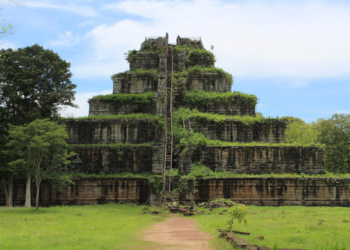
Though largely in ruins today, the Royal Palace complex within Angkor Thom once housed Khmer royalty. At its center stands Phimeanakas, a pyramidal temple that, according to legend, was topped by a golden tower where the king spent each night with a nine-headed naga spirit in the form of a woman.
Decline & Rediscovery
By the 15th century, Angkor Thom was gradually abandoned due to environmental strain, shifting trade routes, and Siamese invasions. The jungle consumed the city until French explorers, including Henri Mouhot, brought it back to the world’s attention in the 19th century.
Visiting Angkor Thom Today
Angkor Thom is part of the Angkor Archaeological Park, accessible with the same ticket as Angkor Wat. The best time to visit is early morning or late afternoon, when the soft light enhances the temple’s mystical atmosphere. Exploring the site by bike or tuk-tuk allows visitors to appreciate its vast scale.
Angkor Thom is more than just a collection of ruins—it is a symbol of Cambodia’s golden age, a city where history, religion, and artistry converge. From the enigmatic smiles of the Bayon to the grandeur of its gates, Angkor Thom remains one of the world’s most extraordinary ancient sites, offering a glimpse into the soul of the Khmer Empire.