Khmer architecture, with its profound sense of harmony, grandeur, and spirituality, stands as one of Southeast Asia’s most enduring cultural legacies. More than the mere crafting of temples and palaces, it represents an expression of cosmological beliefs, royal authority, and artistic imagination woven deeply into Cambodia’s history. From the earliest shrines of the Funan and Chenla periods to the majestic monuments of the Angkorian Empire and the refined wooden houses of the countryside, Khmer architecture reflects a civilization that placed balance between stone and nature, heaven and earth, at the very center of its worldview.

Origins and Foundations
The roots of Khmer architectural expression can be traced to the early Indian influences that reached the Mekong delta in the first centuries of our era. Funan and Chenla, the kingdoms that predated Angkor, absorbed artistic and religious models from the Indian subcontinent, adapting them to local conditions. The use of brick and laterite, ornamented with sandstone lintels, announced the beginning of a distinctive Khmer style. Already, even in these more modest sanctuaries, the Khmer genius revealed itself in its mastery of symbolic space, linking earthly dwellings with the divine order.
It was during the Angkorian period, beginning in the 9th century, that Khmer architecture attained its most ambitious scale. The innovations of this era were not born out of pure imitation of foreign forms but rather from a profound internalization and transformation of art and belief. Each temple, each causeway, and each reservoir were designed both as practical structures and as cosmic allegories. The Khmer people did not simply build; they inscribed their spiritual vision into stone.
Monumental Temples and Symbolism
Central to Khmer architecture are the temples, embodiments of Mount Meru, the mythical center of the universe in Hindu and Buddhist cosmology. The use of stepped pyramids, rising towers, and concentric enclosures symbolized the ascent from the earthly realm to the divine. Temples such as Bakong, with its tiered structure and surrounding shrines, or the mountain-temple of Phnom Bakheng, exemplify this cosmic image.
The towers resembled lotus buds opening towards the heavens. Their vertical thrust was not only an aesthetic gesture but a direct expression of transcendence. Each sanctuary’s layout recalled the concentric seas and mountains of Hindu cosmology, with outer enclosures representing the earthly domains and the central sanctuary embodying the home of the gods. Entering such a temple meant embarking on a spiritual journey, crossing from one world to another.
Angkor Wat, perhaps the most emblematic Khmer monument, represents the culmination of this architectural philosophy. Its five central towers symbolize the five peaks of Mount Meru; they mirror in the surrounding moat to evoke the union of heaven and earth. The careful alignment to the sun and moon, the precision of the galleries, and the monumental bas-reliefs narrating epics from the Ramayana and Mahabharata, testify to the extraordinary sophistication of Khmer builders. It is architecture conceived as ritual, stone as scripture.
Sandstone and Craftsmanship
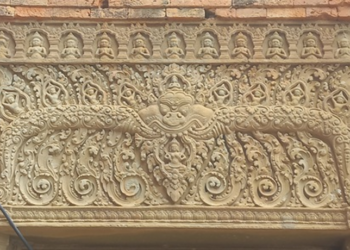
Khmer architects were remarkable not only in spatial conception but also in technical mastery. They perfected the art of carving sandstone, transforming hard stone into flowing forms of apsaras, floral motifs, nagas, and celestial guardians. Each lintel and pediment was a canvas for sculptors, where divine narratives and ornamental beauty coexisted. The precision with which blocks were cut and placed, often without mortar, displays an expertise that continues to fascinate engineers and historians today.
The integration of sculpture into architecture was never superficial. Decorative elements were always part of the sacred narrative. A lintel depicting Vishnu reclining on the serpent Ananta was not mere decoration but a vital symbol of cosmic creation, linking temple walls to the eternal cycle of the universe.
Hydraulic Engineering and Urban Design
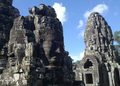
Beyond temples, Khmer architecture extended to the very landscape. The Angkorian kings undertook vast hydraulic projects, constructing barays (artificial reservoirs) and canals that served both as practical irrigation systems and symbols of cosmic oceans. The alignment of these waterworks with temples underscored the Khmer vision of harmony between environment and belief. Angkor Thom, the great capital founded by Jayavarman VII, exemplifies urban planning on a monumental scale. Its fortified walls, grand gates adorned with giant faces of Lokesvara, and its central Bayon temple demonstrate an architectural vision that united spiritual, political, and practical dimensions.
Unlike many civilizations, where cities passively grew around geography, the Khmers reshaped geography itself. They did not only adapt to the land; they reconstructed it in their image of the cosmos, ensuring that city, temple, and water system functioned as a single harmonious organism.
Wooden Traditions and Everyday Architecture
While stone temples claim much of the attention today, it is essential to remember that most Khmer architectural life was constructed in wood and bamboo. Palaces, civic buildings, and homes were predominantly made from perishable materials. Although these have vanished with time, the wooden architectural traditions survive in Cambodian houses still visible in the countryside today.
The traditional Khmer house, raised on stilts, is both elegant and functional. Elevated floors protect against seasonal floods and allow for ventilation, while sloping roofs of palm leaves or tiles provide shade and lightness. The structure is adaptable to both family life and festivals, with open verandas serving as transitional spaces between nature and interior. This fusion of practicality and beauty mirrors the same spirit of harmony found in the grand stone temples.
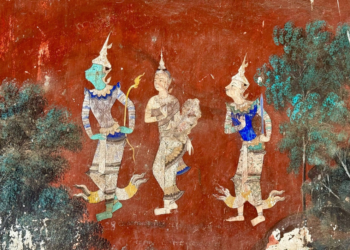
Village monasteries, with their wooden vihara and painted walls, carry forward the tradition of architecture as a medium of community and spirituality. Here too, architecture is not inert shelter but part of a living culture.
Continuities and Transformations
Khmer architecture has never been static. Across centuries, it absorbed new currents of belief and adapted to changing historical circumstances. The transition from Hinduism to Mahayana Buddhism, and later to Theravāda traditions, reshaped the symbolic content of structures while preserving architectural principles of symmetry, balance, and orientation. Towers once dedicated to Shiva became sanctuaries for the Buddha, without losing their cosmic resonance.
In the colonial and modern periods, Khmer architecture faced disruptive transformations. French scholars catalogued and restored monuments, while new administrative buildings in Phnom Penh attempted to blend Western forms with Khmer motifs. The Independence Monument, built in 1958, and the State Palace of the Sangkum era reflect an intentional revival of traditional forms in a modern context. Even recent Cambodian architecture, whether hotels in Siem Reap or urban housing, remains infused with references to Angkorian aesthetics, lotus towers, and naga balustrades.
Spirit of Harmony
What defines Khmer architecture, across its monumental and vernacular expressions, is a spirit of harmony: harmony with the cosmos, with nature, with community. The same intuition guides the planning of Angkor Wat’s axis as it does the positioning of a farmer’s stilted home. It is a vision in which beauty is inseparable from function, and in which construction is inseparable from belief.
Though wars, climate, and time have tested these monuments, the essence of Khmer architecture endures. Walking through the shadowed galleries of Angkor, gazing at the gentle slope of a wooden Khmer roof in a rural village, or watching the reflection of a lotus tower in still waters, one perceives this enduring harmony. It is not stone alone that has survived; it is a vision of space as sacred order, of architecture as the dwelling of both humans and gods.
Khmer architecture speaks without words. It invites silence, immersion, and contemplation. Its towers reach upward, its bas-reliefs unfold legends, its homes breathe with the rhythm of seasons. To contemplate it is not merely to admire the past but to encounter a living tradition that continues to inspire, within Cambodia and far beyond, the timeless art of building in harmony with life.