In Cambodia, AI translation has become a daily reflex for expats and NGOs – but between privacy risks and shaky Khmer output, relying on it blindly can be a costly mistake.
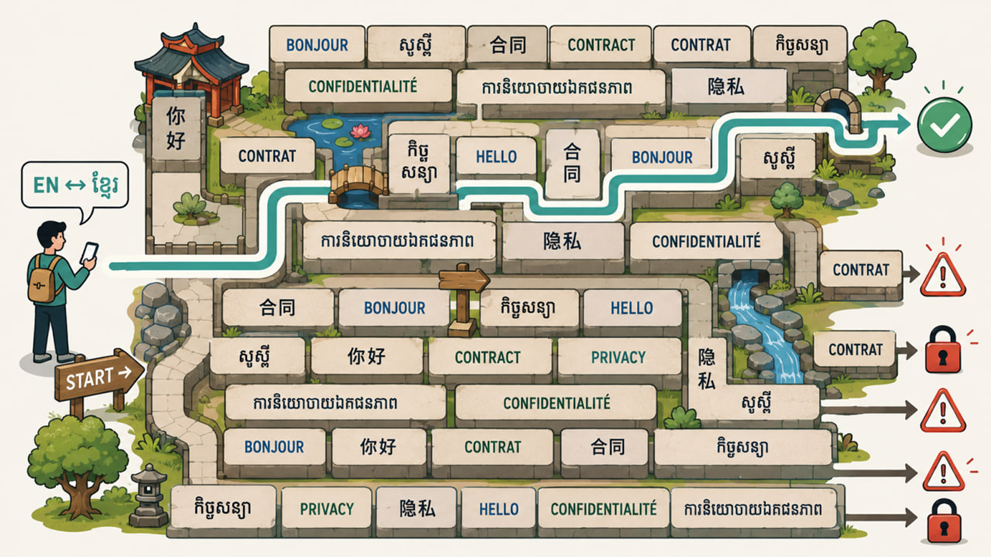
In today’s Cambodia, using AI translation has become almost instinctive. A message pops up in Khmer, an official letter arrives in French, a form is in English or Chinese: we grab our phone, open an app, and within seconds a translated version appears on the screen. It feels like a problem solved – fast, free and always available.
But once you move beyond casual chats and tourist menus, the picture changes. For English speakers living or working in Cambodia – business owners, NGO staff, teachers, freelancers, and long-term residents – relying blindly on AI translation can create real trouble: leaks of confidential information, wildly uneven quality between languages, serious misunderstandings in Khmer, and decisions based on badly translated documents.
It’s tempting to think of AI as a clever bilingual assistant that reads your document and explains it in another language. That is not what is happening.
Modern AI translation systems are pattern machines. They have been trained on huge collections of texts and translations, and they predict likely wording in the target language based on what they have seen before. With short, simple sentences and everyday topics, this can work surprisingly well. But with contracts, administrative letters, medical information, or anything nuanced, the cracks start to show.
The dangerous part is that the result often looks good. The English is smooth, the sentences are well formed, and the page appears professional. Yet key details may be wrong, softened, exaggerated, or simply missing. Unless a reader knows both languages, the problem may go unnoticed.
One of the biggest blind spots is privacy. Many people routinely paste into translation apps things they would never post publicly: employment contracts, leases, invoices, tax documents, internal reports, email exchanges, medical notes, visa paperwork, and NGO field reports.
It feels harmless: “I just need to understand what this says.” But in reality, the text is often sent to remote servers, sometimes in another country, under terms of use that few people ever read carefully.
That is where the risk begins. For many free or low-cost tools, uploaded content may be stored or analyzed to improve the service. This does not necessarily mean a person is reading your file, but it does mean the information does not simply stay on your phone. For businesses, schools, clinics, and NGOs, this can raise serious concerns about confidentiality, internal policy, donor compliance, or legal exposure.
A good rule is simple: if a document is sensitive, private, or professionally important, it should not be fed casually into a public AI translation tool.
Why Khmer is especially difficult
Another point many users do not realize is that AI translation is not equally good in all languages.
These systems perform best where they have access to large amounts of high-quality bilingual material, such as English-French or English-Spanish. Khmer is far less well served. Because the available data is thinner, less standardized, and often inconsistent, AI tools tend to struggle much more with Khmer than with major global languages.
This leads to familiar problems:
- major mistranslations in legal and administrative texts,
- sentences that are grammatically acceptable but sound strange to Khmer speakers,
- wording that is too informal for official contexts or too stiff for everyday communication,
- inconsistent terminology in law, health, education, development, and public administration.
For English speakers who cannot read Khmer, this is especially risky. A translated lease, memo, letter, or brochure may look polished in English while failing to reflect the actual meaning of the Khmer original. The same issue appears in Khmer-to-English communication used in NGOs, companies, and universities throughout Cambodia.
Many people assume the solution is obvious: let AI do the first draft, then have someone “check it quickly.”
Sometimes that works for simple, low-stakes content. But with weaker language pairs such as Khmer and English, the reality is often very different. If the machine output is poor, reviewing it properly means going back to the original text sentence by sentence. At that point, the editor is no longer just correcting grammar – they are effectively retranslating the document.
In some cases, this takes longer than translating from scratch. Worse still, time pressure creates a strong temptation to accept text that feels “good enough,” even when it still contains serious errors. In legal, institutional, medical, and educational contexts, those errors can have concrete consequences.
Why human translators still matter
This does not mean AI translation is useless. It means it has limits, and those limits matter.
A qualified human translator does more than tidy up wording. A professional checks meaning line by line, adjusts the tone for the intended audience, keeps terminology consistent, identifies cultural misunderstandings, and spots ambiguities that could cause problems later.
For Khmer in particular, human review is not a luxury. It is often the only reliable way to make sure that a contract, report, brochure, policy, or public-facing document actually says what it is supposed to say.
AI can help with speed. It can help with rough understanding. It can help with first drafts. But when accuracy, confidentiality, and credibility matter, a human translator remains essential.
Using AI translation wisely in Cambodia
AI translation can be genuinely useful in Cambodia when used with clear boundaries. It is helpful for getting the general meaning of a news article, understanding informal messages, or creating a rough draft that will later be checked properly.
But public AI tools should be avoided for confidential documents, legal texts, medical records, HR files, internal strategy papers, donor reports, and anything that could create risk if mistranslated or exposed. And whenever a document represents an organization, carries legal weight, or involves Khmer in a serious context, human review should be considered mandatory.
AI translation is here to stay, and for English speakers in Cambodia it can be a valuable everyday tool. But it is not magic. The real skill lies in knowing when it is enough – and when it is not.
For readers and organizations who prefer to avoid these risks altogether, Simili Consulting offers professional translation and reviewing services tailored to the Cambodian context. Working with experienced translators who really understand English, French, Khmer and Chinese – and the cultural and legal realities behind the words – ensures that contracts, reports and public communications say exactly what they are meant to say, with the confidentiality and precision that AI alone still cannot guarantee.
About the author
Pascal Médeville has been working for many years as a professional translator and editor between English, French, Khmer and Chinese, with a particular focus on Cambodia and mainland Southeast Asia. His experience spans legal and administrative documents, NGO reports, tourism and cultural content, allowing him to spot the kinds of mistranslations, cultural gaps and confidentiality issues that automated tools often miss.