Estimated reading time: 7 minutes. A close look at Cambodia’s tallest flying bird, from its remarkable biology to the meaning of three new nests.
Three newly discovered Sarus crane nests offer a welcome glimpse of hope for one of Cambodia’s most remarkable birds. The discovery puts the spotlight on a species built for wetlands, open landscapes and long seasonal journeys.
A remarkable bird with a very Cambodian story
The discovery of three new Sarus crane nests in Cambodia is encouraging news, but the real story begins with the bird itself. The Sarus crane, Antigone antigone (syn. Grus antigone), is one of the world’s most imposing wetland birds, a species whose extraordinary height, resonant calls and long-legged elegance make it difficult to mistake for anything else.
Known in Khmer as សត្វកៀល (sat kiel), the Sarus crane has a special place in Cambodia’s natural landscape. The country is the last major stronghold of the Eastern Sarus crane in mainland Southeast Asia, and the Cambodian population is particularly important for the survival of the subspecies Grus antigone sharpii.
Three new nests discovered in Lomphat Wildlife Sanctuary at the beginning of the 2026 breeding season therefore deserve attention. They are not simply three reproductive records. They are evidence that a pair of these vulnerable birds has found a landscape suitable for breeding, raising chicks and continuing a very old seasonal cycle.
Meet the Sarus crane
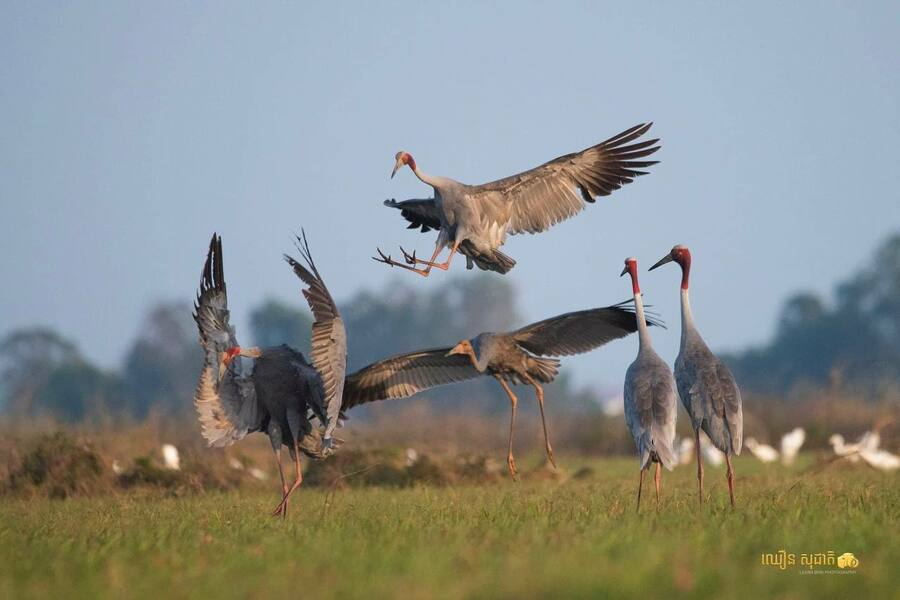
The Sarus crane is the tallest flying bird in the world, with adults capable of reaching roughly 1.8 meters in height. Seen standing in a Cambodian grassland, it can look almost absurdly tall, as though someone had accidentally stretched a perfectly respectable bird.
Its appearance is nevertheless remarkably elegant. Adults have a pale gray body, a long neck, long legs and a bare head and upper neck marked with vivid red skin. The upper neck is dark, while the wings are broad and powerful. Juveniles are less dramatic in appearance, with brownish tones replacing some of the adult’s stronger colors.
The species belongs to the crane family, Gruidae. Cranes are generally associated with wetlands and open landscapes, and the Sarus crane is no exception. In Cambodia, its life is closely tied to the seasonal movement of water.
Its voice is another unforgettable feature. The loud, trumpeting calls of Sarus cranes can carry across open grasslands, particularly during the wet season. A pair calling together can produce a remarkably powerful sound for birds that, from a distance, may appear almost motionless.
The species is also known for its strong pair bonds. Sarus cranes are generally found in pairs or family groups during the breeding season, and parents remain closely associated with their young after hatching.
The Eastern Sarus crane in Cambodia
The Sarus crane occurs in several distinct populations across South Asia, Southeast Asia and Australia. Cambodia is especially important because it supports the remaining Southeast Asian population of the Eastern Sarus crane, Grus antigone sharpii, together with neighboring areas of Laos and Vietnam.
The regional population experienced a severe decline over the past few decades. According to NatureLife Cambodia, synchronized census totals for the Lower Mekong Basin fell from 869 birds in 2011 to only 156 in 2022. Encouragingly, the trend has since begun to reverse. The 2025 census recorded 214 Sarus cranes in Cambodia, the highest national figure since 2020.
That recovery is encouraging, but the numbers remain small enough to make every breeding pair significant. The Sarus crane is classified as Vulnerable, and its survival depends heavily on the continued protection of wetlands and grasslands.
Cambodia’s importance is therefore not merely a matter of having cranes within its borders. The country contains some of the most important breeding and non-breeding habitats remaining for this population.
A bird governed by the seasons
The Sarus crane’s life in Cambodia follows the country’s hydrological calendar.
During the rainy season, temporarily flooded grasslands and seasonal wetlands provide breeding habitat. These landscapes are especially important because the cranes need open, waterlogged areas where they can build their nests and feed.
As the dry season arrives and temporary wetlands shrink, the cranes move toward more permanent sources of water. One of the most important non-breeding areas is Ang Trapeang Thmor in Banteay Meanchey Province, where large numbers gather to feed.
This seasonal movement is one reason why Sarus crane conservation cannot focus on a single reserve. Protecting a breeding site is essential, but so is maintaining the feeding areas that the birds need at other times of the year.
In ecological terms, the crane is following a landscape rather than occupying one particular address. Its annual journey connects wetlands, grasslands, open forest and agricultural areas across Cambodia.
Why Sarus cranes choose these nesting sites
Sarus cranes are ground nesters, which immediately makes their breeding strategy rather more complicated than that of a bird safely perched in a tree.
In Cambodia, they typically select remote, rain-fed wetlands within open deciduous landscapes. Nests are built from grass and other vegetation, often in waterlogged grassland or on small elevated patches surrounded by water.
The location matters. A good nesting site offers access to food, relatively open visibility and some protection from terrestrial predators. It also needs to remain suitable long enough for eggs to hatch and chicks to leave the nest.
The breeding season generally coincides with the rainy season. Once the chicks hatch, they are able to leave the nest and follow their parents rather quickly. The family then feeds in the surrounding wetland and grassland.
The diet is varied and opportunistic. Sarus cranes feed on insects, frogs, roots, tubers and other foods available in their seasonal environment. They are not specialized to one item on the menu, which is fortunate because Cambodia’s wetlands do not operate a supermarket timetable.
Three new nests in Lomphat
The discovery of three new Sarus crane nests in Lomphat Wildlife Sanctuary at the beginning of the 2026 breeding season is therefore significant because it tells us that the species is actively reproducing in this landscape.
Lomphat has become an important location for the Eastern Sarus crane. NatureLife Cambodia has recorded the species breeding there and has documented encouraging observations in recent years. In December 2024, for example, 22 Sarus cranes, including eight young birds, were recorded across seven locations in the sanctuary.
The three new nests provide an even more direct indication of the site’s importance. A crane nest is evidence of successful habitat selection by a breeding pair. It tells conservationists that the birds have found the combination of wetland conditions, food and relative security that they require.
It is important, however, not to confuse the discovery of nests with breeding success. Eggs can be lost to predators, flooding or human disturbance, and chicks remain vulnerable after leaving the nest. The real measure of success will come later, when monitoring reveals how many eggs hatch and how many young birds survive.
That is why nest monitoring is so important.
From egg to chick
A Sarus crane nest is a surprisingly exposed place to begin life. The eggs are laid on the ground, often in wet grassland, and the nest itself provides little physical protection compared with a tree cavity or a nest high in a canopy.
Conservation programs in Cambodia have therefore developed nest protection schemes involving local communities. Local people can locate nests, monitor them and help prevent disturbance or egg collection. Their knowledge of the landscape is invaluable, and their involvement turns conservation from an outside intervention into a local responsibility.
Natural predators can also pose a threat. Wild pigs, domestic dogs and other animals may destroy eggs or threaten young chicks. Flooding is another obvious risk during the rainy season.
Yet the strategy is not to eliminate every danger from the birds’ environment. The objective is to reduce avoidable human threats while allowing the cranes to remain wild and behave naturally.
A species that needs a whole landscape
The Sarus crane is a useful reminder that protecting a species means protecting the ecological system that supports it.
Cambodia’s cranes need seasonal wetlands for breeding and permanent or semi-permanent wetlands for feeding during the dry season. They also depend on open forest and grassland landscapes that provide access to food and nesting sites.
The Northern Plains are particularly important, supporting one of Southeast Asia’s most important breeding populations. WCS has documented the importance of large waterlogged grasslands there and the role of local communities in protecting nests.
Elsewhere in Cambodia, Ang Trapeang Thmor is a major non-breeding refuge, while places such as Anlung Pring demonstrate how conservation can work alongside agriculture. NatureLife Cambodia’s Crane Rice initiative involves farmers in maintaining crane-friendly landscapes around the protected area.
This wider approach matters because a crane does not know where a protected-area boundary lies. Neither does the water that fills a wetland.
Why the discovery matters
Three nests may sound modest beside the hundreds of thousands of birds found in some famous wetlands around the world. For Cambodia’s Eastern Sarus crane population, however, the scale is very different.
The 2025 national census recorded 214 birds. That makes each breeding pair important, and each successful chick potentially valuable to the future of the population.
The recent increase in Cambodia’s Sarus crane numbers is encouraging, but conservationists have no reason to relax. Habitat loss, agricultural conversion, hunting, disturbance and other pressures continue to affect wetlands and grasslands.
The discovery in Lomphat is therefore best understood as a reason for cautious optimism. It shows that the species is still breeding in Cambodia and that important habitat remains functional. It also provides an opportunity for continued monitoring and protection.
More than a beautiful bird
There is an understandable temptation to admire the Sarus crane simply because it is spectacular. Its height, red head, slow deliberate movements and extraordinary call make it one of Cambodia’s most memorable birds.
But the species is also an ecological indicator. When Sarus cranes breed successfully, they are telling us that seasonal wetlands and surrounding open landscapes are still providing the conditions they need.
That makes the bird a useful ambassador for a much larger conservation story. Protecting Sarus cranes also means protecting wetlands, grasslands, dry forests, local livelihoods and the remarkable biodiversity associated with these habitats.
The crane may be the most visible character in the story, but it is certainly not the only one.
Conclusion
The three new Sarus crane nests discovered in Cambodia’s Lomphat Wildlife Sanctuary are a small but meaningful sign of hope for one of Southeast Asia’s most remarkable birds. The species remains vulnerable, yet its recent population trend and continued breeding in Cambodia show what sustained habitat protection and local conservation can achieve. For the elegant សត្វកៀល, three nests are not just three nests. They are three more reasons to keep Cambodia’s wetlands alive.
About the author
Pascal Médeville is a writer and digital publisher based in Cambodia. He writes about Cambodian history, culture, nature, food and everyday life, with a particular interest in documenting the country’s remarkable heritage and biodiversity for readers around the world.