A dead elephant becomes the prize in a quarrel between an eagle and a crocodile. But in this classic Khmer tale, victory belongs not to the strongest, but to the one who can produce evidence.
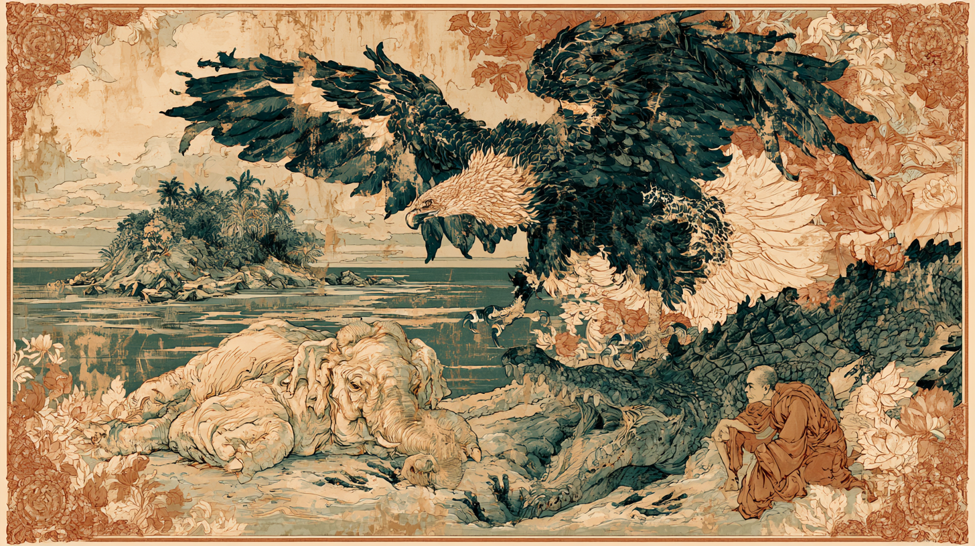
Khmer folklore has a remarkable talent for turning ordinary conflicts into small lessons in justice. An eagle, a crocodile, an elephant and a hermit may sound like the beginning of an unusually competitive Cambodian wildlife documentary, but this traditional tale is really about something much more human: ownership, jealousy, evidence and the search for a fair judgment.
The story belongs to a broad Cambodian storytelling tradition in which animal fables combine entertainment with moral instruction. Many Khmer tales have been transmitted orally and later written down, while Buddhist ideas have deeply influenced Cambodian literary culture and traditional storytelling. Collections such as the Gatilok preserve numerous stories in which animals, villagers, monks and rulers confront questions of wisdom, justice and human behavior.
The Eagle and the Crocodile
There was once an eagle living on an island in the middle of the sea. A crocodile had also made its burrow on the same island.
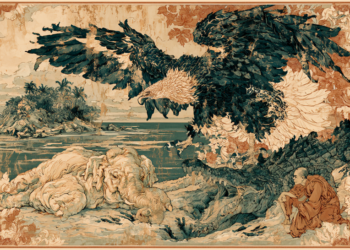
The eagle regularly flew across the sea to the shore, where it would seize an elephant and carry it back to the island. There, near the crocodile’s burrow, the eagle would eat its catch. This happened routinely.
One day, the crocodile watched the eagle carrying an elephant back to the island and eating it. The crocodile became envious: “I shall take the elephant meat from the eagle and eat it myself,” it thought.
When the eagle returned with another elephant and placed it in the usual spot, the crocodile crawled out of its burrow and approached the eagle: “Hey, eagle! Why have you come and stolen my elephant meat for your food?” the crocodile demanded.
The eagle was astonished: “I captured this elephant myself on the other shore of the sea and brought it here only moments ago. Why do you accuse me of stealing your food?”
Neither would give way.
The crocodile insisted that the elephant belonged to him. The eagle insisted that it had caught and carried the animal itself. They argued back and forth, neither willing to give up the meat.
Eventually, they decided to take their dispute before a hermit, a bodhisattva who lived on the island and was regarded as a wise and impartial judge.
The crocodile presented its case first: “I killed this elephant and intended to eat it near my dwelling. This eagle came and stole the elephant meat from me so that it could eat it.”
The eagle then gave its version: “I certainly captured this elephant on the opposite shore of the sea and have only just brought it here. I was about to eat it when this crocodile crawled out of its burrow and accused me of stealing its food. Your Reverence, please consider the matter carefully and judge between us.”
The hermit went to inspect the place where the elephant lay. There he found evidence. On the ground were the marks of the eagle’s claws. But there were no marks left by the crocodile’s teeth.
The hermit examined the eagle’s claws and compared them with the marks on the ground. They matched.
His judgment was therefore clear.
“The eagle appears to have genuine evidence. The crocodile has none.”
The hermit ruled in favor of the eagle. And so the crocodile lost the case.
Justice, Evidence and a Very Khmer Lesson
The charm of this Khmer folktale lies partly in its simplicity. Nobody needs a courtroom, a lawyer or a complicated legal code. The hermit simply goes to the scene, examines the physical evidence and reaches a conclusion.
The crocodile may be powerful, but power does not establish ownership. Nor does loudly repeating a claim make it true.
The eagle, meanwhile, does not win merely because it is stronger or more impressive. It wins because the evidence supports its version of events.
That is an especially interesting feature of traditional Cambodian storytelling. Folktales were not merely entertainment. They could transmit social values and ideas about proper conduct, wisdom and justice. Cambodian literary traditions include stories and fables used in monastery-based education, while many traditional tales draw upon Buddhist moral teachings.
There is also a delightful touch of everyday humor here. The crocodile sees someone else eating well and immediately decides that the meal must somehow belong to him. It is an ancient version of the argument that possession begins wherever one’s appetite begins.
The hermit’s response is refreshingly practical: look at the evidence.
A Small Story with a Larger Moral
The elephant is the most valuable object in the story, but it is almost incidental. The real subject is the dispute surrounding it.
The eagle represents legitimate possession supported by action and evidence. The crocodile represents opportunism, claiming what it did not obtain. The hermit stands between them as the figure of reasoned judgment.
Like many Khmer animal tales, the story also gives human qualities to animals without making them entirely ridiculous. They quarrel, scheme, accuse one another and defend their interests much as people do. This is one reason such stories remain so effective: the animals are amusing precisely because their behavior is recognizably human.
Khmer folklore often moves comfortably between the ordinary and the moral, the humorous and the serious. A crocodile demanding an elephant may raise a smile, but the underlying message is sober: when disputes arise, claims should be tested against evidence, not settled by strength, noise or greed.
That is a lesson as useful today as it was when this story was first told. And, fortunately, no elephant was required to testify.