(Estimated reading time: 9 minutes – less time than it takes your bank to find the “right person to talk to” about your corporate account.)
Starting a business in Cambodia in 2026 is much easier than it used to be, but it still pays to know the rules of the game. This practical guide walks you through the online registration process, legal structures, documents, costs and timelines, with a few seasoned tips to keep you out of bureaucratic trouble.
Introduction: Cambodia, Where Ideas Meet Paperwork
Cambodia has become a remarkably welcoming place for entrepreneurs, from small Khmer family businesses to foreign-owned tech startups registering their first company. The country combines relatively light regulation with a modern digital system for business registration, which is good news if you prefer clicking over queuing.
This article explains how to register a business in Cambodia using the current online systems, what structures you can choose, what documents you need, and the typical costs and timelines you should expect. It is written for both local and foreign founders who want a clear, realistic overview rather than vague promises of “instant incorporation”.
By the end, you should understand the main steps from choosing a business structure and reserving a name to tax and labor registration, and you will have a practical checklist you can use whether you file everything yourself or work with a local service provider. Think of it as a map through the administrative Angkor.
Understanding Business Structures in Cambodia
Main Legal Forms You Can Register
When you register a business in Cambodia, the first decision is the legal form you want to use. The Ministry of Commerce lists several options: sole proprietorship, partnership, private limited company, public limited company, and foreign company such as a branch or representative office.
- Sole proprietorship is simplest and usually suits very small, owner-run activities, but it does not separate your personal assets from business liabilities.
- Partnerships, either general or limited, allow two or more people to run a business together with shared responsibilities and profits.
- Private limited companies are the most common vehicle for SMEs and foreign investors because they offer limited liability and a clear share structure.
- Public limited companies and branches are used for larger or more complex operations, including regional groups expanding into Cambodia.
For most new ventures, especially those involving investors, clients abroad or staff hiring, a private limited company is usually the most practical choice. It balances flexibility, recognition by banks and partners, and reasonably straightforward registration.
Choosing a Structure That Fits Your Project
Your choice should reflect how big you expect the business to grow, how many partners or shareholders you have, and whether you want to raise capital later. If you plan a small cafe you run yourself, a sole proprietorship may do; if you build a digital agency serving regional clients, a private limited company will probably be more appropriate.
Foreign investors typically opt for a private limited company or branch, especially when they need clear shareholding rules, tax registration, and sector licenses such as banking or education. Specialized industries may require additional approvals and oversight from regulators, so the more formal company structures make compliance easier.
A useful rule of thumb: if you expect to open a corporate bank account, sign longer term contracts or hire staff, think in terms of a limited company rather than informal arrangements. It saves explanations later when your counterpart asks for your certificate of incorporation.
The Online Systems: One Portal, CamDX and MoC
The Digital Shift in Business Registration
Cambodia has modernized business registration through online platforms managed by the Royal Government. The process now runs largely through a centralized “Single Portal” based on the CamDX system, integrating the Ministry of Commerce (MoC), the General Department of Taxation (GDT) and the Ministry of Labour and Vocational Training (MLVT).
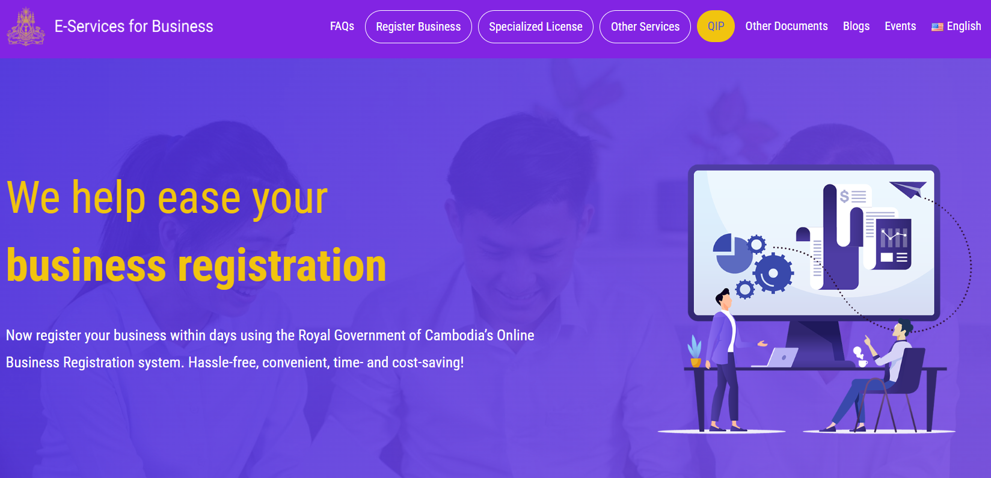
The MoC business registration website itself offers online services to incorporate sole proprietorships, companies and partnerships, with clearly defined steps for each type. You create an account, choose the kind of entity you want to register, and move through a sequence of screens where you enter general information, addresses, ownership details, and upload supporting documents.
The result of this digital evolution is that the full legal setup, including company and tax registration, often takes between 7 and 15 working days when your documents are in order and you respond promptly to any queries from the system.
Core Features of the Single Portal
On the Single Portal, you can check and reserve your company name, fill in business activity codes, enter shareholder and director data, upload identification and lease agreements, and pay government fees online in a single workflow. Once your application is approved, you receive a digital certificate of incorporation and tax registration documents.
The same integrated process also handles labor declaration to the Ministry of Labour and registration with the National Social Security Fund when you employ staff, reducing the number of separate trips to different ministries. For entrepreneurs who remember the purely paper-based era, this feels almost luxurious.
You also have a 15-day window to complete an application once you start it, otherwise it is removed from the system, so it is wise to prepare documents properly before you click “Begin”.
Step-by-Step: How to Register a Business in Cambodia
Step 1: Prepare Your Documents
Before you touch the keyboard, gather all required documents in clean digital format. Typically, you will need identification for all shareholders and directors, such as passports or national IDs, a recent photo of each, a draft of your Articles of Incorporation or use of the MoC model constitution, and proof of your registered office address, usually a lease agreement or land title.
For branches, you may also be asked for the latest audited financial statements of the parent company, and for some sectors, a business plan and evidence of investment amounts. Make sure scans are legible and consistent; a blurry passport page is the modern equivalent of illegible handwriting.
In terms of capital, a minimum of around 4,000,000 KHR, roughly one thousand US dollars, is common for basic company setups, although many advisers suggest declaring at least five thousand dollars to present a realistic operational budget in the eyes of the tax department.
Step 2: Reserve and Format Your Company Name
Next, use the online portal to propose and reserve your company name. Names must be unique and cannot mislead users into thinking you are a government body or regulated institution such as a bank or university unless you hold the proper license.
For companies that display both Khmer and English names, there are specific formatting rules: the Khmer version must be above or before the English name, the Khmer font at least as large, and the Khmer wording should be a phonetic transliteration rather than a translation of the meaning. This helps ensure clarity and consistency in official records and signage.
Avoid terms like “Group” or “Holding” unless your company genuinely controls several registered subsidiaries, and do not use restricted words such as “Bank”, “Insurance”, or “University” without regulatory approval, or you will experience the swift and terrible justice of the rejection button.
Step 3: Register with the Ministry of Commerce
Once the name is reserved, you can move ahead with full registration at the Ministry of Commerce through the online system. For companies, the sequence typically includes entering general information, proposed name, business activities, share par value and number of employees, then addresses and contacts, director information, and finally shares and shareholders.
For sole proprietorships, the sequence is simpler: you enter the proposed name, business activities, then address, contacts and owner information. Partnerships have their own flow, with fields for partner and manager information in addition to general data.
Once complete, you submit your application and pay the relevant fees online. If the application is approved, the company is immediately incorporated and a certificate of incorporation is issued, which you will need for bank accounts, leases, and most formal contracts.
Step 4: Tax Registration with GDT
After incorporation, you must register with the General Department of Taxation within a defined timeframe, often within 15 days of incorporation. Through the Single Portal, this step is integrated into the workflow, and you receive a Tax Identification Number and VAT registration if your business activities require it.
This stage is separate from annual patent tax certificates, which are municipal level obligations, but it is the foundation of all future communication with the tax authorities. Late registration or mismatched declarations can lead to penalties, and dealing with penalties is rarely part of anyone’s dream entrepreneurial journey.
You may later be asked to upload a bank statement showing the deposit of your declared capital into a corporate account, which completes some aspects of tax compliance.
Step 5: Labor and Social Security Registration
If you plan to employ staff, you must register with the Ministry of Labour and Vocational Training and the National Social Security Fund. The Single Portal sends labor declaration data automatically once MoC and GDT registration are done, but you still need to ensure proper work permits for foreign employees and NSSF enrollment for staff.
Enterprises must also keep the labor office informed of movements of employees, such as hiring or resignation, and pay monthly contributions to NSSF for occupational risk and health care schemes. In practice, many smaller businesses rely on accountants or service firms to handle these ongoing obligations.
If your activities involve import and export, you will additionally need to register with the customs department and the ASYCUDA system before you can move goods across borders. Banking, insurance, telecom, medical and education sectors need specific licenses from their respective regulators, on top of the general company registration.
Costs, Timelines and Practical Tips
Government fees for registering a standard limited company are usually in the range of a few hundred US dollars, with estimates commonly starting around two hundred for basic MoC registration and four hundred to six hundred when using the centralized online portal for full integration of company and tax registration.
If you use legal or consulting services, total setup costs often rise to between roughly two thousand and four thousand US dollars, including advisory fees, notarization, and translation into Khmer and English for key documents. Many foreign investors consider this a reasonable cost for peace of mind and avoidance of administrative surprises.
The whole process, from name reservation to tax registration and labor declaration, generally runs between one and three weeks when everything is well prepared, with individual segments like name reservation taking one or two days and tax registration taking around seven to ten days.
Practical Tips to Avoid Delays
Several simple habits can keep your registration on track. First, double check the spellings of names and ID numbers in all documents and forms; small inconsistencies are a surprisingly common cause of delays. Second, keep your capital declaration realistic and coherent with your business plan and bank account deposits.
Third, prepare Khmer versions of your key documents properly, even if your operational language is English. Khmer remains the primary language of official records, and accurate translation avoids awkward interpretations later. Many service providers offer model constitutions or bilingual templates aligned with MoC expectations. Simili Consulting can help you with all your translation needs.
Finally, be aware of the 15 day limit between starting an application and final submission in the MoC system, and keep an eye on email notifications. The system will not chase you with a friendly phone call if you simply disappear.
Registering a business in Cambodia in 2026 is more straightforward than many founders expect, thanks to the Single Portal and MoC online systems, but it still demands a clear choice of structure, careful document preparation and respect for tax and labor rules. With the right preparation and realistic expectations about cost and timing, turning your idea into a registered Cambodian business can be a short, fairly civilized journey rather than an epic bureaucratic saga.
Pascal Médeville is a writer and digital publisher based in Cambodia, where he runs Wonders of Cambodia and produces content on business, culture and everyday realities of life in the kingdom. He writes practical guides for entrepreneurs, cultural essays, and commentary on Southeast Asian development, often blending field experience with patient document reading.