
Introduction
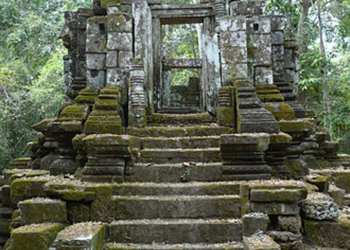
Banteay Srei (បន្ទាយស្រី) is one of the most celebrated and exquisite temple complexes of Cambodia’s Angkor region. Located around 25 kilometers northeast of Angkor Wat, near the hill of Phnom Dei, Banteay Srei is a remarkable example of the skill and artistry that characterized the Khmer Empire’s architects and craftsmen. Its name translates to “Citadel of Women” or “Citadel of Beauty,” which is highly appropriate given its delicate carvings, small-scale architecture, and distinct pink sandstone that seems to glow in the morning light. Built in the latter half of the 10th century, this Hindu temple dedicated to the god Shiva is notable for its fine decorative work, exquisite bas-reliefs, and remarkably well-preserved details.
Historical Background
Banteay Srei was consecrated in 967 CE, during the reign of King Rajendravarman II. Unlike most Angkorian temples, which were commissioned by kings, Banteay Srei was founded by a Brahmin named Yajnavaraha, who was both a royal advisor and a tutor to Jayavarman V. The temple was built on sacred ground and dedicated to Shiva under the title Tribhuvanamaheshvara, “Lord of the Three Worlds.” Its construction reflects the close relationships between the monarch, Brahmin scholars, and the royal court during this period.
The temple’s inscriptions offer significant insight into its dedication and patrons. Some of these inscriptions detail the endowments of land and labor that supported the temple’s activities. Banteay Srei thus provides valuable historical information about Angkorian society, including its hierarchical structure, patronage networks, and the close relationship between religion and political power.
Architectural Design
Banteay Srei is modest in size compared to the monumental Angkor Wat or Bayon. Its architecture is organized along an east-west axis. The temple faces east and is enclosed within multiple concentric enclosures. Unlike the larger royal temples, Banteay Srei was constructed on a more intimate scale, and its shrines and halls feel more like delicate pavilions than grand monuments. Its scale accentuates its fine craftsmanship, encouraging visitors to appreciate the intricate carvings up close.
The inner sanctuary is built entirely of fine-grained pink sandstone, allowing a level of intricate carving rarely achieved elsewhere. The outer walls and gateways were built of laterite and brick, which provided a rustic backdrop to the central complex’s elegant beauty.
Artistic Mastery and Iconography
Banteay Srei is world-famous for its elaborate carvings, often regarded as the pinnacle of Khmer decorative art. Every surface is adorned with floral motifs, divine figures, and scenes from Hindu mythology. The temple’s pediments and lintels depict episodes from the Ramayana and Mahabharata epics, bringing these sacred texts to life with expressive and dynamic reliefs.
Some of the most celebrated carvings can be found on the central sanctuary’s east-facing pediment, which depicts Indra atop his three-headed elephant, Airavata, surrounded by celestial beings. Another exquisite carving portrays the abduction of Sita by Ravana, a tense and vivid moment from the Ramayana.
The careful attention to detail extends even to the temple’s tiny devatas, apsaras, and dvarapalas (guardian figures). These carved figures possess refined jewelry and delicate features that give them an almost ethereal beauty. The repeated floral and geometric motifs, carved with astonishing precision, reflect the immense skill of the artisans who shaped these stones more than a millennium ago.
The Significance of the Pink Sandstone
One of the most striking features of Banteay Srei is its construction material: pink sandstone. This durable stone allowed artists to achieve a level of detail that would have been impossible with coarser stones. Unlike Angkor Wat’s gray sandstone, the pink hue of Banteay Srei glows warmly under sunlight, especially at sunrise or sunset. This visual effect enhances the temple’s otherworldly beauty and supports its poetic nickname as the “Jewel of Angkor.”
Layout and Principal Structures
The temple complex consists of three main enclosures surrounded by laterite walls. The outer gopuras (entrance pavilions) feature lintels adorned with garlands and divine beings, introducing visitors to the temple’s rich visual program. Beyond the outer walls lie two inner galleries that surround the central sanctuary.
At the heart of the complex stand the three sanctuaries dedicated to Brahma, Vishnu, and Shiva. These sanctuaries are tower-shaped structures known as prasats and were intended to house the images of the gods. While most of these images have since been moved to museums or lost, the architecture and decoration clearly reflect the temple’s religious purpose.
Two small “libraries” lie to the north and south of the central sanctuary, constructed for sacred manuscripts and other ritual items. Like the sanctuaries, they are adorned with elaborate carvings that highlight episodes from Hindu mythology.
Conservation and Restoration
Banteay Srei fell into disrepair like many other Angkorian monuments after the decline of the Khmer Empire. It was rediscovered in 1914 by French archaeologists and became famous after André Malraux, a French adventurer and future minister of culture, stole several of its carved lintels in 1923. His capture and the subsequent return of the carvings brought international attention to the temple, prompting serious restoration work.
The École française d’Extrême-Orient (EFEO) undertook major restoration efforts during the 1930s, employing the anastylosis method—a careful process of reassembling original pieces without introducing new material. These restoration efforts preserved Banteay Srei’s most important artistic features for future generations.
More recently, the APSARA Authority (the Cambodian agency responsible for Angkor) has conducted conservation projects to manage water drainage, reduce visitor impact, and preserve fragile carvings. This ongoing work ensures that Banteay Srei’s treasures remain protected despite the pressures of tourism and natural wear.
Cultural and Spiritual Legacy
More than just a historic monument, Banteay Srei embodies the cultural and spiritual ideals of 10th-century Cambodia. Its construction under a Brahmin patron underscores the important role of Hinduism in Khmer society, where Hindu epics informed political and religious life. Its iconography connects the temple with a cosmological worldview in which kings were seen as divine agents upholding cosmic order.
The temple’s carvings, rich with episodes from Hindu scripture, also reveal the depth of religious knowledge among its patrons and artists. Banteay Srei celebrates divine beauty, creating a sacred landscape that invites reflection on the eternal and the ephemeral. Even as its small scale renders it more approachable, its intricate design commands respect for the creative energies of its makers.
Modern Appeal and Tourism
Today, Banteay Srei is one of Angkor’s most visited temples. Its remote location, about an hour’s drive from the main Angkor Archaeological Park, allows visitors to appreciate the landscape as they travel past rice paddies, villages, and rural Buddhist monasteries. Unlike Angkor Wat and Bayon, Banteay Srei is more intimate, encouraging slower, more contemplative visits.
The temple’s popularity also underscores its role in Cambodia’s broader cultural revival. Angkor’s monuments, including Banteay Srei, symbolize national identity and continuity, especially after decades of conflict. The careful stewardship of Banteay Srei reflects Cambodia’s commitment to protecting its past as it looks toward the future.
Banteay Srei is a true jewel among Angkorian temples. Its small size belies its extraordinary artistry, with every inch of its pink sandstone surfaces alive with intricate carvings that captivate the eye and inspire wonder. The temple’s inscriptions and iconography speak to its historical context—a world where religion, artistry, and political power were seamlessly intertwined.
As a testament to the skill of its craftsmen and the devotion of its patrons, Banteay Srei continues to captivate visitors, scholars, and conservationists alike. Its enduring beauty and delicate features make it a highlight of any visit to Angkor and a proud cultural treasure of Cambodia.